

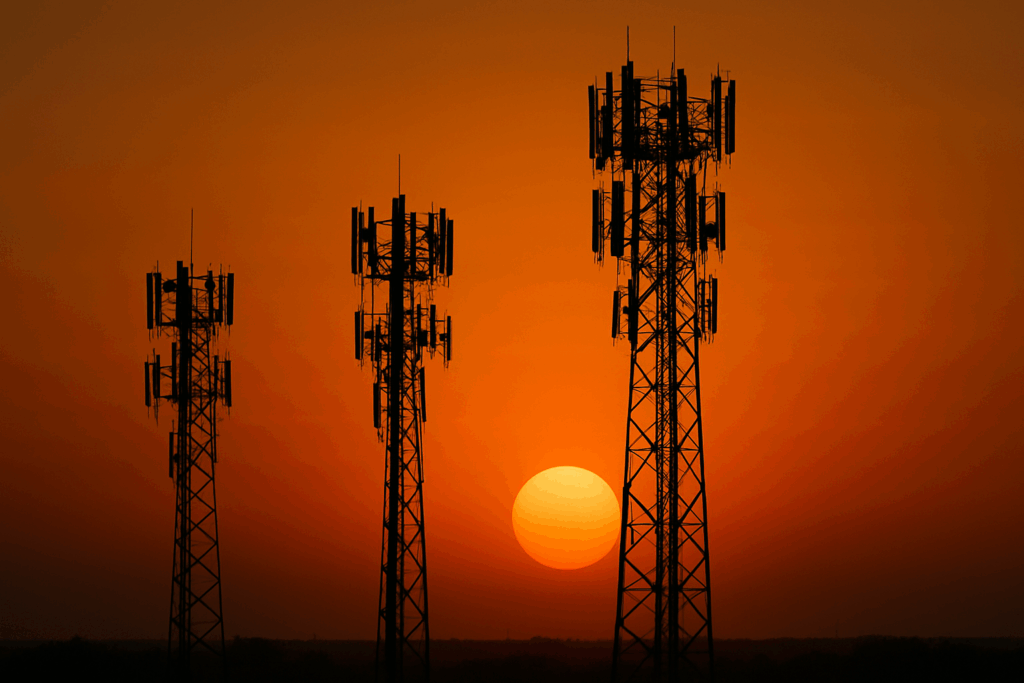
Starlink’s direct-to-cell voice plan is more than a technical upgrade; it is a strategic leap that transforms SpaceX from a broadband disruptor into a full-spectrum telecommunications powerhouse. Yet every satellite revolution eventually collides with the ground. Even a constellation of thousands of low-orbit satellites must touch terrestrial fiber and cell networks to complete a call. If Elon Musk wants Starlink’s direct-to-cell (DTC) voice service to work seamlessly and rival AT&T or Verizon, he cannot rely solely on orbital hardware. He needs a massive, low-latency, fiber-connected footprint on the ground. The fastest way to get it is to buy one: Vertical Bridge.
Vertical Bridge is the largest private tower company in the United States, operating more than 17,000 towers and managing more than 500,000 rooftop and utility sites across urban and rural America. Unlike Crown Castle or American Tower, it is not beholden to any one carrier. That neutrality makes it uniquely compatible with SpaceX’s mission to provide universal, carrier-neutral coverage. A Starlink acquisition of Vertical Bridge (and possibly DigitalBridge Group Inc NYSE: DBRG as it controls more than 100,000 towers across nine companies) would instantly give SpaceX the terrestrial network density it needs to support DTC voice, while also delivering regulatory advantages, latency reduction, and nationwide zoning permissions that would take years to replicate organically.
The logic is simple. Starlink’s satellites already form a dense mesh through optical laser interlinks, allowing data to hop across orbit without touching the ground. This design is ideal for broadband and backhaul. But voice is different. Voice requires near-instantaneous packet delivery, often below 25 milliseconds end-to-end, to maintain call quality and avoid echo or delay. That kind of responsiveness depends on short paths to ground stations tied directly into terrestrial carrier networks. Each downlink acts as a voice handoff point between orbit and fiber. To make DTC voice viable at scale, Starlink needs hundreds of those handoff points across every major metropolitan and rural region. That means towers, power, and fiber, precisely what Vertical Bridge already has.
In technical terms, Vertical Bridge offers the low-latency infrastructure Starlink lacks. Its towers are pre-wired with fiber backhaul from major providers like Lumen, Zayo, and Verizon. They sit near key regional internet exchanges or carrier aggregation hubs. These are the exact sites where Starlink’s new eNodeB gateways and micro-PoPs could be installed to serve as hybrid cellular-satellite gateways. Building such sites from scratch would require years of local permitting, environmental review, and rights-of-way negotiations. Buying Vertical Bridge circumvents those obstacles overnight.
The timing could not be better. In 2024, Verizon transferred operational control of more than 6,000 towers to Vertical Bridge in a $3.3 billion prepaid lease deal. Those towers are already tied into Verizon’s high-capacity fiber network. If Starlink were to acquire Vertical Bridge, it would inherit both that infrastructure and the legal rights to manage it, enabling an elegant triangulation: transmit over T-Mobile’s spectrum (its DTC partner), route through Vertical Bridge’s towers, and carry traffic over Verizon’s fiber. In effect, Starlink could unify three competing telecom layers, spectrum, structure, and transport, without owning any of their liabilities.
Critics might object that SpaceX has never been a terrestrial real estate company. Yet history shows that every major telecom breakthrough required control over physical infrastructure. AT&T’s dominance came not from spectrum but from its copper network. Verizon’s strength lies in its fiber and tower assets. Even Amazon and Google, nominally cloud companies, have invested billions in undersea cables and edge data centers. SpaceX, by contrast, has focused almost exclusively on orbit, outsourcing its ground presence to leased facilities. That model works for broadband, but it cannot support carrier-grade voice. The margin of delay between a clear call and a dropped one is measured in microseconds, and microseconds are lost not in space but on Earth.
Vertical Bridge’s independence from any single carrier also matters. Crown Castle and American Tower have deep financial and technical ties to AT&T and Verizon, which could limit SpaceX’s ability to deploy competing voice infrastructure on their towers. Vertical Bridge, by contrast, markets itself as a carrier neutral host. Its sites already accommodate equipment from multiple carriers, WISPs, and public safety networks. That neutrality allows SpaceX to deploy Starlink DTC gateways wherever T-Mobile’s spectrum coverage extends, without entangling itself in carrier exclusivity contracts. In practical terms, it lets Starlink scale without interference.
Then there is the regulatory advantage. Every tower in America sits under a dense web of local zoning laws, FAA regulations, and environmental reviews. Securing approval for thousands of new Starlink ground terminals would trigger years of bureaucratic wrangling. Vertical Bridge already holds those approvals. Most of its sites qualify for co-location exemptions, allowing SpaceX to mount new hardware without fresh review. That alone could shave two to three years off Starlink’s DTC rollout timeline. Combined with Vertical Bridge’s relationships with state broadband agencies and federal BEAD program partners, SpaceX would gain not just physical sites but political pathways for expansion.
Owning Vertical Bridge would also align SpaceX with DigitalBridge, the global infrastructure investment firm that holds a controlling stake in Vertical Bridge. DigitalBridge’s portfolio spans data centers, fiber networks, and edge computing platforms. It has worked closely with hyperscalers like Google, Meta, and Amazon to deploy low-latency edge systems. That ecosystem fits perfectly with Starlink’s next frontier: linking satellite-to-cell-to-cloud. Some analysts might argue that rather than stopping with Vertical Bridge, SpaceX could pursue a full acquisition of DigitalBridge itself, consolidating control over data centers, edge compute, and tower assets in a single transaction. The integration of Vertical Bridge sites with DigitalBridge’s data center footprint could then allow Starlink to route voice and data directly into cloud computing nodes at the edge, enabling the real-time connectivity required for applications like autonomous vehicles, IoT, and augmented reality.
Financially, the acquisition is within reach. Vertical Bridge’s valuation, estimated around $17–20 billion after the Verizon transaction, is significant but not insurmountable for SpaceX, whose private valuation exceeds $180 billion. Given that Starlink already contributes the majority of SpaceX’s cash flow, it could structure the acquisition as a combination of equity swap and debt issuance backed by predictable tower lease revenue. Tower companies generate stable, utility-like returns. Integrating that cash flow could help smooth the volatility of launch revenue while anchoring SpaceX in recurring terrestrial income.
The synergy is not only operational but philosophical. Starlink’s stated goal is to connect the unconnected. Vertical Bridge’s mission has been to build infrastructure in underserved rural and tribal regions. Both aim to erase the urban-rural divide through access to modern communications. Combining them would create the first end-to-end network that truly spans from the most remote ground to orbiting space. For Musk, who has always pursued audacious vertical integration, from rockets to cars to batteries, acquiring the infrastructure that connects space to Earth would be a natural extension of his industrial logic.
Of course, there are risks. Regulators might worry about vertical integration across spectrum, satellite, and ground infrastructure. Competitors could argue that owning Vertical Bridge gives Starlink an unfair advantage. Yet these concerns ring hollow when compared to the public benefit of a unified, resilient network capable of surviving natural disasters, cyberattacks, or geopolitical disruption. In an era when China’s state-backed companies are rapidly expanding their 5G satellite networks, the US can ill afford a fragmented approach. A Starlink–Vertical Bridge merger would strengthen national resiliency by ensuring that America’s most advanced communications network remains domestically owned and controlled.
The broader strategic picture is clear. Starlink is no longer just a satellite service; it is becoming a global carrier. To succeed, it needs terrestrial infrastructure at the same scale as its orbital one. Leasing that infrastructure site by site would waste precious years. Buying Vertical Bridge would give SpaceX immediate, carrier-neutral access to thousands of ready-to-use towers, each tied to the fiber backhaul essential for low-latency voice. It would also embed Starlink within DigitalBridge’s broader ecosystem of data centers and edge computing, anchoring the network’s future expansion into advanced connectivity markets.
Elon Musk has always understood that true innovation requires control over the supply chain. Tesla’s Gigafactories secured battery dominance. SpaceX’s in-house rocket production made reusability possible. Starlink’s next evolution, turning satellites into cell towers, will depend on mastering the final missing link: ground infrastructure. Buying Vertical Bridge would complete that circle, transforming Starlink from a constellation of satellites into a fully integrated communications network. It is a bold move, but then again, so was launching a rocket that lands itself.
If you enjoy my work, please share my work and subscribe: https://x.com/amuse.
Sponsored by the John Milton Freedom Foundation, a nonprofit dedicated to helping independent journalists overcome formidable challenges in today’s media landscape and bring crucial stories to you.
READ NEXT: Supreme Court About To Target Draconian Ban?


















Reuse idle wind turbines for Vertical Bridge nationwide & other power towers
Anything that is good and beneficial for our country is going to be targets for terrorists, including the home-grown ones.