



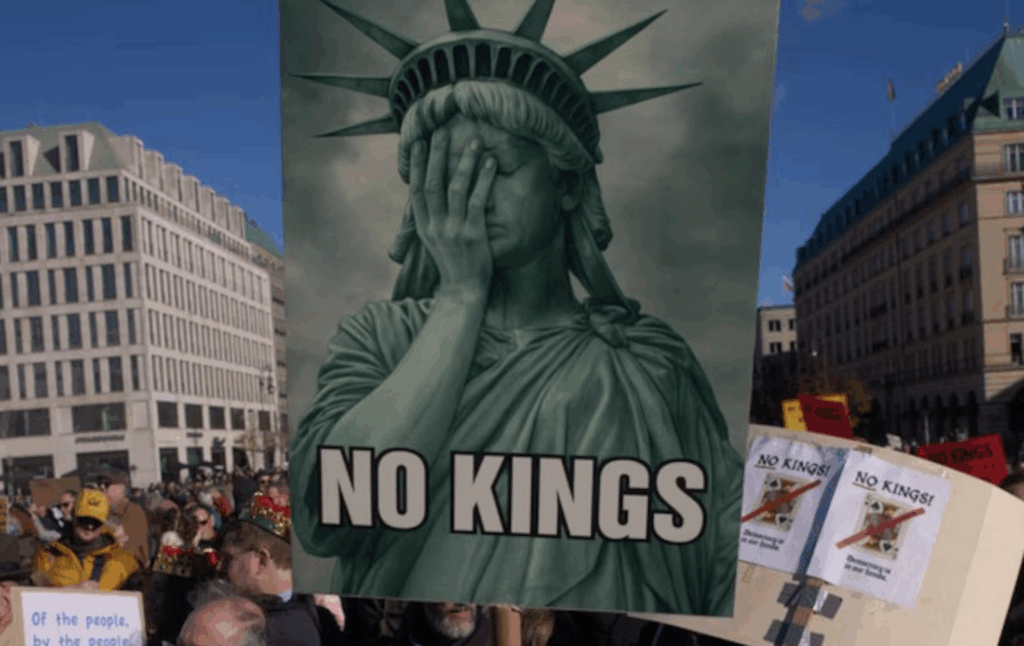
The premise is simple. A republic is a system in which power is dispersed, authority is answerable, and the people, not a sovereign, are the final court of appeal. Yesterday’s “No Kings” protests did not expose a monarchy in the making, they displayed the opposite. They showed a public that can gather, criticize, and mobilize without seeking permission from a crown. The critical question is not whether protesters dislike the sitting president or his agenda. The critical question is whether they can say so in public, organize around that belief, seek to persuade, and if they fail today, try again tomorrow under the protection of law. They can, and they did. That is the meaning of a republic.
Some readers will ask a sensible question. How can protests aimed at delegitimizing an elected president serve as evidence that the constitutional order is working as designed, rather than failing? The answer turns on a familiar analogy. Think of ventilation in a crowded hall. Ventilation is not a verdict that the air is bad, it is a mechanism to ensure that, whether the air is sweet or stale, people do not suffocate. Protest in the American system functions as political ventilation. It is a channel, not a conclusion. When tens of thousands, or millions, decide to use that channel, the fact of their assembly is not proof of despotism, it is proof that the vents are open and the room is built to handle heat. Monarchies suppress ventilation. Republics encourage it.
A second question arises. If the left, as Sasha Stone argues, is a well resourced cultural elite that postures as the voice of the unheard, does that not undermine the claim that these demonstrations are the flowering of popular sovereignty rather than the theater of insiders? The point is subtler. It is true that progressive activists enjoy outsize platforms in legacy media, in academic institutions, and in cultural production. It is also true that a nontrivial share of mainstream journalists identify with the Democratic Party, and that elite campuses skew left in donations and rhetoric. But the republic does not promise equal volume to every faction. It promises equal rights. The very fact that this elite coalition feels the need to march, chant, and persuade rather than command reveals the continuing grip of republican structure. In a monarchy, cultural elites would whisper to the court and secure favors by fiat. In the United States, even the loudest cultural elites must submit to elections, to constitutional litigation, to congressional power, and to persuasion in a competitive field of speech. Their demonstrations acknowledge the reality that they cannot rule by decree.
A third question follows naturally. Stone’s narrative highlights a refusal on the left to accept electoral defeat, beginning in 2016 and continuing through Trump’s second victory. Does that not threaten the basic dignity of elections? At the level of tone, yes, it is troubling when national figures hint that results are illegitimate when they lose and sacrosanct when they win. At the level of structure, however, the republic proves sturdier than the rhetoric. The outcry after 2016 coexisted with the peaceful transfer of power. The women’s marches, the airport sit‑ins, and the countless rallies did not prevent the new administration from taking office, staffing departments, and executing policy. Criticism of 2024’s result did not stop inauguration day in 2025 from unfolding on schedule. If repeated refusal to concede defeat had the force that critics claim, we would have seen the machinery of government buckle. Instead we saw the judiciary resolve cases, Congress legislate where it could, the executive govern, and voters prepare for their next chance to revise the verdict. Protest injects noise, not nullification. The framers designed a system that turns noise into information rather than crisis.
To see why, recall the architecture. Federalism divides power between national and state governments. The separation of powers splits authority among Congress, the presidency, and the courts. Regular elections let citizens course‑correct. Rights of speech, press, petition, and assembly protect both the popular faction and the lonely dissenter. In such a structure, conflict is not an anomaly, it is an input. The “No Kings” marches, whether you cheer them or jeer them, are inputs. They do not override elections, they register claims that must be translated into votes, legislation, or adjudication to have force. When activists, donors, celebrities, and committee chairs pour into the streets, they confess that in this country arguments must be won in public, not settled in palace corridors. There is no palace, there is only the public square.
The charge that the left’s style is tantrum, not governance, is not without merit. Stone underscores a pattern of maximalist demands, refusal to compromise, and a moralized posture toward opponents. Equally, Ruy Teixeira has warned Democrats about an all or nothing impulse that alienates persuadable voters. One could multiply examples, from immigration sloganeering that outran public consent, to ideological pressure campaigns around gender that treated dissent as vice rather than disagreement. Yet, even here, the republic’s design is the point. A monarchy indulges tantrums from the court favorites, because power derives from proximity to the throne. A republic puts tantrums on television, and then subjects them to votes. When protesters chant “No Kings,” they are not uncovering a secret crown, they are participating in a system that strips crowns of relevance.
Consider immigration, a hard problem that tempts both moralism and demagoguery. If a faction argues for generous benefits combined with soft enforcement, they do not thereby enact it. If another faction argues for strict enforcement combined with reformed legal pathways, they do not thereby enact it. Each must legislate within a bicameral Congress, defend positions in courts, and sell tradeoffs to a skeptical electorate. When activists on either side take to the streets, they may shift the Overton window, but they do not rewrite the statute books by marching. The country remains the richest on earth by gross output and a magnet for immigration because, over time, the republic forces convergence toward workable rules that match the median voter’s appetite for order and opportunity. If our institutions were captive to a monarch, or to a single party immune from alternation, dysfunction would accumulate without release. Instead, the cycle of claim and counterclaim, debate and decision, continues. It is untidy, but it is liberty’s untidiness, not tyranny’s order.
What about the worry that elite media, universities, and corporate boards amplify one side to a degree that crowds out genuine pluralism? The worry is not trivial. But it proves the opposite of what critics fear. If progressive dominance of prestige platforms guaranteed political supremacy, Republicans could not have won the presidency twice in a decade while improving among working‑class voters of all races. They could not have secured durable gains in statehouses while facing a daily barrage from anchors, professors, and celebrities. The gap between cultural hegemony and political power demonstrates that American voters remain a stubborn, independent public that cannot be browbeaten into submission by tone alone. The republic’s center of gravity lies in ballots, not blue checks. It lies in town councils, governorships, and a Supreme Court that answers to texts and precedents, not to hashtags. Protest is part of that ecology. It is loud, and often theatrical, but it is not sovereign.
The First Amendment is the hinge. The same rule that protects a pro life vigil protects a pro choice rally, that shelters a lockdown protest protects a climate march, that guards a MAGA caravan guards a “No Kings” march. If the government favored one message as official and throttled the other, we would drift toward a managed democracy with unofficial thought crimes. That is why it is crucial to defend the speech rights of those with whom we disagree. It is also why the presence of senior Democrats at yesterday’s rallies does not impeach the argument. Their attendance may confirm Sasha Stone’s point that the left occupies cultural high ground while performing outsider status. Yet it simultaneously confirms that even the well connected must appeal to the crowd, not issue edicts from a throne. Leaders in a republic persuade, they do not command belief.
A critic might object that speech in the streets is a weak substitute for material flourishing, that real proof of a healthy republic lies in prosperity. The answer is that the two are connected. People around the world risk their lives to come to the United States not because our protests are photogenic, but because protest is part of a broader architecture that safeguards enterprise, innovation, and civil peace. The right to speak without fear lowers the cost of criticizing policy, which improves policy, which supports growth. The predictable rule of law that protects a rally permit also protects a contract. The habit of tolerating one’s rivals in public life grows the habit of trading with strangers in private life. The country’s wealth and its speech culture are not separate facts, they are mutually reinforcing features of a system that prefers dispersed decision making to centralized fiat. Monarchies can be rich on oil or conquest. Republics are rich on ideas, and ideas need oxygen.
There is a temptation after any large protest to see only pathology. The signs are crude, the slogans are hyperbolic, the historical analogies are poor. Some activists will slide from protest into lawlessness, and that must be punished without apology. But we should not misread the central phenomenon. The United States is not unstable because it contains millions who dislike the president and say so. It would be unstable if it forbade them from saying so. The genius of the constitutional order is to convert discontent into organized politics, and then to let that politics rise or fall by peaceful means. This is why the name “No Kings” lands with unintentional irony. The protesters are not making a discovery, they are reenacting a founding conviction. We have no king because we have citizens.
Add now a final concern that haunts every modern debate, the alleged weaponization of institutions. When indictments touch a former president, or when agencies overreach in content moderation, the fear is that we are drifting toward rule by enemies in uniform. The correct response in a republic is scrutiny and reform by constitutional means. Use oversight. Rewrite statutes. Litigate. Elect. That is precisely what has happened, often messily, across the last decade. Cases have been won and lost on the merits. Regulations have been stayed, narrowed, or upheld. Congress has hauled officials before the cameras. Voters have moved majorities in both directions across cycles. These are not the footprints of a king. They are the footprints of a people that knows how to correct itself over time.
There is a harder philosophical point beneath the news cycle. A republic does not guarantee that the faction I favor will prevail at any given moment. It guarantees that no faction can foreclose the peaceful contest of ideas and interests. Because no one can foreclose that contest, no one can claim the permanence that monarchy promises. That is why, in the end, even those who are certain they are right must be content to argue within the rules. The rules welcome mass protest and then require translation into legislation, adjudication, and elections. The rules welcome a biting op‑ed and then demand patience as rivals reply. The rules welcome a wave election and then permit the other side to rebuild. The rules do not enthrone men, they enthrone procedures, and procedures are difficult to love until you notice that they are the true antidote to kings.
Skeptics will push once more. If the left is as culturally dominant as Stone claims, if elite institutions lean as far as critics say, is not the field tilted beyond repair? The best reply is empirical. In a decade of saturation coverage against one side, that side still won the presidency twice. In a decade of institutional preference for progressive causes, voters still punished extremes on crime and gender policy and forced moderation. In a decade of constant protest, the country did not become ungovernable, it became noisy and then chose. That is the picture of functions, not failures. The people remain sovereign. The institutions they inherited remain sturdy. The future remains open.
No king would tolerate yesterday’s demonstrations. No monarch would permit rivals to flood the streets, mock his pretensions, and rally support to defeat his allies. Yet in the American republic, that is ordinary life. The police protect the marchers. The courts stand ready if permits are denied. The executive absorbs the criticism and continues to govern. The legislature hears the message and weighs its own priorities. Elections return, as faithful as the seasons, inviting voters to repeat, revise, or reverse. The protests, viewed with cold philosophical eyes, are not a symptom of looming tyranny. They are the ritual of a free people proving to themselves, again, that they have no need of a crown.
If you enjoy my work, please share my work and subscribe: https://x.com/amuse.
Sponsored by the John Milton Freedom Foundation, a nonprofit dedicated to helping independent journalists overcome formidable challenges in today’s media landscape and bring crucial stories to you.
READ NEXT: US Arsenal Rocked — Billionaire’s Grim Warning Sends Shockwaves


















More than anything, these “protests” self-demonstrate that there are a lot of stupid and/or evil people in our country.
They wont Honor
Louis the 14th Or Henry the 8th
I see lots of walks around our area, cancer, mental health, etc. We had one this weekend for those with TDS.