

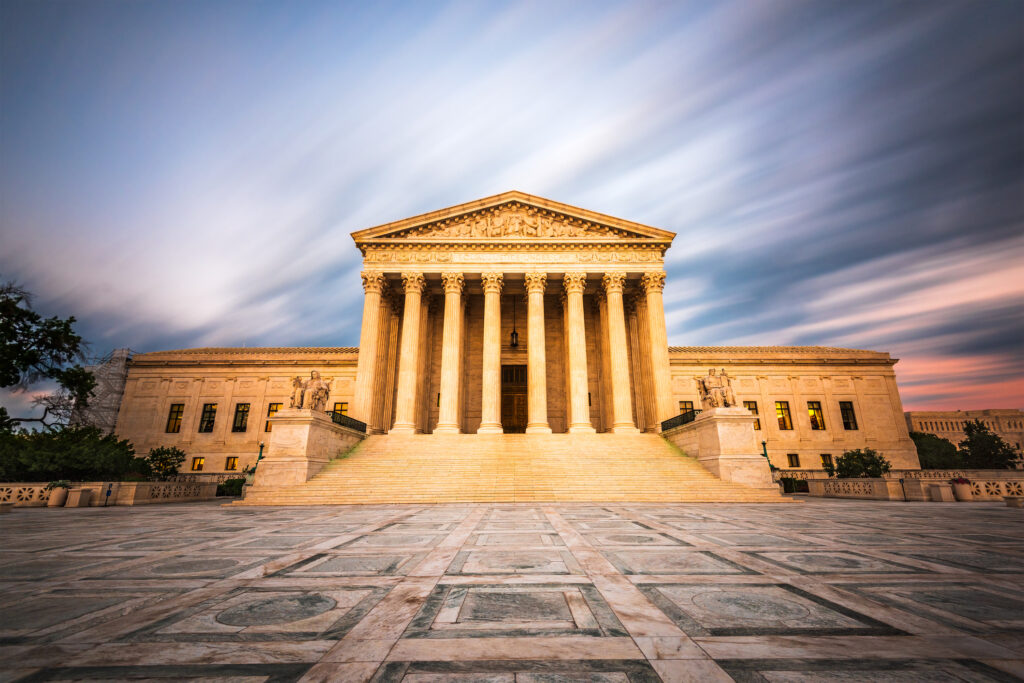
Despite a unanimous 9-0 defeat at the U.S. Supreme Court, the state of Wisconsin is doubling down on its effort to deny Catholic Charities Bureau (CCB) a tax exemption previously afforded to other religious groups — and now, state officials are trying to eliminate the exemption altogether for all religious nonprofits.
The legal battle stems from Wisconsin’s refusal to grant Catholic Charities Bureau, a social services arm of the Diocese of Superior, an exemption from the state’s unemployment insurance tax, a benefit typically extended to religious organizations. The Supreme Court ruled that the state violated the First Amendment by denying the exemption based on the agency’s charitable activities being labeled “non-religious” by state officials.
“Claiming a Catholic ministry serving those in need isn’t religious was always absurd,” said Eric Rassbach, senior counsel at the Becket Fund for Religious Liberty, which represented CCB. “Trying to wriggle out of a 9-0 loss is even more absurd.”
Wisconsin’s Response: Eliminate the Exemption for Everyone
Rather than complying with the ruling by extending the religious exemption to Catholic Charities and similar groups, Democratic Attorney General Joshua Kaul filed a brief Monday with the Wisconsin Supreme Court, arguing that the solution is to abolish the exemption entirely for all religious organizations.
“Discrimination is cured by restoring equal treatment,” Kaul wrote, “which can be accomplished here in one of two ways: either by expanding the statutory exemption to groups like Catholic Charities or else by eliminating it altogether.”
Kaul’s position implies that extending equal treatment via broader exemptions would create a new form of “discrimination” — against secular nonprofits — because religious organizations could claim exemptions based on their beliefs, while secular counterparts doing similar work could not.
“An expanded exemption would have to cover nonprofits that are simply motivated by religious beliefs (like certain hospitals)… Meanwhile, comparable secular nonprofits… would still have to participate in the state system,” Kaul argued.
Attorneys: Wisconsin’s Retaliation Is Transparent
Attorneys for Catholic Charities say the state’s actions amount to retaliation for being forced to include the religious nonprofit.
“It is unavoidably clear that there has been one and only one circumstance in which Wisconsin has ever tried to jettison the entire scheme of religious exemptions—when it lost at the United States Supreme Court and was forced to include Catholic Charities,” they wrote in a court filing.
They argue the state’s position displays open animus toward religious groups, and that its refusal to accept the ruling signals a broader agenda to weaken First Amendment protections for faith-based organizations.
Supreme Court Ruling: Religious Neutrality Is Not Optional
The Supreme Court’s June decision was notable for its unanimity and clear condemnation of Wisconsin’s position. Writing for the Court, Justice Sonia Sotomayor said the state had imposed “a denominational preference” by selectively deciding which religious groups were “religious enough” to qualify for exemptions.
“There may be hard calls to make… but this is not one,” Sotomayor wrote. “When the government distinguishes among religions based on theological differences in their provision of services, it imposes a denominational preference that must satisfy the highest level of judicial scrutiny.”
The ruling reversed a Wisconsin Supreme Court decision that claimed Catholic Charities Bureau was not “operated primarily for religious purposes” and therefore ineligible for the exemption — a claim the U.S. Supreme Court flatly rejected.
What’s at Stake
Wisconsin’s attempt to abolish the exemption entirely could have major ramifications for church-run hospitals, schools, shelters, and nonprofits, who rely on tax-exempt status to sustain operations.
Critics say the state’s strategy is not only legally questionable but politically tone-deaf, as it appears to punish all religious groups rather than comply with a constitutional mandate.
“The state should take the L and move on,” said Rassbach.
If the Wisconsin Supreme Court sides with Kaul’s proposal, the case may once again climb the judicial ladder, potentially leading to another U.S. Supreme Court showdown — this time, not over discrimination against one religious group, but the attempted dismantling of religious liberty protections statewide.
READ NEXT: Tim Walz Denied Security Funding To Catholic Schools



















Are their employees eligible for unemployment compensation? If so, they should pay the tax; if not, they shouldn’t. Simple and fair.