







A Supreme Court justice should embody impartial reasoning, intellectual humility, and precise craftsmanship. By those measures, Justice Ketanji Brown Jackson falls short. Her selection was the product of a process that elevated identity above merit, and her subsequent performance on the Court confirms that this method yields mediocrity. To say so is not prejudice but principle. The critique is twofold. First, the criteria that produced her nomination were explicitly discriminatory, substituting demographic traits for excellence. Second, her record on the Court displays recurring problems of logic, clarity, and legal rigor that make her an embarrassment to the institution she serves.
When Justice Stephen Breyer announced his retirement, President Biden repeated his campaign promise to nominate the first black woman to the Supreme Court. He did not say he would nominate the best legal mind available. He did not open the search to all Americans. He narrowed the pool in advance to three black women: Ketanji Brown Jackson, J. Michelle Childs, and Leondra Kruger. That exclusionary approach ensured that talent from every other background, gender, and ethnicity was ignored. One may claim that symbolic firsts have social value, but symbolism cannot replace substance. A president who promises to appoint a justice of a particular race and sex undermines the credibility of the very office he fills. The point is not that black women lack ability; it is that ability was made secondary. The decision structure guaranteed that the pool would be smaller, the search shallower, and the outcome less likely to produce the best candidate.
Defenders insist that Jackson’s credentials demonstrate merit. She holds degrees from Harvard, clerked for Justice Breyer, and served on the Sentencing Commission. These are accomplishments, but they are not extraordinary within the pool of potential nominees. Hundreds of federal judges, professors, and advocates possess comparable records. What distinguished Jackson was not her scholarship or jurisprudence but her alignment with the president’s demographic promise. That is the problem. When the criterion of selection precedes the evaluation of competence, the process itself becomes discriminatory. It is not racism to say that a racial filter narrows the search. It is fidelity to the idea that equal opportunity demands open competition.
Even if one were to set aside the flawed method of selection, Jackson’s record on the Court provides independent cause for concern. Her writing and reasoning repeatedly fail to meet the standards expected of a Supreme Court justice. Her dissent in Students for Fair Admissions v. UNC exemplifies the problem. The majority opinion, grounded in the plain text of the Fourteenth Amendment and Title VI, reaffirmed the principle that government and institutions receiving federal funds may not discriminate on the basis of race. Jackson’s dissent ignored that legal command. Instead, she delivered a political manifesto celebrating diversity and lamenting America’s historical wrongs. She accused the majority of “let them eat cake obliviousness” and mocked the idea of “colorblindness for all.” Yet she never articulated a coherent legal principle explaining when and why racial discrimination might be lawful. Her dissent read not as an analysis of law but as a sermon on social justice. The role of a justice is not to moralize about history but to interpret the Constitution. On that measure, her opinion failed.
This pattern extends beyond one case. In Trump v. Casa (2025), a separation-of-powers dispute, Jackson’s dissent warned that the majority’s reasoning posed an “existential threat to the rule of law.” Justice Barrett’s majority opinion replied in strikingly blunt terms, noting that Jackson’s theory departed from two centuries of precedent and envisioned an imperial judiciary unconstrained by constitutional limits. Even Justice Sotomayor, usually an ideological ally, distanced herself from Jackson’s reasoning in a separate concurrence. Public disagreement of this sort within the liberal bloc is rare. It reflects not politics but alarm at a colleague’s disregard for doctrinal discipline.
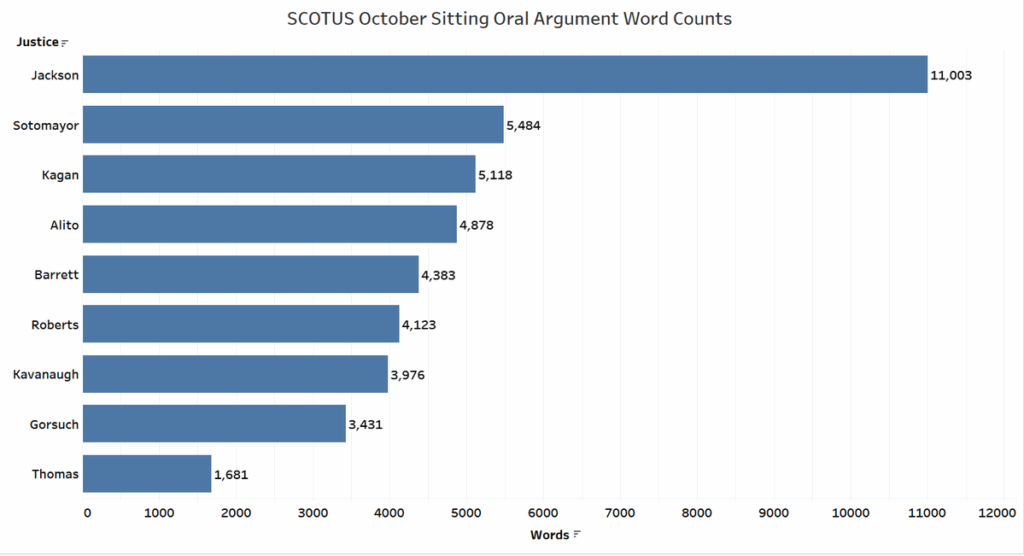
Her difficulties are not confined to writing. During oral arguments, Jackson’s behavior has drawn criticism for verbosity and self-display. Empirical SCOTUS data show that in her first eight arguments, she spoke more than 11,000 words, far exceeding any other justice, none of whom exceeded 2,000. A high word count does not prove incompetence, but it suggests a tendency to lecture rather than inquire. Oral argument is a forum for testing ideas, not for delivering classroom monologues. By monopolizing time, Jackson deprived advocates of opportunities to clarify essential issues. Her long-winded interventions often blurred the boundaries between advocacy and adjudication.
A telling moment came during Louisiana v. Callais, when she compared racial vote dilution to a lack of wheelchair ramps under the Americans with Disabilities Act. Her intent was to analogize unequal access. The result was confusion. The ADA analogy ignored that disability accommodations do not involve racial classifications, while racial gerrymandering does. Critics pounced, interpreting her words as equating black voters with the disabled. That reading was uncharitable, but it revealed a deeper problem: when a justice repeatedly chooses moral theatrics over precise argument, she invites misinterpretation. The Supreme Court is not a pulpit for performative empathy; it is the final interpreter of law.
Jackson’s jurisprudence also lacks methodological coherence. She sometimes claims fidelity to original meaning, then abandons it when inconvenient. She gestures toward textualism in confirmation hearings but reverts to living constitutionalism when writing. The result is inconsistency, not adaptability. Her decisions are often anchored in broad moral premises rather than legal ones. She warns of threats to democracy where the issue before the Court concerns jurisdiction or administrative delegation. Such overreach reflects a misunderstanding of the judicial role. A justice may hold passionate views about fairness or policy, but her duty is to apply rules, not to rewrite them.
Even her allies have noticed the problem. Liberal commentators such as Laurence Tribe and Neal Katyal have praised her advocacy but expressed unease at her lack of doctrinal focus. Conservative scholars have been harsher, describing her opinions as “rhetorical essays masquerading as law.” Justice Barrett herself issued a pointed rebuke in one opinion, cautioning that Jackson’s reasoning lacked connection to the controlling legal framework and warning that persuasive rhetoric cannot substitute for disciplined analysis. Neither assessment is flattering. Both agree that her writing prioritizes persuasion over precision.
To call Jackson the most embarrassing justice in US history is a strong charge. Yet embarrassment here does not mean scandal. It means visible deficiency in reasoning, repeated disregard for legal form, and public correction by peers. Her dissents read like editorials. Her analogies confuse rather than clarify. Her questioning disrupts more than it illuminates. A vivid example came in Loper Bright Enterprises v. Raimondo, the first case that Jackson had decided as a lower-court judge to reach the Supreme Court, where the Court overturned her ruling in spectacular fashion and explicitly rejected her deferential reasoning toward the administrative state. That reversal underscored the gap between her rhetoric and the rule of law. When multiple colleagues, both conservative and liberal, find her work off course, the criticism transcends partisanship. It signals professional concern.
One final point bears emphasis. Some accuse critics of racism for questioning the DEI framework that produced her nomination. This accusation collapses under its own logic. The only person who made race central to the appointment was President Biden. Critics merely observed that he did so. To argue for open competition is not to attack any group; it is to defend the ideal that the law should be blind. In every field where performance matters, medicine, aviation, the military, we understand that excellence requires merit-based selection. The Supreme Court is no different. When identity politics governs appointments to the nation’s highest tribunal, the consequence is predictable: the erosion of competence and the politicization of law.
The Court will survive Justice Jackson, as it has survived lesser minds before. But her tenure should stand as a warning. When presidents choose symbolic representation over merit, they degrade the institutions they claim to honor. The next administration must learn that lesson. Search broadly. Judge carefully. Select on excellence alone. The Supreme Court deserves nothing less.
If you enjoy my work, please share my work and subscribe: https://x.com/amuse.
Sponsored by the John Milton Freedom Foundation, a nonprofit dedicated to helping independent journalists overcome formidable challenges in today’s media landscape and bring crucial stories to you.
READ NEXT: New Details Reveal Sweeping Changes At White House
























She can’t even define what a woman is, even though she allegedly is one!