

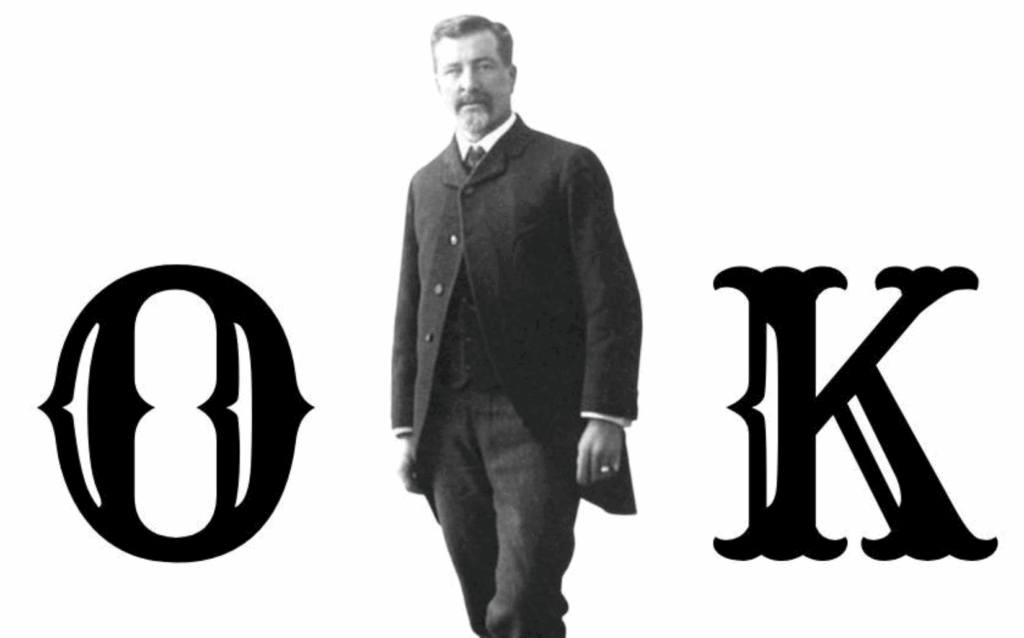
The word “OK” is everywhere. It sits comfortably in text messages, headlines, presidential speeches, and even rocket transmissions. Yet its origins are so unassuming that few realize this global linguistic phenomenon began as a Boston newspaper joke in 1839. What started as a bit of editorial humor, an intentionally misspelled abbreviation, became the most universally recognized word on Earth. The story of “OK” is not only about language but about the American genius for turning the playful into the permanent, the trivial into the essential.
In the 1830s, Boston’s young intellectuals entertained themselves with what one might call the meme culture of their day: humorous misspellings and abbreviations. Newspapers joined in, coining expressions like “O.W.” for “oll wright” and “K.Y.” for “know yuse.” Among these inside jokes, one would prove immortal. On March 23, 1839, the Boston Morning Post printed a witty jab at a rival, ending the piece with “o.k.” for “oll korrect.” It was an abbreviation of “all correct,” deliberately misspelled for comic effect. The editor, Charles Gordon Greene, likely had no idea that this small act of humor would echo through centuries of communication.
BOOK CLUB: The story of how the Boston Morning Post's Charles Gordon Greene invented the word "OK" in 1839.https://t.co/2RHRw3Ade3 pic.twitter.com/on07R2d4Lu
— @amuse (@amuse) October 26, 2025
The charm of “OK” lay in its simplicity. It was playful but clear, brief but expressive. Other abbreviations from that fad vanished within months, but “OK” caught on. Within a year, the joke had jumped from Boston’s papers to national politics, thanks to Martin Van Buren’s 1840 reelection campaign. Van Buren, nicknamed “Old Kinderhook” after his hometown in New York, leaned into the initials. His supporters formed “OK Clubs” and rallied behind the slogan “Old Kinderhook is OK.” The term’s new association with political approval gave it a boost of patriotic legitimacy. Van Buren lost the election, but “OK” won the linguistic race, becoming embedded in the American vocabulary.
Ironically, Van Buren’s opponents helped spread the term even further. The Whigs gleefully mocked “OK,” twisting it into insults: “Out of Kash, Out of Kredit, Out of Karacter.” Yet ridicule only increased its reach. By the end of the campaign, Americans across political lines knew what “OK” meant. It had escaped the world of jokes and slogans and entered everyday speech as a shorthand for agreement and adequacy. Even those who despised Van Buren found the term too useful to abandon.
As decades passed, the original context faded. People continued saying “OK” without knowing why, and in the absence of clear history, myths multiplied. Some said it came from the Choctaw word “okeh,” meaning “it is so.” Others thought it derived from the Greek phrase “ola kala,” or “all good.” President Woodrow Wilson even favored “okeh” in his official papers, convinced of its Native American origin. Still others imagined “OK” had been coined by Andrew Jackson, who supposedly scrawled “O.K.” for “Oll Korrect” on military documents, a charming tale but entirely unsubstantiated. The true story remained buried in old newspapers until the mid-20th century.
The mystery was finally solved in the 1960s by the meticulous work of Allen Walker Read, a Columbia University linguist who treated the word’s history like an archaeological dig. Scouring archives, Read unearthed Greene’s 1839 “oll korrect” joke and traced its replication across the American press. His findings ended more than a century of speculation, showing that “OK” had been born not from foreign tongues or presidential quirks but from a uniquely American impulse: to play with language, abbreviate, and laugh at one’s own jokes. In 1964, the New York Times hailed Read’s discovery as the linguistic equivalent of uncovering the Rosetta Stone of modern slang.
By then, “OK” had already taken over the world. Telegraph operators used it for confirmation signals, aviators for preflight checks, and later astronauts for mission control exchanges. In 1961, when astronaut Alan Shepard radioed back “A-OK” during his spaceflight, he carried the Boston pun into orbit, literally universalizing it. “OK” had evolved from satire to science, from the newsroom to the launch pad.
Part of what made “OK” unstoppable was its flexibility. It could be a noun (“Give me the OK”), a verb (“She OK’d it”), an adjective (“That’s OK”), an adverb (“It went OK”), or an interjection (“OK, let’s go”). Few words can slip so effortlessly into every grammatical role. It is both formal and casual, positive yet understated. It conveys acceptance without enthusiasm, approval without excess. In that sense, “OK” expresses a distinctly American temperament, a mixture of practicality and restraint. It says: things may not be perfect, but they work well enough. As linguist Allan Metcalf put it, “OK” embodies “the American philosophy of pragmatic optimism.”
This philosophy explains why “OK” found a home in nearly every language. Across continents, “OK” requires no translation. French, Japanese, and Swahili speakers all use it. It crosses linguistic and cultural boundaries more easily than any word except “Coca-Cola” and “Internet.” In an age obsessed with diversity, “OK” remains a quiet monument to universality. Two letters, one sound, infinite comprehension.
There is something profoundly American about that universality. The same country that turned the telegraph into the telephone and the Model T into the highway also turned a small Boston joke into the world’s default word of agreement. It reflects the nation’s combination of humor, simplicity, and productivity. “OK” succeeds because it works, just as America’s best inventions do. It doesn’t insist, it affirms; it doesn’t dazzle, it delivers.
In a cultural sense, “OK” is a triumph of democratic language. It was not invented by scholars or committees but by common speech, shared freely and adopted by all. The high and the low, the educated and the unlettered, the president and the printer, each found it useful. It spread not by decree but by imitation, the same way memes travel today on 𝕏. The early 19th-century newspaper culture that birthed “OK” is not so different from our digital world. Both thrive on speed, wit, and the joy of shared humor. If Charles Greene were alive today, he might have coined it in a tweet.
Over time, “OK” even absorbed its rivals. When someone says “okey-dokey,” “okie,” or “A-OK,” they are extending a single idea through rhyme and repetition. The variations play with tone, but the meaning stays the same: acknowledgment, approval, readiness. Each iteration reveals our impulse to personalize the universal, to make language serve our mood. That adaptability is why “OK” remains modern after nearly two centuries. It evolves with the medium. Whether printed on a telegraph slip or glowing on a smartphone screen, it feels right at home.
In the end, “OK” has become more than a word. It is a cultural fingerprint. No other expression captures so neatly America’s genius for combining humor with utility, informality with precision, and individuality with universality. It began as an abbreviation for “oll korrect,” but it endures because it embodies something larger: the belief that being “OK” is good enough to move forward. In an imperfect world, that is no small thing.
So next time you tap “OK” on your phone, think of that Boston editor in 1839, chuckling as he closed his column. He couldn’t have known that his small joke would someday orbit the Earth or appear on every digital screen. Yet perhaps he sensed that good humor and plain speech, two American virtues, can carry farther than any pompous phrase. And that, as we might say, is perfectly OK.
If you enjoy my work, please share my work and subscribe: https://x.com/amuse.
Sponsored by the John Milton Freedom Foundation, a nonprofit dedicated to helping independent journalists overcome formidable challenges in today’s media landscape and bring crucial stories to you.
READ NEXT: Blue State Bleeds $3 Million Daily Under Governor’s Watch
















Let us not forget the hand sign of circled thumb and extended three fingers used to silently signal OK where the verbal form would not be heard due to noise or the need for quiet.
Ok or Okay, can mean all those things. I use it as everyone does. It’s perfect. And because of this article I now know the rest of the story!
I think, at least in English, people use the word “up” more often than ok. Up is used a noun, verb, adjective, adverb and preposition. Up has more meanings than any other two-letter word.
Why do we wake UP? Why do we speak UP, and why are the officers UP for election and why is it UP to the secretary to write UP a report? We call UP our friends, brighten UP a room, polish UP the silver, warm UP the leftovers and clean UP the kitchen. We lock UP the house and fix UP the old car. A drain must be opened UP because it is stopped UP.
People stir UP trouble, line UP for tickets, work UP an appetite, and think UP excuses. To be dressed UP is special. We open UP a store in the morning but we close it UP at night. We seem to be pretty mixed UP about UP!
Look UP the word UP in the dictionary. In a desk-sized dictionary, it takes UP almost 1/4 of the page and can add UP to about thirty definitions.
If you are UP to it, you might try building UP a list of the many ways UP is used. It will take UP a lot of your time, but if you don’t give UP, you may wind UP with a hundred or more.
Perhaps UP is over-used and in most instance could be dropped altogether.