

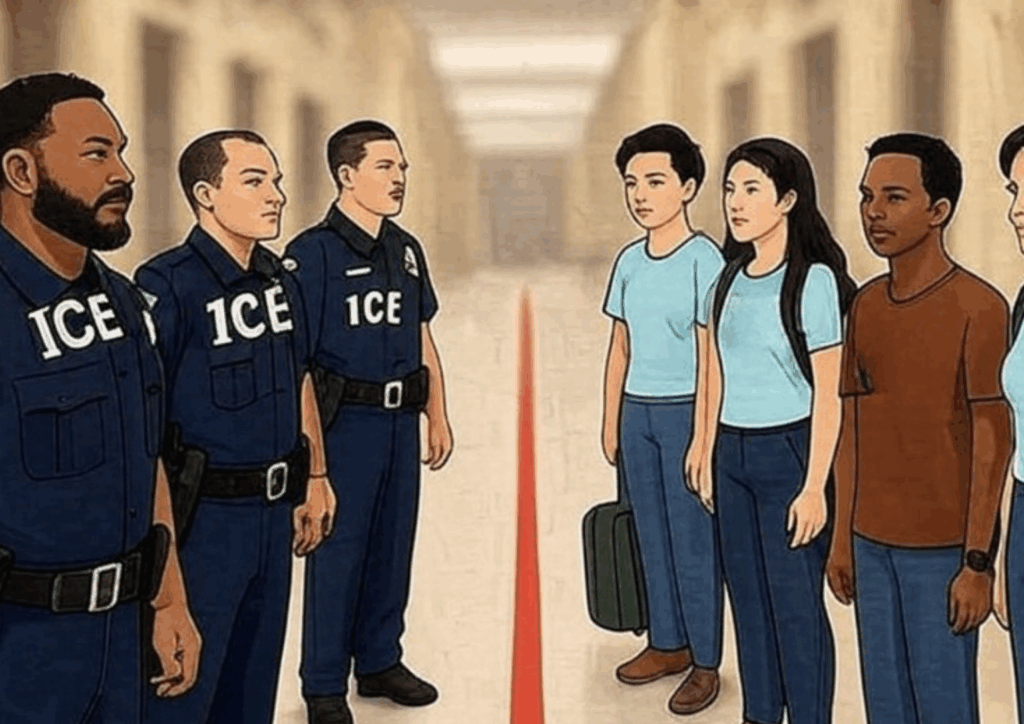
The Constitution leaves no room for states to carve out pockets of immunity from federal law. Yet states like Illinois, California, and Connecticut have enacted laws attempting to bar Immigration and Customs Enforcement (ICE) from making civil arrests in or around courthouses. These measures may sound compassionate, but they are plainly unconstitutional. By forbidding federal officers from enforcing federal immigration statutes within specified “safe zones,” these states have crossed a constitutional line that was drawn long ago.
Illinois’ newly enacted law typifies the problem. It declares that no civil immigration arrest may occur within any state courthouse or within 1,000 feet of one, granting undocumented individuals a legal “privilege from arrest” while traveling to, attending, or leaving court. It even authorizes lawsuits against ICE agents for false arrest or imprisonment, with statutory damages of $10,000 per violation. This resembles the medieval notion of sanctuary in churches, where fugitives could claim temporary protection from the law. But modern America is not medieval Europe. The federal government, not individual states, determines how and where immigration law is enforced.
The Supremacy Clause of the Constitution, found in Article VI, states that federal law “shall be the supreme Law of the Land.” That means when a valid federal statute conflicts with a state law, the state law must yield. Immigration enforcement falls squarely within that federal sphere. Congress has charged ICE and the Department of Homeland Security with enforcing immigration laws, including the arrest and detention of those present unlawfully. A state directive telling federal officers where they may not make arrests is thus in direct conflict with federal law. It is null and void the moment it is signed.
Illinois has joined California and Connecticut in barring federal immigration agents from conducting “civil arrests” of illegal aliens around state courthouses. The sanctuary law appears largely performative since it also appears unconstitutional… https://t.co/e8f14GqbTi
— Jonathan Turley (@JonathanTurley) November 2, 2025
The Supreme Court has said as much for over a century. In Mayo v. United States (1943), the Court held that “the activities of the Federal Government are free from regulation by any state.” South Carolina v. Baker (1988) reaffirmed that a state may not discriminate against or burden the federal government or those carrying out its duties. The principle is known as intergovernmental immunity: states cannot control federal officers any more than they can tax the federal treasury. Chief Justice John Marshall put it best in McCulloch v. Maryland (1819): “The States have no power, by taxation or otherwise, to retard, impede, burden, or in any manner control the operations of the constitutional laws enacted by Congress.” Illinois’s law does exactly what Marshall warned against. It impedes the enforcement of federal law and burdens federal officers with potential civil liability simply for performing their duties.
Even if Illinois or California had good intentions, say, to ensure witnesses and defendants feel safe attending court, the Constitution does not permit states to advance such goals by obstructing federal power. The landmark case Arizona v. United States (2012) is instructive. There, the Supreme Court struck down sections of an Arizona law that allowed local officers to arrest suspected illegal immigrants without federal authorization. The Court held that immigration is an exclusively federal field, and any state law that interferes with or supplements federal immigration enforcement is preempted. If Arizona could not aid enforcement, then Illinois cannot obstruct it. The rule cuts both ways: states may neither assume nor deny the federal government’s authority over immigration.
Federal statutes underscore this point. Under 8 U.S.C. §1226(c), ICE is required to take into custody certain criminal aliens when they are released from state or local detention. Under §1231(a), ICE must arrest and remove aliens with final deportation orders within a specific timeframe. Congress’s commands leave no discretion for states to decide that certain places, like courthouses, are off-limits. The duty to arrest applies wherever the person may be found. By criminalizing or penalizing ICE activity in certain areas, states are directly frustrating congressional mandates.
In 2020, a federal court struck down a similar New York law that prohibited ICE from conducting courthouse arrests without a state judicial warrant. The court ruled that the state law conflicted with the Immigration and Nationality Act, which authorizes federal agents to issue and execute their own civil warrants. New York’s attempt to impose a state-level precondition, requiring ICE to secure state judicial approval, was preempted by federal law. The reasoning applies with even greater force to Illinois’s 1,000-foot buffer zone, which seeks to erase federal jurisdiction over public streets and sidewalks near courthouses.
California’s Assembly Bill 668, passed in 2019, prohibits civil immigration arrests of persons attending court proceedings unless a judge issues a warrant. Connecticut’s Chief Justice adopted a similar rule barring ICE from courthouses unless they carry a judicial warrant. These measures do not merely decline cooperation; they attempt to dictate where federal agents may operate. That distinction is crucial. Under the anti-commandeering doctrine, states are free to refuse assistance to federal authorities. They cannot, however, actively obstruct them. A state may tell its sheriffs not to assist ICE, but it may not tell ICE agents they are forbidden to enforce federal law in certain places.
Supporters of these laws argue that ICE’s presence in courthouses chills participation in the justice system, discouraging victims and witnesses from appearing. But that argument, while emotionally charged, cannot justify violating the Constitution. The proper way to address concerns about enforcement priorities is through Congress, which has authority over immigration policy. State legislatures cannot simply veto federal law through local ordinances. To allow that would revive the discredited doctrine of nullification, the very notion that sparked secession in the 19th century. The Civil War settled that question at terrible cost. Federal law is supreme, and states may not declare independence from it in piecemeal fashion.
Illinois Governor J.B. Pritzker has not helped his case by framing his state’s defiance in moralistic terms. Comparing federal immigration enforcement to Nazi tactics or claiming democracy is dying under President Trump’s administration does not change constitutional reality. Hyperbole cannot mask illegality. The state’s creation of a 1,000-foot sanctuary radius may play well with certain political constituencies, but even Pritzker’s allies concede the legal weakness of the measure. Illinois Senate President Don Harmon admitted during debate that the state was “playing with a stacked deck” and expected a Supremacy Clause challenge. That candid acknowledgment should have been reason enough to reconsider.
The broader danger is precedent. If Illinois can create zones where federal arrests are forbidden, other states could do the same for other federal agencies. One state might bar the FBI from executing warrants near schools, another might block IRS agents from visiting certain offices, and another could forbid ATF agents from operating in state parks. The result would be chaos, a checkerboard of jurisdictions where federal law applies in some places but not others. The Founders wrote the Supremacy Clause precisely to prevent such fragmentation. The Union cannot endure if its laws vanish at state borders or courthouse doors.
There is also a practical harm to immigrants themselves. These sanctuary laws foster false hope. They encourage undocumented individuals to believe they are immune from arrest within designated zones, when in fact federal agents remain fully authorized to act. ICE has continued to conduct courthouse arrests in California and New York despite state prohibitions, proving that these laws offer symbolic protection at best. Immigrants who rely on them risk disappointment, detention, and deportation. A state that misleads vulnerable people about their legal exposure does not deserve praise for compassion; it deserves censure for deceit.
Historically, every serious attempt by a state to obstruct federal law has failed. During desegregation, several southern governors tried to block federal court orders enforcing civil rights, invoking “states’ rights” to justify defiance. The Supreme Court responded in Cooper v. Aaron (1958), affirming that state officials are bound by federal law and court orders. The principle is the same here. Federal immigration law binds all states, regardless of whether their governors approve. A courthouse is not a constitutional sanctuary, and a 1,000-foot buffer zone does not place its surroundings beyond federal reach.
Ultimately, these laws reveal the performative nature of progressive governance. They are not designed to survive constitutional scrutiny; they are designed to generate headlines. They let state leaders signal moral virtue while daring the federal government to act. But the inevitable result will be the same: the courts will strike them down. The Constitution, written to ensure national uniformity in matters like immigration, will not bend to accommodate state-level defiance.
The Framers understood that divided sovereignty could not function if states could selectively nullify federal power. Their solution was clear and elegant: federal law reigns supreme within its proper domain. Immigration enforcement belongs to that domain. The effort by Illinois, California, and Connecticut to create courthouse “safe zones” is not a bold act of compassion but a futile gesture of defiance. The Supremacy Clause will have the last word.
If you enjoy my work, please subscribe: https://x.com/amuse.
Sponsored by the John Milton Freedom Foundation, a nonprofit dedicated to helping independent journalists overcome formidable challenges in today’s media landscape and bring crucial stories to you.
READ NEXT: Red State Freezes Trump Initiative After Major GOP Losses


















Can the feds swear in common citizens to go into these spaces to do the arrests? I would love to a judge try to interfere with this kind of arrest and end up being arrested for breaking the law. Citizens have the right of citizens arrest, but when temporarily sworn they would carry the full intent of the law.
Hum? All for illegal aliens. Barnie has been saying the DNC is gonna be gone soon without new voters. HUM, a big AHAHA? A new plantation of voters for the dimwit nitwits that they want the rest of the nation to pay for in taxes and funding. How dumb are the voters of today? The fools elected a staunch marxist for mayor of NYC. Then voted in NJ and VA for more dimwit nitwits. Yup! Voters today are super dumb. Sorry but calling a spade a spade does not make it a real heart. Wake up or this country is gonna go to hell. Then we will have to fight to come back if that will be possible. Welfare and a free ride apparently is all the citizen’s want! And I want to tell everyone that dimwit nitwits all lie, cheat and steal. Rolette voting machines, mail box ballot stuffing, etc…….. Oh well!
Illegal alien safety zones:
MS MO Columbia Rivers
LI Sound
Pacific, Caribbean
Off HI
Mexico
Canada
Lock up the state officials with the illegals
Good! Now ICE officer know where they can find the illegals and arrest a bunch of them all at once.
If everything you say is true and this is settled law, then why hasn’t the federal government simply go to the courts and request a restraining order against these states?
How these states CONTINUE to defy Constitutional law and continue to get away with it, is UNBELIEVABLE !!! Somebody is not doing their job ! Demonocrats LOVE to break laws…..it’s all about MONEY.