




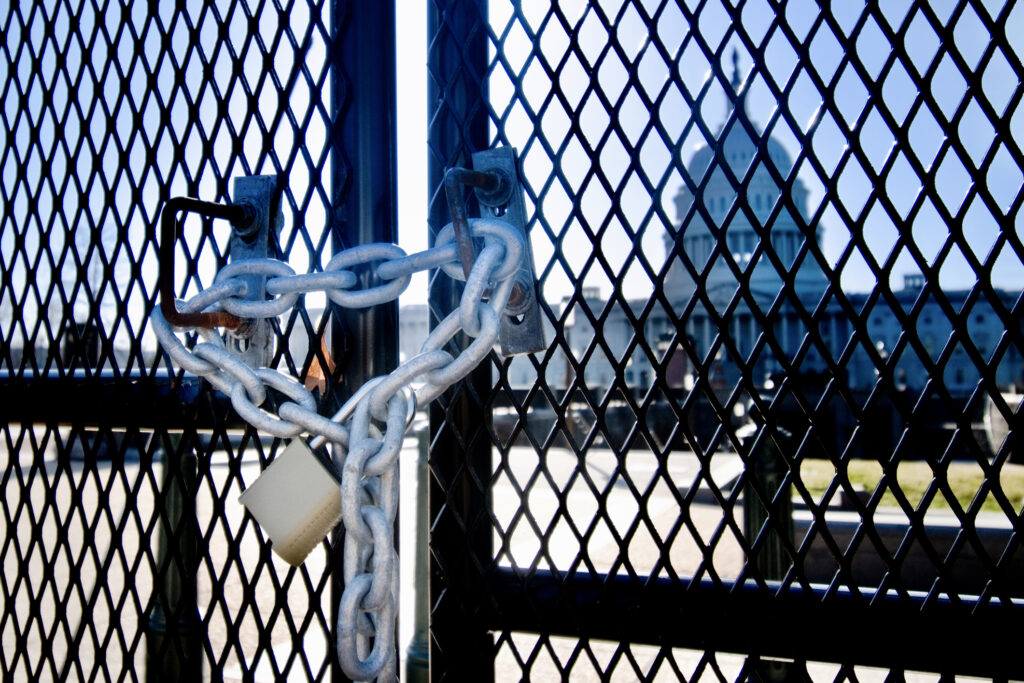
Prediction markets are not crystal balls; they are disciplined aggregators of distributed information. They turn hunches into prices and, in doing so, they force precision. Kalshi is the most prominent regulated prediction exchange for U.S. policy outcomes. Its prices on the length of the current shutdown are not partisan. They are a distilled view of the balance of power, the likely points of compromise, and the timers that matter. What do these markets say today? They say the shutdown ends soon, probably in mid-November, after Democrats bank a narrow concession related to Affordable Care Act subsidies or obtain an ironclad vote commitment. They also say it does not reach December, and almost certainly not 2026. That picture, though not certain, is coherent. It fits how shutdowns usually end, it fits the structure of leverage in the Senate, and it fits the accelerating real-world costs that Congress cannot ignore.
Our traders forecast the shutdown to last a record 48 days pic.twitter.com/qq7YhkJEXO
— Kalshi (@Kalshi) November 6, 2025
First, a brief reminder of pattern. Modern shutdowns usually end with clean continuing resolutions, in other words, bills that extend existing funding without policy riders. In 2013, Republicans attempted to change the trajectory of Obamacare through the appropriations process. After two and a half weeks of stalemate, they accepted a short-term funding bill with no Obamacare changes. In January 2018, a brief lapse tied to immigration ended when Democrats accepted a simple extension, paired with a promise of debate on Deferred Action for Childhood Arrivals. The five-week partial shutdown in 2018 and 2019, the previous record, ended when President Trump approved a stopgap bill with no border wall funding, which temporarily reopened agencies and moved the fight to a separate track. The pattern is consistent. Shutdowns tend to close where they started, with one side dropping its policy condition and agreeing to a clean CR.
This shutdown breaks the usual script in one striking respect. Republicans control both chambers and the White House, and they have tried to keep the government open on a clean basis. Democrats, in the Senate minority, have used the filibuster to hold out for a policy demand tied to expiring health insurance subsidies. That reversal of roles alters the rhetoric but not the underlying logic. The Senate’s 60-vote cloture rule allows a minority to block a motion to proceed unless a faction defects. The party leveraging that rule believes time is its friend. The party trying to govern believes time is an enemy. Each side knows exactly what the other side knows. That is why markets can price the shape of the game even as the sound bites rage.
MSM: "we have no idea how long the shutdown will last"
— Kalshi (@Kalshi) October 1, 2025
Meanwhile Kalshi traders say nearly 12 days. pic.twitter.com/aX4hFvGEl3
The key structural facts are simple. Every attempt to advance a clean CR has failed short of 60 votes, though it has earned consistent majority support. A small trio of Democrats and Democratic aligned senators, John Fetterman, Catherine Cortez Masto, and Angus King, have repeatedly crossed to vote with Republicans. Their reason is straightforward. They dislike shutdowns, they see no justification for keeping essential services unfunded, and they are willing to take heat to prevent collateral damage to their constituents. Their votes, however, are not enough. The high watermark has been a mid 50s tally, which leaves Republicans about six votes short of cloture. That is why the Democratic leadership’s hold remains decisive. They can keep the government closed so long as they keep their caucus disciplined and hold defectors to a negligible number.
Leverage explains the messaging. Early in the shutdown, Democratic leaders spoke openly about using the lapse to win concessions. There is nothing mysterious here. A shutdown concentrates public pain. Unemployment claims go unprocessed, federal workers miss paychecks, airports slow, small businesses lose access to routine financing, and critical programs like SNAP face rationing. The side that believes it can pin blame on the other side will tolerate those costs longer. Post election, Democrats interpreted their wins as a mandate to stay the course. They shifted from asking for a permanent subsidy fix to asking for a one year extension inside the CR. They framed that offer as a minimal step to prevent premium spikes on January 1. Republicans rejected it on process grounds. They said reopen first, then vote on the subsidies, either as a stand alone bill or as part of the regular appropriations cycle. That produced the current glide path. Democrats want the policy inside the vehicle that reopens the government, or a guarantee that is functionally equivalent. Republicans want policy off the reopening vehicle, with separate consideration after the lights are back on.
Kalshi’s tape captures how traders update when new information arrives. Before the lapse, the going expectation was that a shutdown, if it happened at all, would be brief. Prices implied a duration under two weeks. As the Senate deadlock persisted through October and as Democrats signaled they would not peel off before two timing moments, the nationwide No Kings protests and the November elections, the market repriced. By late October, the modal forecast had more than doubled to roughly 46 or 47 days, a record breaker and a mid November endpoint. The probability that the shutdown would exceed the 35 day record climbed into the 70s. After Election Day, that probability rose further, but not to 100. Traders assigned only modest odds to a shutdown that ran into December. They put a high 90s probability on reopening before New Year’s Day. In short, markets saw a long fight that ends soon. Not a head fake, not a seasonal crisis, not a drift into the holidays. A fight that ends because the next timer favors compromise over defiance.
Why mid November rather than late November or early December. The answer is that the policy timer and the real world timers now point in the same direction. The policy timer is the looming expiry of the enhanced ACA subsidies on December 31. If those lapse, premiums rise for many exchange plan holders, which Democrats will not allow. A one year extension satisfies their floor. A guaranteed vote with enforceable sequencing might also suffice. Either path requires action soon to give insurers and exchanges clarity. The real world timers cut even more sharply. The FAA has warned about reductions in air traffic. Air traffic controllers and TSA agents are essential, but they are not robots. Missed paychecks thin staffing. As the holiday travel cycle ramps up, delays compound. Thanksgiving week is a stress test. Neither party wants to own a meltdown of that scale. Markets understand that Congress tends to avoid disasters of its own making when the costs become immediate and visible to swing voters.
The history also presses toward closure. Each time in the modern era, the final outcome has looked like the starting line. In 2013, Republicans started with a clean CR on offer and ended with one. In 2018, Democrats started with a clean CR on offer and ended with one. In 2019, the White House started with a clean CR on offer and ended with one. This time, Republicans began by offering to keep the lights on with a clean CR. Democrats refused unless their health policy was included. Once Democrats decide they have secured the minimum they can accept, either in substance or in a binding procedural guarantee, the government will reopen on a simple extension. Markets are pricing that moment now.
Some readers will ask whether prediction markets are reliable on politics. They are not infallible, but they are disciplined. They penalize wishful thinking. They draw on traders with different models, from whip count mavens who track every senator’s public and private statements, to policy staffers who watch committee calendars, to macro desks that trade the shutdown’s effect on growth and risk premiums. When they converge around a mid November end date with a sharp drop in probability after 60 days, they are telling you that the constraints of the game, not the speeches, are the main drivers. They are also telling you that some Republican openness to a health care side deal exists, perhaps in the form of a structured vote guarantee with explicit thresholds and dates, and that some Democrats know that pushing into December carries more risk than reward.
Others will ask whether this particular shutdown is different enough to break the pattern. After all, the party out of formal control is using the filibuster to press a major policy ask, and public blame is contested. Will that increase the chance of a December scenario. The market is aware of the novelty. Prices already reflect it. Yet the civil service reality does not change. Prolonged lapses inflict concrete harm. Federal workers do not work for free. Military families cannot plan around missing paychecks. Logistical systems like air travel require steady staffing. Essential programs like SNAP cannot run indefinitely on workaround authority. The longer the shutdown runs, the more Republicans and Democrats will face intensifying pressure from unions, chambers of commerce, small business lenders, airlines, governors, and mayors. That coalition is not ideological. It is practical. It wants the system funded. Markets are sensitive to that pressure because it translates into phone calls, headlines, and, eventually, votes.
A final question concerns the content of the eventual deal. Will Democrats get a permanent subsidy extension. Unlikely. The public case for a permanent change is weaker than the case for a temporary patch, and Republicans have the leverage to insist on a separate debate. Will Republicans walk away with nothing. Also unlikely. They will probably secure one or more of the following, a formal up or down vote on the subsidy extension within a fixed window, a bipartisan working group with concrete reporting deadlines on health care affordability, or agreement to move several regular appropriations bills together with the CR to prevent another cliff in a few weeks. None of these satisfy the maximalist goals on either side. They clear the runway. They let Congress reopen government and then fight about policy the normal way, by committee and conference, not by hostage.
If that forecast feels oddly prosaic, that is precisely the point. Shutdowns do not end with grand theory. They end when incentives align enough to permit a vote. The market says those incentives are aligning now. The cost curve is steepening. The next travel cycle is unforgiving. Democrats have already moved from permanent to temporary on their core ask, which is a reveal about their true reservation point. Republicans have held on their process principle because they believe it matters for future fights. Both sides now have a path to claim a win without rewarding shutdown tactics. Democrats can say they protected families from premium spikes. Republicans can say they prevented policy riders from being jammed into a reopening bill. That is the shape of the compromise that ends this standoff in mid November.
There will be objections from the loudest voices on both flanks. Some progressives will say that giving up a permanent fix wastes leverage. Some conservatives will say that any side deal on health care rewards bad behavior. Both critiques have force. Neither objection alters the brute arithmetic of cloture or the hard reality of the calendar. A young airman’s missed mortgage payment does not care about Senate rhetoric. Neither does the Thanksgiving rush at Hartsfield or O’Hare. The adults in the room know this and, in the end, the adults usually prevail. Markets are betting that they will again.
In short, Kalshi’s message is clear. Expect a shutdown that remains the longest on record, that resolves before December, and that ends on a familiar script. Expect the Senate to pass a simple extension once Democrats secure either a one year subsidy patch or a binding vote that is equivalent in practice. Expect the House to follow within hours. Expect airplanes to keep flying and SNAP to avoid catastrophic shortfalls. The shutdown has been a costly civics lesson. It will also be a reminder of an old rule. In Washington, pain beats posture when the deadline is real and visible. Mid November is real. Everyone can see it from here.
If you enjoy my work, please subscribe: https://x.com/amuse.
READ NEXT: Contested Build, Legal Right: What The ATF Is Arguing — And What You Can Do
















Shutdown ends before Thanksgiving??
Give the Democrats NOTHING! Treat them like any other kidnappers. Paying a ransom just encourages them.