










The term “color revolution” refers to a strategy used abroad to depose governments under the banner of democracy and anti-corruption. It has a familiar rhythm: mobilized NGOs, pliant media, bureaucratic resistance, and international coordination dressed in moral language. Data analyst Jenica Pounds, known on 𝕏 as DataRepublican, has now exposed evidence suggesting that this playbook was imported home. According to recordings she surfaced, a network of State Department and USAID insiders, aided by foreign partners and billionaire-funded NGOs, began coordinating before Trump’s January 20, 2025, inauguration. Their aim was to protect themselves from the incoming administration and preserve a parallel architecture of governance capable of outlasting any elected populist.
🧵🚨 MAJOR BREAKING: International actors are involved in the State Department led color revolution 🚨🚨
— DataRepublican (small r) (@DataRepublican) November 9, 2025
This is not speculation; it’s straight from a recorded call.
Ex-USAID employees describe how, before January 20, they moved internal groups off government systems and into… pic.twitter.com/XtinGt306o
The recordings are startling not for their novelty but for their candor. Former USAID employees recount how, in the days between the election and inauguration, they moved coordination from government servers to encrypted Signal chats. This was not routine caution. They explicitly cite fear of Trump’s personnel changes and possible oversight, explaining that encrypted channels would safeguard “continuity” with international allies. Once Trump froze foreign aid and issued stop-work orders across USAID, these off-network groups sprang into action, launching websites, chat hubs, and coordination channels to resist. Public records confirm these “Stop Work” efforts and the resulting protests, which reached 50 states by early February.
The moral framing of this network, as Pounds shows, is what gives it away. The speakers describe their effort as part of a “global anti-authoritarian movement,” an international alliance against leaders deemed nationalist or illiberal. They reference colleagues abroad who had “dealt with this directly,” as though Trump’s election placed the United States within the same category as post-Soviet states targeted by regime-change campaigns. In short, the revolutionaries now saw themselves as liberators at home.
This self-conception was not born overnight. For years, elite donors and foreign policy veterans have built an infrastructure for “democracy promotion” abroad, often through entities like the National Endowment for Democracy, the National Democratic Institute, and the International Republican Institute. These bodies, created to nurture democratic transitions overseas, operate under the assumption that certain values, pluralism, bridging divides, and trusted information, are universal goods. Yet in practice, they have served as instruments of influence, exporting Western political norms and shaping internal governance abroad. Pounds’ research contends that the same machinery is now aimed inward.
At the center of her findings lies USAID’s Office of Transition Initiatives (OTI). By statute, OTI was designed for foreign transitions, not domestic politics. Its mandate under Section 491 of the Foreign Assistance Act is to respond quickly to political crises overseas. Yet alumni of OTI and its contractors appear throughout the networks Pounds mapped. Their expertise in rapid mobilization, civic narrative management, and “anti-corruption framing” now finds application on US soil. When one of the speakers in the recording says they plan to “mobilize around corruption,” it echoes OTI manuals used in places like Ukraine and Tunisia, where “anti-corruption” became shorthand for elite-sponsored revolts.
— @amuse (@amuse) November 10, 2025
This would be alarming enough if confined to bureaucratic dissent. But the ecosystem surrounding these efforts is vast and well-funded. Pounds traces connections from USAID alumni to philanthropic consortia such as New Pluralists and More Perfect, projects backed by the Rockefeller Brothers Fund, Ford Foundation, and the Koch network. These initiatives, presented as civic renewal campaigns, pursue structural changes under the guise of “bridging divides” and “trusted elections.” They partner with universities, presidential libraries, and nonprofits, building what Pounds calls a “democracy industrial complex.” It is a global network of donors, scholars, and technocrats whose stated goal is to reinvent democracy for the 21st century, but whose practical effect is to constrain populist sovereignty.
Critics might object that this interpretation exaggerates mere bureaucratic discontent. Dissent within agencies, they argue, is not conspiracy but conscience. Yet this misses the crucial distinction between ordinary resistance and coordinated subversion. When federal employees move official business off government systems, collaborate with foreign NGOs, and organize mass protests while still on the payroll, they cross from policy disagreement into political action. The Hatch Act forbids partisan activity by on-duty officials. The Federal Records Act requires preservation of official communications. And the Foreign Agents Registration Act prohibits Americans from acting under the direction of foreign principals in domestic matters. Each of these statutes could be implicated if the behavior described in Pounds’ evidence proves accurate.
Skeptics also point out that “color revolution” rhetoric has been abused by foreign autocrats to justify repression. This is true, but it does not follow that the tactics themselves are imaginary. They exist, and they have been refined for decades with US support. What Pounds reveals is that these tactics, originally crafted to manage transitions abroad, are now normalized domestically by officials who see themselves as guardians of liberal order against the populist voter. They are convinced that certain outcomes, globalization, technocratic governance, supranational cooperation, are too important to be left to electoral risk. Thus, “democracy” becomes a brand to legitimize their interventions.
To understand the scale of this shift, consider the philanthropic layer. The American Academy of Arts and Sciences’ report Our Common Purpose, co-chaired by Rockefeller Brothers Fund president Stephen Heintz, proposes 31 reforms to reinvent American democracy. It urges mandatory national service, expanded civic education, and “trusted information” systems, a euphemism for centralized control over permissible speech. The implementation network, branded as More Perfect, partners with dozens of presidential centers and philanthropies. It speaks the language of pluralism but operates through coordination with the very NGOs Pounds identifies. The rhetoric is one of inclusion, yet the outcome is consolidation.
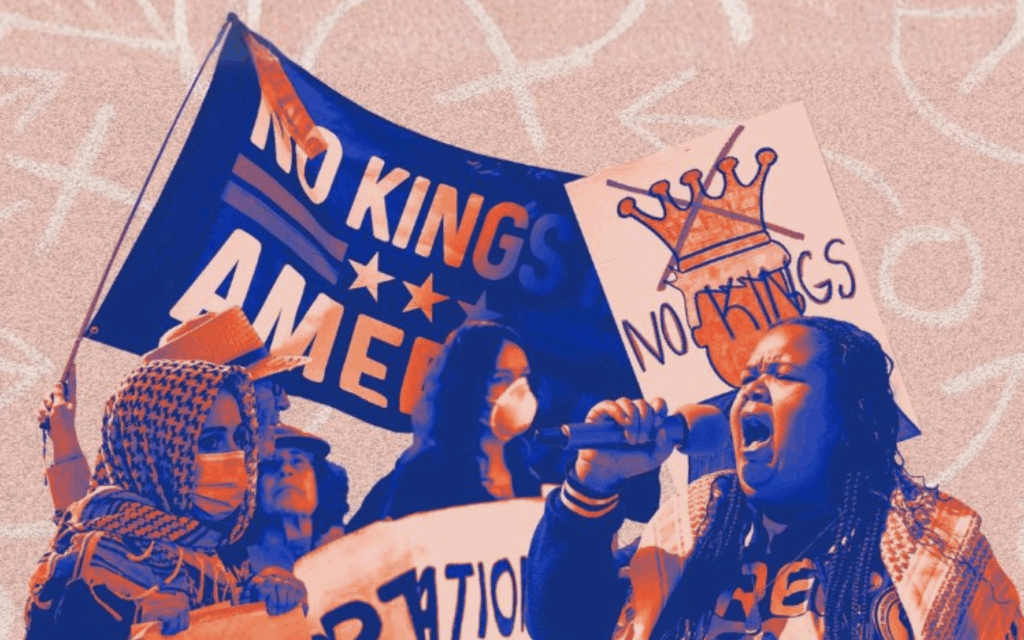
The street-level manifestation came swiftly. On February 5, 2025, just weeks after Trump’s inauguration, the 50501 movement staged synchronized protests across all 50 states. Branded “No Kings,” the campaign presented itself as grassroots dissent against authoritarianism. But its organization mirrored color revolutions abroad: rapid mobilization, unified messaging, legal support, and international media amplification. The question is not whether citizens may protest, they can and should, but who funded the logistics, buses, and communications for a nationwide rollout within days of an administrative order. Pounds suggests that the answer lies within the same NGO-philanthropy nexus she documents.
Seen together, these elements, encrypted coordination by officials, international partnerships, philanthropic funding, and street mobilization, form a pattern. It is the architecture of a color revolution adapted for domestic use. The vocabulary of democracy has been weaponized to preempt democratic outcomes. Those who claim to defend the republic from authoritarianism have, in effect, built an unelected government of their own.
What would accountability look like? Congress should begin with narrow, documentable questions. Did any USAID or State Department employees move official business to encrypted applications without records retention? Were foreign NGOs consulted or funded in response to domestic policies? Did philanthropic entities coordinate grants with active federal employees or former officials on transition teams? These are factual inquiries, not partisan ones. They test whether the legal boundary between foreign policy and domestic politics has been breached.
Defenders of the network may call this paranoia, but that too is part of the playbook. Label skepticism as extremism, cast oversight as intimidation, and present coordination as coincidence. Yet transparency is not persecution. If these actors are confident in their virtue, they should welcome public scrutiny.
The broader philosophical question is sobering. Can a democracy survive if its permanent institutions regard elections as contingencies to be managed rather than mandates to be implemented? When unelected elites collaborate with international partners to “reinvent” civic life, they substitute managerial design for popular consent. The result is not democracy’s perfection but its domestication. What began as an experiment in self-government becomes, in effect, a guided republic, a nation ruled by its NGOs.
Pounds’ work does not prove treason in the constitutional sense, but it does reveal sedition. It exposes a coordinated effort to subvert lawful authority and undermine the will of the electorate. Congress must investigate this seditious conspiracy and bring its members to justice. By importing the tools of regime change into domestic politics, the bureaucracy has blurred the line between defending democracy and defining it. The public deserves to know which side of that line its institutions stand on.
If you enjoy my work, please subscribe: https://x.com/amuse.
Sponsored by the John Milton Freedom Foundation, a nonprofit dedicated to helping independent journalists overcome formidable challenges in today’s media landscape and bring crucial stories to you.
READ NEXT: One Every 39 Minutes — The Shocking Toll Of Open-Border Policies






















Been planning for years