

Ken Burns’ new six-part, 12-hour PBS series The American Revolution arrives with the familiar promises. It will be definitive. It will scrape away myth. It will finally tell “everyone’s” story. At the level of production values, it delivers exactly what viewers expect. The maps are elegant, the voice-over is confident, the selection of anecdotes is often moving. Roughly 80% of the factual scaffolding is solid. Yet precisely because the scaffolding is solid, the remaining 20% matters. Burns uses the trust he earns with competent narrative history to smuggle in a present-day ideological project, one that quietly teaches viewers to be embarrassed by the American founding and to transfer moral credit for its achievements away from the people who actually built it.
The core problem is not that Burns includes Native Americans, enslaved Africans, women, and dissenters in his story. Any honest account should. The problem is how he includes them, and how he frames everyone else. Again and again, the series moves from careful description into unargued assertion, from history into catechism. The pattern is simple. First, offer a conventional fact. Second, attach to it a tendentious gloss. Third, omit the evidence that would let a viewer test that gloss. A well-produced documentary becomes a vehicle for a subtle but thorough rewriting of the American Revolution along contemporary ideological lines.
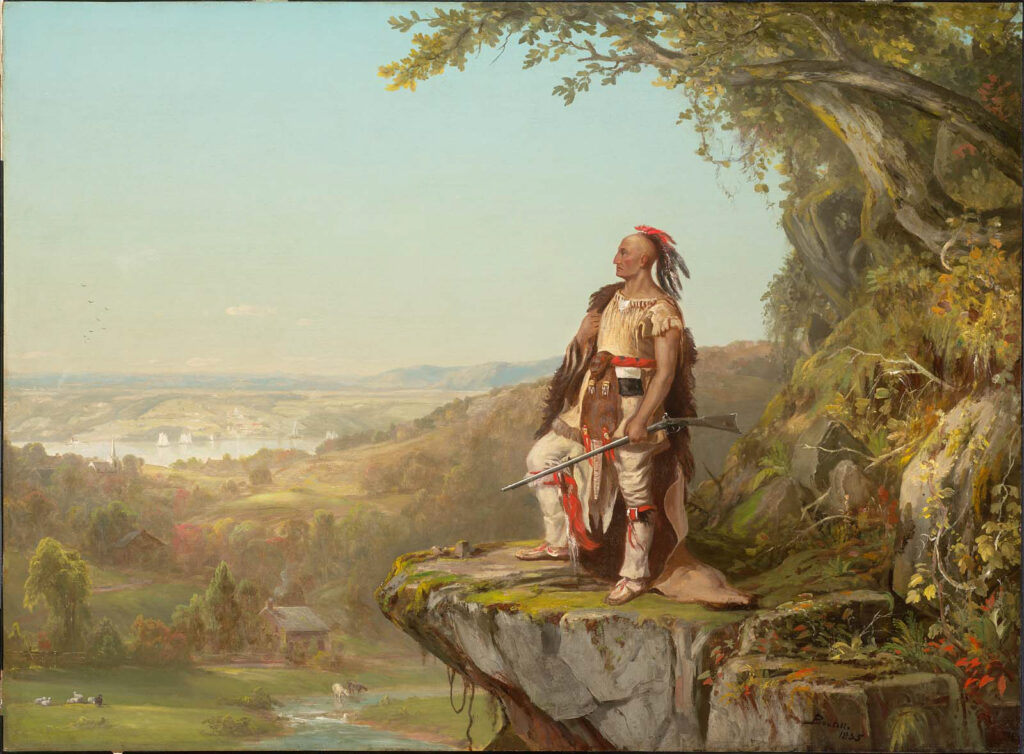
Consider the very first move the series makes. Before the colonies are even on screen, we are told that the six nations of the Iroquois Confederacy had a thriving democracy and that later the Founders would create a similar union. The unmistakable implication is that we owe our constitutional order, in significant part, to the Haudenosaunee. This is presented in the magisterial tone that Burns has perfected over decades, as if it were a settled finding of the historical profession rather than a contested, fringe thesis. No primary source is quoted on screen, no debate acknowledged, no footnote even hinted at. The viewer simply absorbs that American self-government is derivative of indigenous models.
This suggestion collides with the documentary record. If the Iroquois design played a real role in the creation of American federalism, one would expect it to surface in the immense paper trail of the founding. Yet the Journals of the Continental Congress, the records of the Constitutional Convention, the ratification debates, and the public essays of the period are silent on any Iroquois template. The authors of the Federalist Papers explain their influences in great detail. They cite Montesquieu, Polybius, the Dutch Republic, the Swiss cantons, and, of course, the English constitution. They do not cite the Great Law of Peace. Individual colonists knew the Iroquois well and sometimes admired their discipline, but admiration is not intellectual dependency.
Burns’ one concrete hook is a line from a 1751 letter, in which Benjamin Franklin notes the practical fact that six nations of what he calls “ignorant savages” had managed to form a union, and remarks that it would be strange if the colonies could not do the same. The letter is an admonition, not a citation. Franklin’s point is that if even people he regards as backward can coordinate, then Englishmen with parliaments and printing presses have no excuse for their disunity. To treat this as proof of direct borrowing from Iroquois constitutional theory is to misread a scolding remark as a philosophical footnote. Burns never explains this, because explanation would reveal how thin the evidence really is.
Equally misleading is the description of the Iroquois system as a “thriving democracy.” The confederacy had no written constitution, relied on hereditary clan structures, and vested decision-making in a small council of sachems selected by clan mothers. Ordinary Iroquois did not cast votes in anything like our sense. It was an impressive indigenous polity, but calling it democratic in the modern sense stretches the term past usefulness. Here again, the series chooses the vocabulary of contemporary legitimacy rather than the vocabulary that best fits the 18th-century reality.
Why does this matter? Because the opening move sets a tone. If the American founders merely borrowed their institutional imagination from the Iroquois, then the uniqueness of the American experiment is diminished, and so is the moral credit we extend to the founding generation. The point is not to honor the Iroquois as such, who deserve study on their own terms, but to recenter the story away from the people who actually wrote the Declaration, fought the war, and built the Constitution. It is a redistribution of prestige, and it is accomplished by selective quotation and silence rather than by argument.
The treatment of slavery reveals the same habits in a more serious register. When Burns turns to the Atlantic slave trade, he speaks in the passive voice. Tens of thousands of Africans, we are told, were captured and put in chains. The obvious question, captured by whom, is left unanswered. The effect is not accidental. A viewer who has not studied the trade will naturally imagine European raiding parties sweeping through African villages. Burns knows this. He also knows that in the overwhelming majority of cases, the first act of enslavement was carried out by Africans themselves.
— @amuse (@amuse) September 4, 2025
European traders operated coastal forts. They did not regularly march armies into the interior. The people who hunted, kidnapped, and marched captives to the coast were African warlords and kings, acting for profit and power. Kingdoms such as Dahomey and Ashanti built entire economies around the sale of human beings. Their armies sacked neighboring towns, seized prisoners, and sold them to European buyers in exchange for guns, powder, and other goods. African elites knew exactly what they were doing. They were not misled merchants handing over criminals for mild indenture. They were engaged in deliberate, large-scale human trafficking.
None of this mitigates the guilt of the European and American buyers, who created the demand and profited from the suffering. But it spreads responsibility more widely than the current moral fashion allows. The transatlantic trade was a collaboration among Africans, Arabs, and Europeans in a world where slavery was a nearly universal institution. Burns has a duty, especially on public television, to tell that uncomfortable truth plainly. He chooses not to. Instead, he gives the impression of a one-way crime, white oppressors and black victims, with a ghostly middle step in which millions of people somehow become captives without agents.
The same evasion surfaces in his treatment of Phillis Wheatley. The film tells viewers that Wheatley was stolen from West Africa and brought to Boston, where the Wheatley family, in Burns’ phrase, “looked after her education.” Again, there is no mention of who did the stealing. The historical record is clear that Wheatley, a seven-year-old girl from the Senegambia region, was almost certainly seized by African raiders and sold to a coastal broker before boarding a slave ship. Burns passes lightly over the mechanics of her kidnapping because the mechanics implicate Africans.
Burns also declines to explore the implications of what happened next. In Boston, the Wheatley family did more than “look after” Phillis’ education. They taught her to read and write, gave her access to Scripture and classical literature, and encouraged her poetry. By her early twenties, she had published a volume of poems that won praise in London and from George Washington himself. Her work became a living refutation of the racist claim that Africans were intellectually incapable, and abolitionists deployed her verses as evidence that slavery warped souls that could clearly flourish in freedom.
There is a deep tragedy in Wheatley’s story. She was taken from her family, suffered illness, and died young. None of that is alleviated by the fact that her intellect was allowed to bloom in Boston. Yet that fact still matters. The American colonial milieu, for all its injustices, contained people willing to recognize her genius and invest in her mind. She herself, in one of her most famous poems, wrote that it was “mercy” that brought her from a pagan land and taught her to know a Savior. Burns omits that line. He omits the chain of choices, African and American, that made Wheatley who she became. He keeps only the pieces that support his favored picture of America as a simple story of white cruelty and black victimhood.
Women receive a similarly skewed treatment. Burns is right to emphasize that women organized boycotts, produced homespun cloth, and shouldered enormous burdens while husbands and sons were away at war. But he cannot leave it there. The narration goes further and suggests that, without women declining to purchase British goods, the Revolution would never have gotten off the ground. The men who sat in Congress, organized committees of correspondence, and marched into musket fire receded, replaced by a suggestion that consumer choices in colonial kitchens were the indispensable engine of independence.
That is a flattering story for a modern audience, but it is not a rigorous one. The non-importation agreements rested on male and female participation, and they affected British merchants. Yet the crisis that produced independence ultimately turned on political arguments and military victories. It was the Continental Congress that issued declarations, the state conventions that voted for independence, and the Continental Army that forced Cornwallis to surrender. Women’s contributions deserve honor on their own terms, not inflation into counterfactual claims that the war could not have begun without them. Burns offers the inflation, but not the evidence.
Even when he has a genuinely inspiring female story to tell, he bends it toward grievance. Margaret Corbin took her husband’s place at a cannon during the Battle of Fort Washington and was terribly wounded. In recognition, Congress granted her a lifetime disability pension at half the pay of a soldier. Burns presents the “half pay” as if it were a sexist discount. He neglects to mention that half pay for life was the standard benefit for disabled soldiers in the Continental service. In other words, Corbin was treated as a soldier, not as a lesser woman. A straightforward reading of the record would present this as an early example of the new republic honoring female courage. Burns wants instead to smuggle in a wage gap narrative. He does so by withholding the key comparison.
Nowhere is the prosecutorial stance clearer than in the treatment of George Washington. Burns cannot deny Washington’s indispensable role in holding the army together and guiding the new nation. But he seems determined to tarnish Washington’s character on racial lines. The series relates a story in which Washington allegedly rebukes a small black boy, demanding that he work for his freedom. There is no acknowledgement that the anecdote is first recorded a century after it supposedly occurred, in a romanticized local history that misidentifies the child and has to be retrofitted to make chronological sense. The doubts that any critical historian would raise are never voiced. The anecdote is treated as fact because it is useful.
When Burns turns to Washington’s slaveholding, he again follows the now familiar pattern. We hear of an enslaved person fleeing Washington’s estate. We do not hear that in the same week, Washington placed newspaper ads for runaway white indentured servants. We are invited to infer that the desire to escape Washington’s household reflects some uniquely racial cruelty. We are not told that poor whites, bound by harsh contracts, ran just as often and sometimes suffered even worse punishments at the hands of less scrupulous masters. Once again, real complexity would dissolve a simplistic moral contrast, so the complexity is held back.
Most strikingly, Burns does not tell viewers that Washington freed his slaves in his will, the only major Virginia founder to do so. He does not quote Washington’s private letters expressing a desire to see slavery end, or his refusal to sell enslaved families away from each other. These facts do not canonize Washington. They do, however, show a man wrestling with the deepest contradiction of his era and taking steps, however limited, to resolve it. The omission is revealing. A balanced portrait of Washington would show both his participation in slavery and his late-life repentance. Burns chooses an unbalanced portrait because repentance complicates the indictment.
All of these choices, on Natives, slavery, women, and Washington, serve a larger narrative frame. That frame is articulated most clearly when the series sprinkles in the fashionable language of “diversity” and “pluralism.” Viewers are told that the American experiment was founded on diversity, that the colonies were a kind of early multicultural society, that the Revolution anticipated a world of religious tolerance in a modern sense. This confuses two very different ideas.
Eighteenth-century America was plural in some respects. Different Protestant denominations lived side by side. There were scattered Jewish communities and a very small number of Catholics. There were significant numbers of Germans and Dutch, as well as Britons. But in cultural terms, the colonies were overwhelmingly European and overwhelmingly Christian. Colonists shared a common language or quickly adopted one. They drew on the same canon of Scripture, the same English legal traditions, and the same stock of classical and Enlightenment writers. What they sought in 1776 was not a celebration of radical difference, but the right to govern themselves as a distinct people within that civilization.
The Founders’ writings bear this out. They spoke constantly of Providence, of a Creator who endowed rights, of the need for public virtue rooted in religion. The Continental and Confederation Congresses issued repeated calls to prayer, fasting, and thanksgiving. State constitutions written in the 1770s and 1780s assumed that civic life would be sustained by Christian belief, even when they rejected formal establishments. Whatever their denominational differences, the Founders did not imagine the United States as a secular, neutral space dedicated to managing endless cultural fragmentation. They imagined a republic of relatively like-minded citizens disciplined by faith and reason.
To retroactively treat the Revolution as a prologue to today’s diversity, equity, and inclusion ideology is to invert that picture. It is to tell Americans that their country was born for a purpose it did not in fact own, and to suggest that resistance to contemporary multiculturalism is a betrayal of the founding itself. Burns never argues for this proposition in explicit terms. He simply selects quotations and talking heads that insinuate it, while excluding voices that would remind us that John Adams, George Washington, and their peers did not see irreducible difference as a civic ideal.
— @amuse (@amuse) November 10, 2025
At this point a defender of Burns might object that every historical narrative requires selection and emphasis. That is true. No twelve hour film can cover every angle. But there is a difference between selection guided by the question “What is most explanatory?” and selection guided by the question “What will validate my audience’s current moral intuitions?” The former leads to hard edges and uncomfortable facts all around. The latter leads to precisely what we see in The American Revolution, a story that mixes real insight with a consistent tilt, in which certain kinds of complexity always cut in one direction.
The irony is that Burns’ stated aim is to scrape away myths. In practice he replaces one set of myths with another. The old civic myth of flawless Founders and a spotless Revolution was always too simple. It reduced slavery, dispossession of Native peoples, and the exclusion of women to footnotes. That myth needed correction. But the corrective myth, in which indigenous confederacies invented our institutions, slavery is a uniquely white crime, women secretly made independence possible, and the Founders were proto secular cosmopolitans, is no better. It simply flatters a different set of prejudices.
A serious country deserves better from its publicly funded historians. It deserves narratives that can admit admiration and condemnation in the same breath, that can say without embarrassment that the American Revolution was both morally compromised and a world historical leap toward ordered liberty, that can acknowledge real debts to marginalized actors without inventing fictional ones. The true story of the Revolution is strong enough to stand on its own. It does not require the downgrading of Washington, the exaggeration of Iroquois influence, or the airbrushing of African complicity to deserve our loyalty.
If you enjoy my work, please subscribe: https://x.com/amuse.
Sponsored by the John Milton Freedom Foundation, a nonprofit dedicated to helping independent journalists overcome formidable challenges in today’s media landscape and bring crucial stories to you.
READ NEXT: Trump Approves New Policy Immediately Affecting Our Heroes















I soured on Ken Burns decades ago and I never read or see anything he does. He’s clearly a WOKE nut case, who has attempted to rewrite American history by invoking by viewing it through the lens of WOKE ideology and falsehoods. He’s an historical fraud, and what a shame it is that has likely misled millions of Americans about such an important subject.
Furthermore, it’s so consistent whit the left’s web of lies that the WOKE media has promoted Burns’ false portrayals about our history. I’m calling for a boycott by all right thinking and patriotic Americans of anything and everything Ken Burns has ever had his hand in I look forward to the day when he can no longer mislead poorly educated Americans ever again.
Our dismal education today, driven by the leftist unions, leave our children ignorant of U.S. History and then the little left wing piss ants like Burns go out and propagandize them.
You are absolutely right, pure leftist rewrite of real history. Propaganda without a leg to stand on, pure balderdash.
Did OK for other docu serials, watch Kelsy Grammer Fox Nation docu stories
It’s on PBS. Of course it’s left wing.
PBS is illegally taxpayer funded leftist claptrap!
“If I cannot sell my captives taken in war, I must kill them, and surely the English would not like that.” – King Gelele of Africa (tenth King of Dahomey)
STAND IN THE DOOR!
Everyone knows PBS is
Propaganda
Government
Style
Propaganda Government Style
Amuse, like Burns, has little interest in true historical facts. I have tried to provide factual depth, but there is no willingness to learn.
Apparently, Ken Burns has been hanging around Lie-berals. They want more DEI. I will pass on watching this documentary.
Burns is a left wing propagandist, always has been. The last thing he is is a historian!! He gets all of his “informartion” from left wing “historians.” He gets is leftist propaganda from Heather Cox Richardson, et al. There is no shortage of anti-American, anti-Founding miscreants out there doing the dirty work for Burns.
This is why I didn’t bother watching the latest Ken Burns docudrama.
I assumed that I might actually learn something from it.
But after watching an interview of him about his latest pet project, I realized that his liberal biases would scew the results and facts.
Why people like him and PBS and NPR continue to get taxpayer funding is beyond me.
If it is BURNS it is fancy and propaganda.
Very interesting article! Thank you very much. History should be studied and understood from the perspective of those who lived it. Shoe-horning one’s own perspective into the narrative is not helpful to those wanting to learn about those who preceded them. Thanks again.