


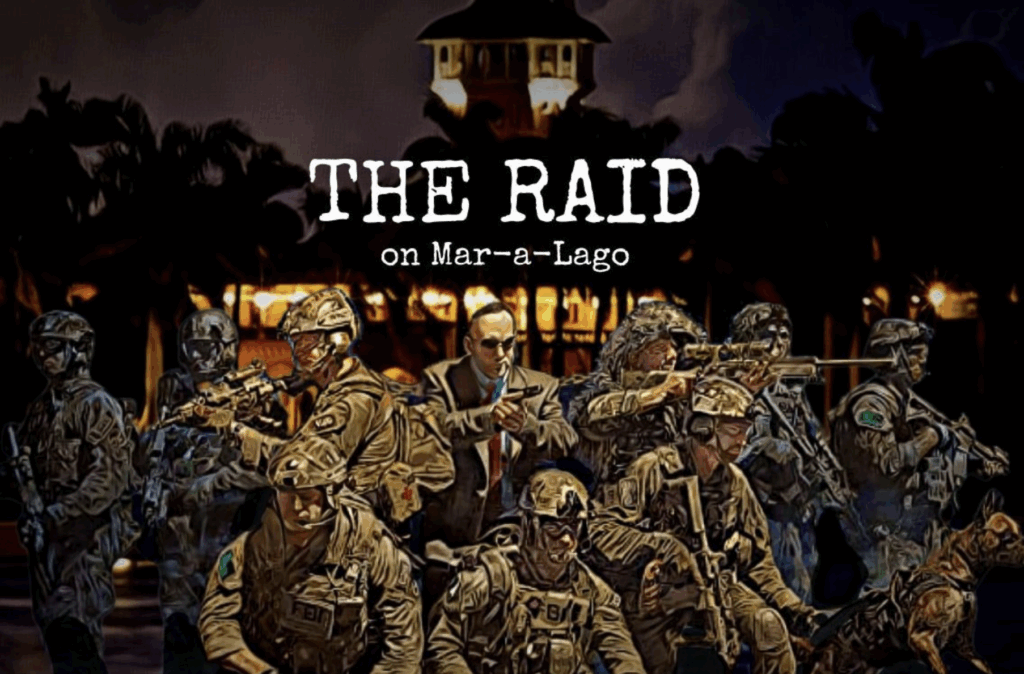
The Mar-a-Lago raid was wrong at its core. That claim does not rest on rhetoric, exaggeration, or partisan outrage. It rests on structure, incentives, and newly revealed facts. Once those facts are placed in order, the conclusion follows with uncomfortable clarity. Authorizing deadly force during a raid on the home of a former president, while knowing the legal basis for the raid itself was defective, was reckless, dangerous, unprecedented, and indefensible.
Begin with the most basic point. Deadly force authorization is not an abstraction. It is not a boilerplate incantation floating free of context. It is a real operational decision that alters incentives, expectations, and risk calculations for armed agents entering a confined space where other armed actors are present. When the FBI authorized deadly force for the Mar-a-Lago raid, it did so knowing several things simultaneously. It knew the target was a former president. It knew heavily armed Secret Service agents would be on site. It knew family members and staff could be present. And as recently uncovered emails now show, it knew that its own agents believed probable cause had not been established, warning the DOJ and White House that the raid was illegal.
That last fact changes everything. Probable cause is not a procedural nicety. It is the constitutional threshold that converts coercion into law enforcement. Newly disclosed internal FBI communications, now being prepared for release to Congress by Attorney General Pam Bondi and FBI Director Kash Patel, reportedly show that agents in the Washington Field Office warned prosecutors that probable cause was lacking before the August 2022 raid. These were not political appointees. They were career agents tasked with assessing whether the Fourth Amendment standard had been met. Their conclusion was explicit. They did not believe it had.
Proceeding anyway was not an innocent judgment call. It was an override. And once that override occurred, every downstream decision inherits the taint. This includes the decision to authorize deadly force. One cannot separate operational risk from legal legitimacy. If the raid itself lacked constitutional grounding, then exposing human beings to lethal risk in its execution becomes morally and legally damning.
Defenders of the FBI retreat to a familiar claim. Deadly force language, they say, appears in all operational plans. This response misses the point entirely. The issue is not whether the words appear in a template. The issue is whether normal templates should govern abnormal circumstances. Former presidents’ homes are not raided. Ever. That fact alone should have triggered deviation from standard procedure. Law enforcement does not earn virtue by blindly applying checklists when the context screams for judgment.
Imagine the scenario stripped of politics. Armed federal agents plan to execute a search at a location guarded by another armed federal agency whose mission is to protect a specific individual at all costs. Even in routine circumstances, such overlapping jurisdictions require heightened coordination and de-escalation. Add to this the presence of family members, staff, and a former head of state. Then add knowledge that the legal basis for entry has been determined to be unlawful. At that point, proceeding under ordinary deadly force authorization is not caution. It is negligence.
Two senior FBI officials recognized this at the time. According to unsealed court documents, they described the raid plan as too combative and too dangerous. They recommended a different approach. Simply request access. Trump had done so before. He had allowed the FBI and DOJ into Mar-a-Lago to review and retrieve documents, even against the advice of counsel. There was no evidence of imminent destruction, flight risk, or obstruction that would justify a surprise armed search. The dispute concerned presidential records sought by the National Archives, not contraband or violent crime.
In that light, the authorization of deadly force becomes even harder to defend. This was not a hostage rescue. It was not a drug raid. It was not a situation involving an armed suspect barricaded in a home. It was a document dispute involving a former president under continuous Secret Service protection. If ever there were a case demanding maximal restraint, this was it.
Some will object that no agent intended to use deadly force. That objection is beside the point. Risk is not defined by intent alone. It is defined by foreseeable interaction. Armed agents entering a secure site protected by other armed agents creates a nontrivial risk of misidentification, escalation, or split-second error. Law enforcement agencies spend enormous resources avoiding exactly such scenarios. Here, they walked into one voluntarily.
The recklessness deepens once one accepts the emerging evidence that DOJ leadership knew the raid itself was unlawful. If internal FBI warnings about probable cause were ignored, then DOJ officials knowingly exposed multiple parties to lethal risk in service of an operation they had reason to believe violated the Constitution. That includes Trump’s family, his employees, Secret Service agents, and Trump himself. That risk was not hypothetical. It was operationally real.
The FBI’s subsequent conduct reinforces the inference that this was not careful law enforcement but aggressive theater. After the raid, agents staged photographs by placing classified cover sheets on documents and spreading them across the floor; images later leaked to the media. Those markings were not present when agents arrived. The visual narrative was manufactured. This matters because it shows a mindset. When agencies manipulate optics after the fact, it raises serious questions about their motivations before the fact.
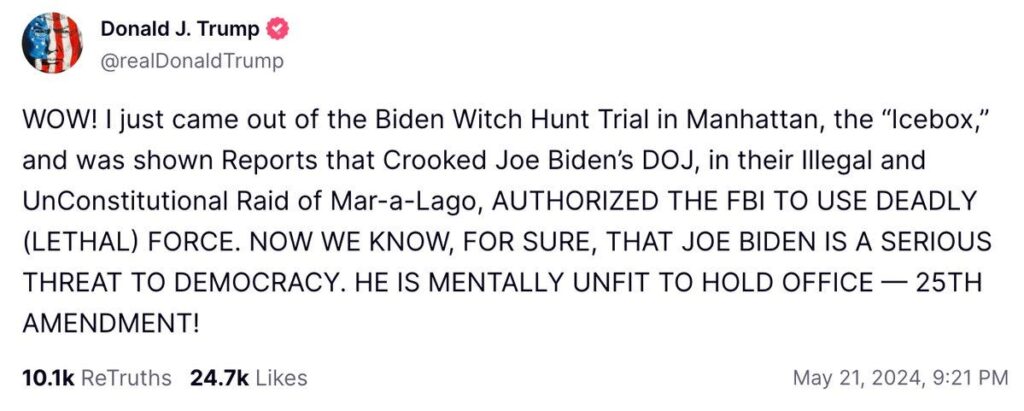
When President Trump reacted publicly to reporting by Julie Kelly that deadly force had been authorized, Special Counsel Jack Smith responded not with transparency but with a motion to gag the former president. Smith claimed Trump’s statements posed a foreseeable danger to law enforcement. Yet Smith’s filing omitted key facts. It did not disclose that agents were instructed to bring standard issue weapons, ammunition, handcuffs, bolt cutters, locking picking tools, and to conceal their badges. Omissions of this sort do not inspire confidence. They suggest an effort to minimize public understanding of how aggressively the raid was planned.
The broader constitutional stakes are obvious. The FBI and DOJ are not ordinary executive agencies when they act against a former president. They are custodians of norms that, once broken, cannot easily be restored. The first raid on a former president’s home sets a precedent. That precedent will not remain confined to Donald Trump. It will be cited, replicated, and expanded. Institutional restraint exists precisely to prevent such cascades.
There is also a moral dimension that cannot be ignored. The state holds a monopoly on lawful violence. With that monopoly comes a duty of extreme care, especially when exercising it against political figures. Authorizing deadly force in an operation that could have been conducted cooperatively, and that internal officials believed lacked probable cause, represents a failure of that duty.
One might ask what should have been done instead. The answer is simple. Subpoenas. Negotiation. Civil enforcement. Direct coordination with the Secret Service. Any of these would have resolved the document dispute without introducing lethal risk. Choosing the most aggressive option was not necessity. It was choice.
In the end, the steelman argument does not require assuming malice. It requires only accepting what the evidence increasingly shows. DOJ leadership overrode internal legal warnings, escalated a routine records dispute into an armed raid, authorized deadly force in a uniquely volatile environment, and then attempted to control the narrative when those facts began to surface. That sequence is sufficient to condemn the decision.
This was not standard procedure. It was an unprecedented convergence of legal recklessness and operational danger. No republic that takes constitutional limits seriously should accept it.
If you enjoy my work, please subscribe: https://x.com/amuse.
Sponsored by the John Milton Freedom Foundation, a nonprofit dedicated to helping independent journalists overcome formidable challenges in today’s media landscape and bring crucial stories to you.
READ NEXT: Commercial Aviation Catastrophe Narrowly Avoided Over Paradise: Report











The deep state lives at the FBI.
Who gave the orders??
Smith
Garland
DHS then