




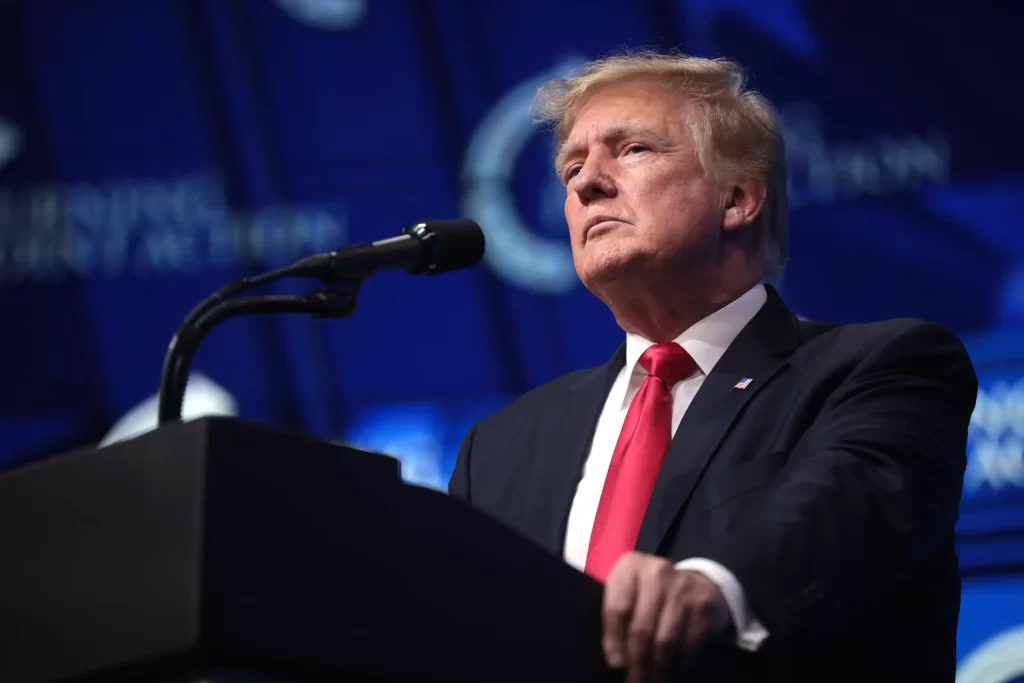
On New Year’s Eve, President Donald Trump used his Truth Social platform to launch a scathing attack on Colorado Governor Jared Polis (D) and a Republican district attorney over the imprisonment of former election official Tina Peters, saying they should “rot in Hell.”
Trump’s language — including calling Polis a “scumbag governor” and referring to the GOP prosecutor as a “disgusting ‘Republican’ (RINO!)” — was part of a broader post.
Trump framed the post around the case of Peters, a former Mesa County clerk who is serving nine years in a Colorado women’s prison after being convicted of multiple felonies for allowing unauthorized access to election equipment as part of an effort tied to fraud claims. He argued that Peters was a “patriot” unfairly punished by state authorities.
“God Bless Tina Peters, who is now, for two years out of nine, sitting in a Colorado Maximum Security Prison, at the age of 73, and sick, for the ‘crime’ of trying to stop the massive voter fraud that goes on in her State ( where people are leaving in record numbers!),” Trump unleashed in a post on Truth Social. “Hard to wish her a Happy New Year, but to the Scumbag Governor, and the disgusting ‘Republican’ (RINO!) DA, who did this to her (nothing happens to the Dems and their phony Mail In Ballot System that makes it impossible for a Republican to win an otherwise very winnable State!), I wish them only the worst. May they rot in Hell. FREE TINA PETTERS!”
Peters oversaw elections in Mesa County until she was suspended and later removed from office amid controversy.
In 2021, while election software was being updated at the Mesa County Clerk’s office, Peters turned off surveillance cameras and allowed an individual to access the secure room housing the county’s election machines and related systems. She permitted that person to copy sensitive election system data — including passwords — without authorization or oversight.
Under state law, election systems and their data are protected to preserve the integrity and security of voting. Disabling security and granting outsiders access is considered a serious breach.
Court evidence showed that Peters helped orchestrate a plan in which an individual posed as someone else to gain access to election systems and then misled state authorities about the breach.
A Colorado grand jury indicted Peters on multiple counts. At trial in 2024, she was found guilty of seven of the 10 charges, including attempting to influence a public servant, conspiracy to commit criminal impersonation, official misconduct, violation of duty, and failure to comply with secretary of state regulations.
In October 2024, a Mesa County judge sentenced Peters to nine years in prison. The judge criticized her conduct and called her actions dangerous to the electoral system.
Peters and some supporters insisted she was trying to expose election fraud. However, the courts found no credible evidence of fraud to justify her actions. Her lawyers have argued constitutional or pardon issues — including seeking to have a presidential pardon recognized — but a U.S. president can only pardon federal crimes, not state convictions.
Several contentious federal actions affecting Colorado have emerged recently, and critics have linked them politically to the broader feud between the Trump administration and the state over the Peters case.
In the past month, the Trump administration denied two disaster declaration requests from Colorado that would have unlocked federal funding for recovery from significant wildfires and flooding earlier in 2025. These included major damage from the Elk and Lee fires and subsequent flooding in southwestern Colorado, prompting a rebuke from the region’s Republican representative in Congress. The denials were issued late on a Saturday before Christmas.
President Donald Trump late Saturday denied Colorado’s request for disaster relief funding following the Elk and Lee fires and Western Slope flooding this summer https://t.co/2gcL7IofU5 pic.twitter.com/jwooLDxxuX
— Denver7 News (@DenverChannel) December 21, 2025
The Lee Fire outside Meeker, Colorado has grown to 123,222 acres and due to continued growth, containment is down to 4%. The reduction in containment is because of an expanding perimeter and not existing containment lines being lost.
— The Hotshot Wake Up (@HotshotWake) August 14, 2025
Critical Fire weather has returned to the… https://t.co/elXLCX2T0B pic.twitter.com/nXTh8cddTr
Normally, major disaster declarations by the president enable FEMA (Federal Emergency Management Agency) to provide financial and logistical assistance when local and state resources are overwhelmed.
“The State does not have the capacity to continue to provide assistance to local communities to support the recovery efforts without federal assistance,” a release from two of the state’s elected representatives said.
The White House stated that the decisions were made in accordance with the Stafford Act criteria and were not about politics. It added that federal assistance must supplement state and local capabilities and that there was “no politicization” of the decisions. Despite that explanation, many elected officials in Colorado — including members of both parties — have interpreted the decisions that way.
At roughly the same time, the administration, through White House Office of Management and Budget Director Russell Vought, announced plans to break up or dismantle the National Center for Atmospheric Research (NCAR) in Boulder, calling it “one of the largest sources of climate alarmism in the country.”
The Trump administration is in the process of dismantling the National Center for Atmospheric Research (NCAR) in Boulder, Colorado. The move has generated enormous alarm in the scientific community, particularly among climate scientists and meteorologists.
— PBS News (@NewsHour) December 20, 2025
NCAR is one of the… pic.twitter.com/xBnI1l5SJ6
🎉 We signed up for another 5 yrs of working w/ @DENAirport to keep travelers safe when winter wx threatens their plans. ❄️ ✈️
— NSF National Center for Atmospheric Research (@NCAR_Science) December 24, 2025
We developed advanced 💻 models and AI techniques to forecast snow and ice at specific points on runways.https://t.co/N4JF9Zy64T
📸 Courtesy DIA pic.twitter.com/UQ3V6z94s7
Some officials, including Rep. Joe Neguse (D-Colo.), have explicitly described the action as retaliation or politically motivated.
On Tuesday, President Trump used the first veto of his second term to block the Finish the Arkansas Valley Conduit Act, a long-running infrastructure project intended to deliver clean, reliable drinking water to rural southeastern Colorado. Specific county results within this area often showed Trump receiving between 70% and 86% of the vote.
The bill passed both the House and the Senate unanimously, making it highly unusual for it to be vetoed.
Rep. Lauren Boebert (R-Colo.), the bill’s sponsor, sharply criticized the veto in a statement to 9News, saying:
“President Trump decided to veto a completely non-controversial, bipartisan bill that passed both the House and Senate unanimously. If this administration wants to make its legacy blocking projects that deliver water to rural Americans; that’s on them.”
She added that she hoped “this veto has nothing to do with political retaliation for calling out corruption and demanding accountability.”
Boebert later posted “this isn’t over” on X, signaling her intent to push for Congress to override Trump’s veto.
The White House said the veto was based on cost concerns, arguing that the federal government should not bear the cost of the “expensive and unreliable” project and that similar infrastructure should be handled at the state or local level. Administration officials explicitly denied political motivation and again claimed there was “no politicization” involved.
This isn’t over. https://t.co/SxRacLX8fp
— Lauren Boebert (@laurenboebert) December 31, 2025
The estimated total cost of the Arkansas Valley Conduit project is about $1.3 billion. By contrast, the U.S. national debt recently surpassed $38 trillion, reaching the milestone in October 2025 as gross federal borrowing continued its upward trajectory. That increase included the fastest $1-trillion accumulation outside the COVID-19 era, with debt rising from about $37 trillion in August 2025 to more than $38 trillion by October.
READ NEXT: Custodian Twice Alerted Security About Brown University Murderer Casing Building
Sponsored





















“…described the action as retaliation or politically motivated.”
Stoopit demorrhoids can’t stand “tit for tat?”
If you listened only to dishonest MSM news (Trump’s correct to label them “fake news”) you wouldn’t know key facts exposing lies about Tina Peters, now a famous Colorado political prisoner who was fighting election fraud/rigging. Her lawyer provided critical details on Steve Bannon’s show, arguing that federal law required preservation of election records, which Peters attempted to do; destruction of digital records formed the crux of her defense but the judge said knowing about federal law would “confuse” jurors!! Prominent Senators wrote a letter to the Executive Branch to express concerns about vulnerability of Dominion voting machines as recently as 2019; Kamala once hosted a “hack-a-thon” to show her Senate colleagues how vulnerable electronic voting machines are to hackers- but the judge evidently wanted juror kept in the dark- he manipulated Peters’ trial:
“Experts… say that it shows fourteen vulnerabilities in the voting system and it shows that there was likely manipulation in the 2020 election by some outside bad actor… Dominion software used throughout the United States and throughout Colorado is a variation of the Smartmatic software that was used to rig elections in Venezuela.” – John Case (13:05)
Peters’ defense was barred from presenting evidence about her intent and the federal obligation, with the judge ruling it “irrelevant.”
“He said it would confuse the jury if they knew that the machines potentially could be rigged…” – John Case (22:18)