





The events of June 2016 reveal something that many Americans have forgotten, or perhaps never fully understood. Long before January 6 became a national flashpoint, Democratic lawmakers carried out a coordinated effort to seize control of the U.S. House of Representatives and obstruct its official proceedings. They did not merely hold signs or deliver speeches. They occupied the House floor, blocked voting machines, shut down legislative business for more than 25 hours, and enlisted hundreds of allies both inside and outside the Capitol to maintain their control of the chamber. They did this despite explicit warnings that their planned actions would violate federal law, including 18 U.S.C. 1512(c)(2), which criminalizes obstruction of an official proceeding and carries penalties of up to eight years in prison. Their conduct was televised, encouraged by party leaders, amplified by the outgoing administration, and celebrated by allied activists. Yet none were arrested, charged, or even seriously investigated.
Understanding why begins with clarity about what happened. A reader might assume that such a dramatic event must have been spontaneous. It was not. Federal investigators later determined that the plot to seize the House floor was first discussed on June 19, 2016, during a meeting between Democratic Leader Nancy Pelosi and Rep. Steve Israel. From the start, the plan was strategic. Two days later, Rep. Katherine Clark convened a secret meeting after dark in Rep. John Larson’s office with a dozen other Democratic members. Their purpose was simple. They wanted to stop the House from conducting business until the Republican majority yielded to their demands. They were told the plan would likely violate federal law. Yet they pressed ahead.
Pelosi encouraged the scheme but insisted they recruit a person of color to be the public face of their occupation. They chose Rep. John Lewis, whose status as a former civil rights icon they believed would shield the plot from criticism. A final planning meeting was held in Lewis’s office late on June 21. By the following morning, Pelosi had summoned the full Democratic caucus, including Democratic presidential nominee Hillary Clinton, to brief them on the impending takeover. Some members were hesitant, so Pelosi framed the action as righteous disruption. She told them moments of silence had become moments of denial and that only dramatic action would force change. She insisted the plot was bigger than politics or elections.
While Pelosi was rallying her members, Larson sought guidance from House Parliamentarian Thomas Wickham. Wickham told him plainly that such a takeover would violate federal law. If the plot succeeded, the participating members could face up to eight years in prison. This clarification did little to deter the organizers. They moved ahead, confident that the political environment would protect them from consequences.
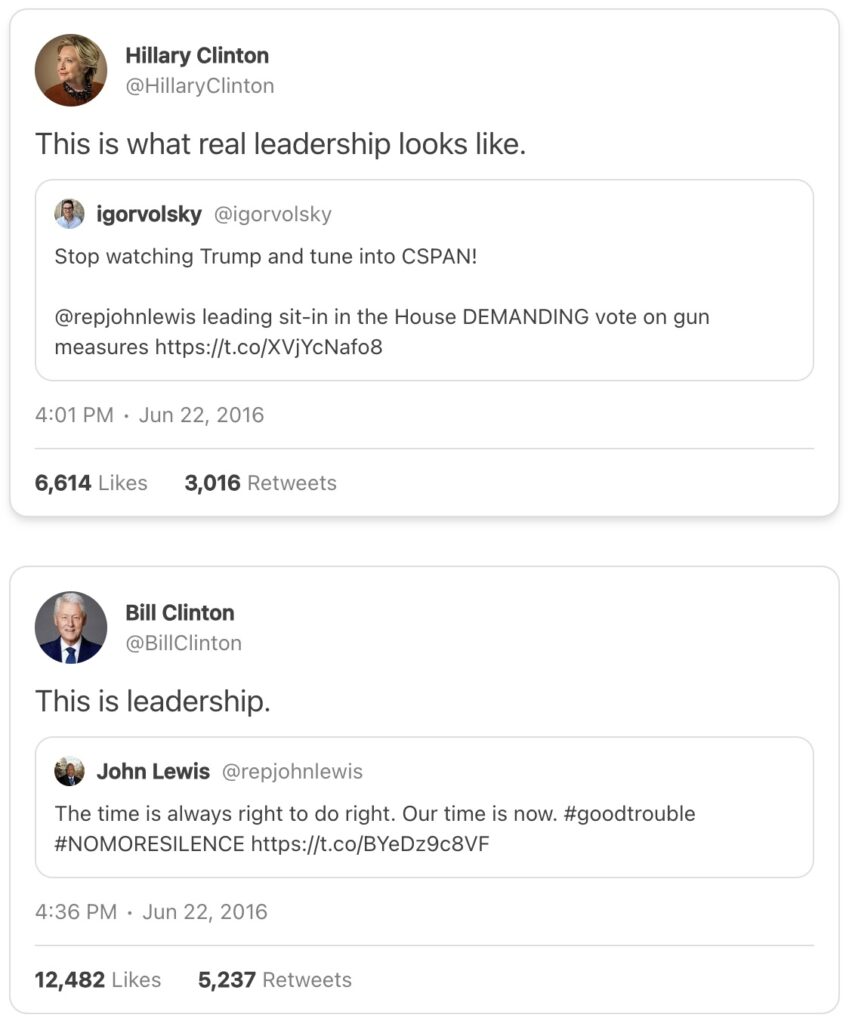
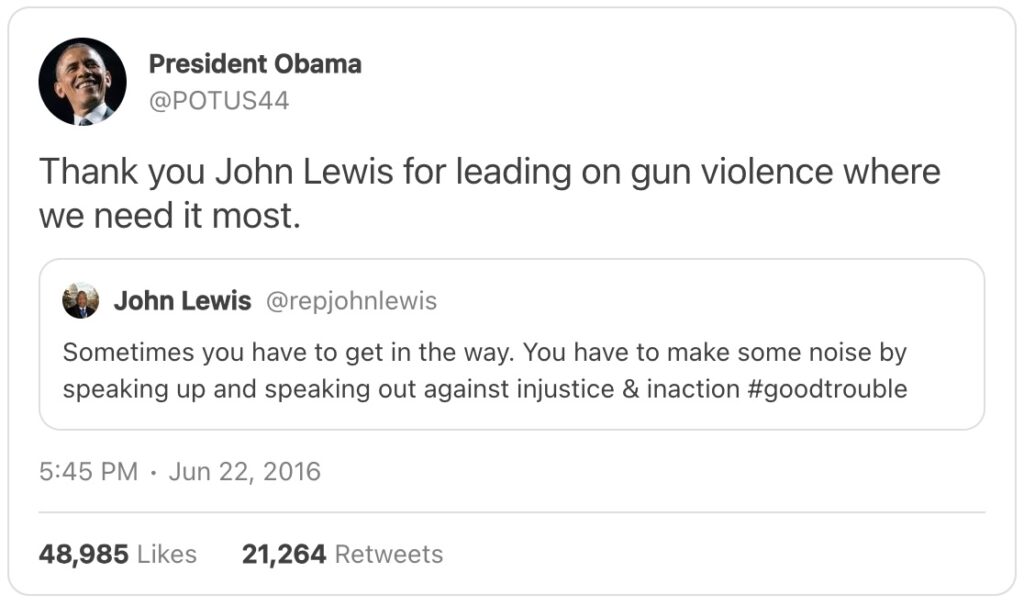
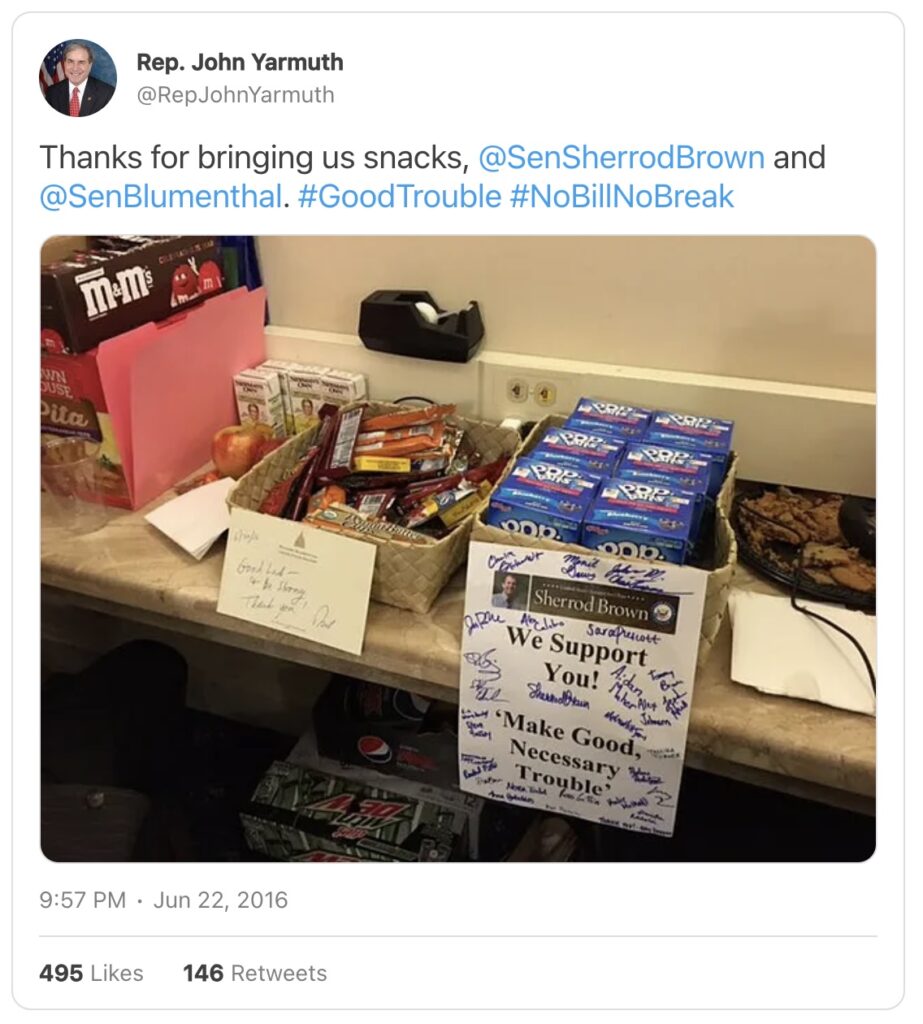
When the occupation began, only 60 House Democrats joined Lewis and Clark on the floor. The threat of imprisonment dissuaded many from joining. Yet the organizers did not relent. Hillary and Bill Clinton tweeted their support. Pelosi and Lewis contacted President Obama, who publicly encouraged the effort. The coordinated messaging emboldened more participants. Soon, the occupation grew beyond the chamber. The Sergeant at Arms expressed concern because the Capitol Police were understaffed. Demonstrators began filling public galleries. Democratic senators ordered staff to deliver food, pillows, and sleeping bags to sustain the occupiers through the night.
A puzzled reader might ask how such an occupation could succeed. The answer lies in the moment Speaker Pro Tempore Dan Webster recognized what was unfolding. He ordered the House into recess before Democrats could seize formal control of proceedings. When the House is in recess, cameras go dark under House rules. C-SPAN cut its feed as required. Yet Democrats responded by using personal devices to livestream the occupation to millions on 𝕏. Their illegal broadcast was carried on C-SPAN, RT, and across platforms. This livestreaming violated House rules and undermined the chamber’s security protocols, yet Capitol Police took no action.
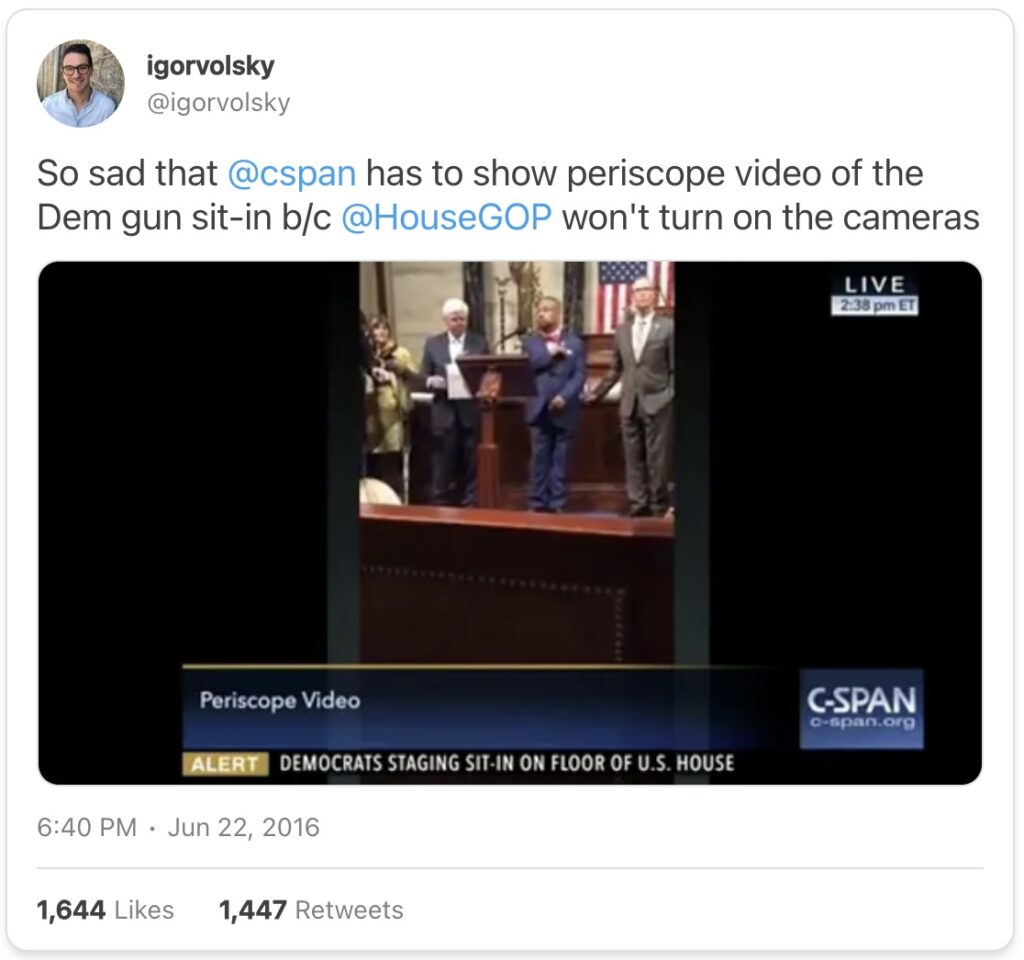
By noon, Speaker Pro Tempore Ted Poe attempted to reconvene the House. The chaplain delivered a prayer. Members recited the Pledge of Allegiance. When Poe attempted to bring the chamber to order, Lewis and his colleagues shouted over him until he was forced to leave the floor. The disruption was total. No legislative business could proceed.
Throughout the day, pressure mounted. Protesters gathered on the Capitol steps, in restricted areas around the Capitol grounds, and even in the lawmaker parking lot. Members of the occupation left the House floor periodically to rile up the crowd. The demonstration had become a coordinated external and internal siege on the legislative branch. By evening, their ranks had swelled to nearly 200.
The House attempted to resume work. Speaker Paul Ryan tried to reconvene the chamber for essential votes, including an override of an Obama veto. Democrats shouted him down. Some physically blocked Republican members from reaching the voting machines. The vote proceeded only through paper cards. The pattern was always the same. Republicans attempted to restore order. Democrats disrupted them. Procedural tools were exhausted. The occupation continued.
Around 2:30 a.m., after hours of obstruction, Ryan reconvened the House to attempt votes on funding for Veterans Affairs, military construction, and Zika virus containment. It became clear the Democrats had no intention of letting the House function. Ryan adjourned the chamber until July 5, hoping the occupiers would leave peacefully. Even after adjournment, Democrats remained. They found a podium, dragged it to the front of the chamber, and continued delivering speeches to an international audience via illegal livestreams. Only when Whip Steny Hoyer ordered Democrats back to the floor did the crowd begin thinning. Rep. Maxine Waters vowed they would remain until July 5, but Lewis ultimately persuaded them to end their occupation the next afternoon.
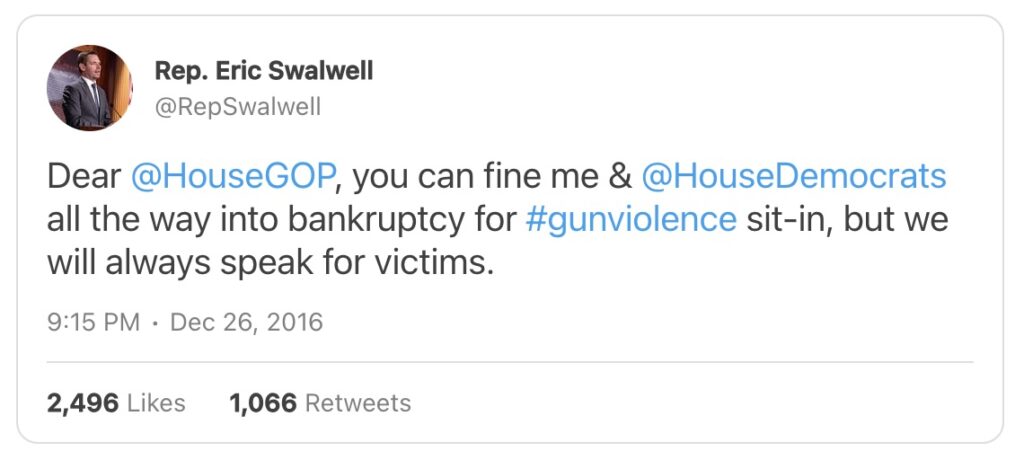
In total, more than 500 Democrats participated either on the floor, in the galleries, or in the coordinated demonstrations surrounding the Capitol. They obstructed the official proceedings of Congress for more than 25 hours. They violated multiple federal laws, including 18 U.S.C. 1512(c)(2), which has since been used aggressively against January 6th protesters. Yet no arrests were made. FBI Director James Comey did not investigate. Attorney General Loretta Lynch took no action. Speaker Ryan declined to impose serious penalties. Instead, he passed a rule fining members $500 for broadcasting from the House floor in the future. Rep. Eric Swalwell complained about the fine online even though he personally was not penalized, a fact that underscores how unserious the consequences were.
A reader might wonder whether describing this event as an insurrection is too strong. But the analogy is precise. The purpose of an insurrection is to seize control of a governing institution or to prevent it from functioning. That is exactly what the Democrats did. They obstructed official proceedings. They used physical control of the chamber to block votes. They coordinated with protesters outside to maintain pressure. They leveraged media, political allies, and livestream technology to maintain their occupation. They were warned their actions were unlawful. They did it anyway.
Some have attempted to frame the occupation as a sit-in. This is misleading. A sit-in is a tactic of the powerless, a tool for those excluded from the political process. It is the method of those shut out of institutions, not those who already run them. When black college students sat at a whites-only lunch counter in Greensboro, they did so precisely because they had no political access. Members of Congress are not similarly powerless. They are among the most powerful individuals on earth. For them to mimic a sit-in in order to halt legislative proceedings is not civil disobedience. It is legislative dereliction.
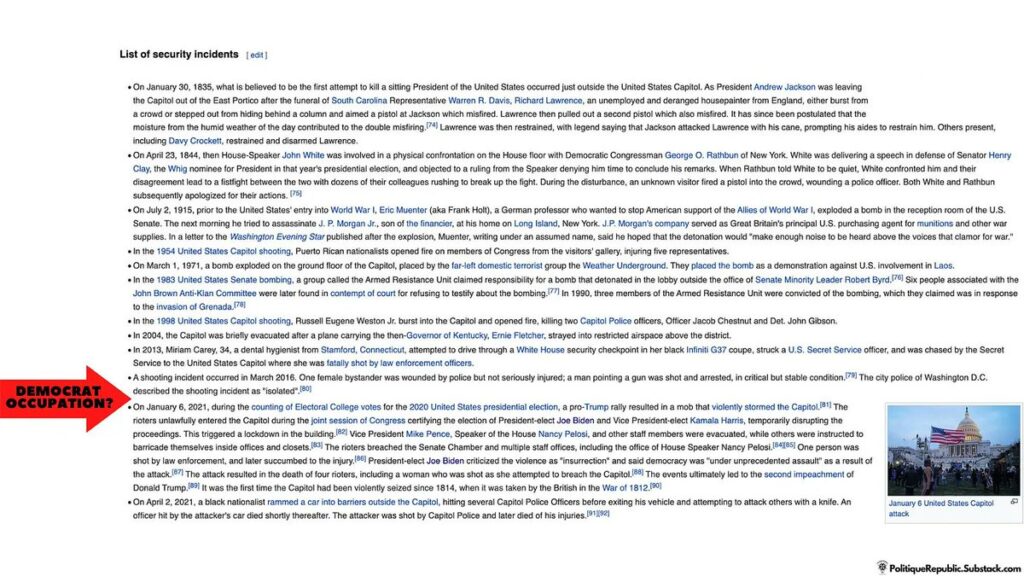
The public memory of the 2016 occupation has faded because powerful institutions have incentives to bury it. Wikipedia editors refuse to list the event among security incidents in the House. Media outlets frame it as noble activism rather than an organized effort to obstruct Congress. This selective framing becomes even more striking when compared with how the January 6 protest has been treated. A puzzled reader might ask why two events, both involving interruptions of congressional proceedings, were met with such wildly different legal consequences. The answer reveals an uncomfortable asymmetry in the enforcement of federal law.
The January 6 protest delayed the joint session for roughly four hours. While individuals who committed violence were rightly charged with crimes involving force, the overwhelming majority of defendants were prosecuted not for violence but for the very same offense the 2016 Democrats were warned about. Many were charged under 18 U.S.C. 1512(c)(2) for obstructing or attempting to obstruct an official proceeding, the identical statute Larson asked the parliamentarian about. Some were charged solely for entering the building without authorization, standing in a hallway, or remaining in a roped-off area while taking cell phone videos. Others were charged for briefly chanting inside the Capitol or for walking in spaces where police were already present and not resisting. In numerous cases, federal charging documents make clear the conduct lasted only minutes and did not involve physical confrontation. Yet these non-violent defendants faced years-long prosecutions.
By contrast, the 2016 Democratic occupation halted the House for more than 25 hours. Democrats physically blocked members from reaching voting machines. They surrounded the presiding officer and drowned out attempts to restore order. They coordinated with protesters in restricted areas outside the chamber to maintain pressure. They illegally livestreamed proceedings after cameras were turned off. Their obstruction was not a matter of minutes but an entire legislative day and night. They were warned beforehand that their plan would violate federal law. They proceeded anyway. If the January 6 protesters who caused a four-hour delay were charged with felonies, then on neutral legal grounds, the 2016 occupiers should have faced the same outcome and arguably a stronger one.
Another example sharpens the comparison. Some January 6 defendants were prosecuted for chanting in the Rotunda or for entering areas where velvet ropes had been shifted aside. These actions were treated as evidence of obstructing a proceeding, even when the individuals were unaware that Congress had recessed. In 2016, by contrast, Democratic lawmakers intentionally recessed the House, then took advantage of the blackout to seize the floor, broadcast from it, and physically block the institution from functioning. If ignorance combined with momentary presence in the Capitol can sustain a felony, then deliberate planning combined with 25 hours of obstruction would appear to be an even clearer case. Yet only one group was prosecuted.
Still another comparison is instructive. Federal prosecutors emphasized that January 6 defendants created a risk that lawmakers could not move safely through the building. But in 2016, the Sergeant at Arms warned there were not enough Capitol Police on duty while the galleries filled with demonstrators. Democratic senators sent staff to deliver supplies to the occupiers, ensuring the event would continue through the night. Members left the chamber to energize crowds on the steps. The House floor was encircled by protesters. The security implications were obvious. Yet no investigation was opened.
These contrasts underscore a simple point. If obstruction of Congress is inherently criminal, then the 2016 occupation was criminal. If seizing control of the House floor is an attack on democracy, then the 2016 occupation was an attack on democracy. If intent matters, the Democratic organizers intended to halt proceedings until their demands were met, which is far more deliberate than many of the January 6 cases, where defendants wandered into the building behind crowds without a plan at all. The contrast is not a matter of political rhetoric but of factual parity. Two sets of actions produced interruptions of congressional proceedings. One lasted four hours, the other more than 25. One involved mostly non-violent individuals acting without coordination, the other involved members of Congress acting after explicit legal warnings. Yet only one group faced aggressive federal prosecution.
The strength of this argument is not partisan. It follows from the principle that laws apply equally regardless of political affiliation. The 2016 occupation demonstrates that elite networks can protect their own when they break rules that others would be punished for. It also shows how easily coordinated pressure from politicians, activists, and media can reshape public memory of an event. A republic depends on even application of law and on institutions that function without intimidation. When lawmakers themselves deploy intimidation, occupation, and obstruction as tools, they compromise the very norms they later demand others follow. The lesson of June 2016 is that selective enforcement erodes public trust. If the law is applied to some but not to others, it ceases to be law and becomes a political weapon.
If you enjoy my work, please subscribe: https://x.com/amuse.
Sponsored by the John Milton Freedom Foundation, a nonprofit dedicated to helping independent journalists overcome formidable challenges in today’s media landscape and bring crucial stories to you.
READ NEXT: AOC Touts $14 Million For District Projects In Bill She Opposed, Promotes Anti-ICE Activism




















The most despicable power and money hungry humans are Democrats.Look and listen to some of their gross members in DC
“All animals are equal, but some animals are more equal than others” from George Orwell’s “Animal Farm”