

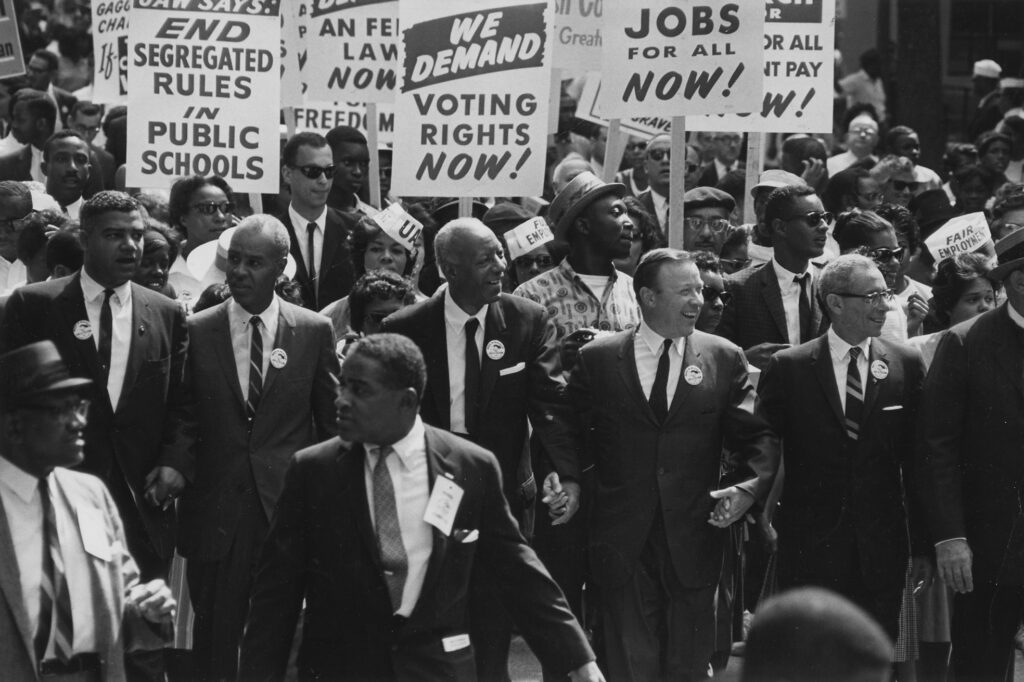
Rev. Jesse L. Jackson, one of the most recognizable figures of the modern civil rights movement, died Tuesday morning at his home in Chicago. He was 84. Family members said he passed away surrounded by loved ones.
For more than five decades, Jackson pressed for racial equality, economic opportunity, and voting rights. A protégé of Dr. Martin Luther King Jr., he carried the movement from the Southern church-based protests of the 1960s into the era of national politics, corporate pressure campaigns, and presidential primaries. He was admired, criticized, and rarely ignored.
From Jim Crow South to King’s Inner Circle
Jesse Louis Jackson was born Oct. 8, 1941, in Greenville, South Carolina, and grew up under Jim Crow segregation. Raised primarily by his mother, Helen Burns, he came of age in a racially divided society that shaped his early sense of injustice.
His early life was complicated. Born out of wedlock in a time and place where that carried stigma, Jackson later reconnected with his biological father. Those experiences, friends and critics alike said, fueled an intense drive for achievement and public recognition.
A strong student and gifted athlete, Jackson earned a football scholarship to the University of Illinois before transferring to North Carolina A&T State University in Greensboro. There, in the heat of the sit-in movement, he threw himself into civil rights activism. He organized protests and rallies and quickly became known for his rhythmic, preacher’s cadence and ability to command a crowd.
By the mid-1960s, he joined the Southern Christian Leadership Conference, led by King. He moved to Chicago and worked on the Chicago Freedom Movement, which targeted housing discrimination and economic inequality in Northern cities.
Operation Breadbasket and Rising Tensions
Jackson’s breakout role came through Operation Breadbasket, an SCLC initiative focused on economic justice. The program pushed companies that operated in Black neighborhoods to hire Black workers and do business with minority-owned firms. Jackson organized boycotts, negotiated hiring agreements, and drew national media coverage.
Supporters saw real results. Companies agreed to change hiring practices. Minority contractors got a foot in the door. Jackson proved he could translate protest into economic leverage.
But his rising profile also created friction within the SCLC. Some senior leaders viewed him as ambitious and overly focused on publicity. His assertive style clashed at times with the organization’s clergy-based hierarchy.
The tensions deepened after King’s assassination on April 4, 1968. Jackson was in Memphis when King was killed. In the days that followed, he appeared on national television wearing clothing stained with King’s blood, a moment that drew sympathy from some and criticism from others. Disputes over leadership and differing accounts of King’s final hours widened divisions. Jackson eventually broke from the SCLC.
Building PUSH and the Rainbow Coalition
In 1971, Jackson founded Operation PUSH, short for People United to Save Humanity, in Chicago. The group focused on economic empowerment, education, and voter registration. It gave Jackson an independent base and expanded his national platform. Later, he formed the Rainbow/PUSH Coalition, reflecting his goal of building alliances across racial and economic lines.
That vision reached its peak during his presidential campaigns in 1984 and 1988. Running as a Democrat, Jackson built what he called the “Rainbow Coalition,” bringing together Black voters, labor activists, Latinos, family farmers, and progressive whites.
In 1988, he won several state primaries and secured millions of votes, making him one of the most successful Black presidential candidates up to that point. While he did not win the nomination, he forced the Democratic Party to grapple more directly with issues of economic inequality and minority political representation.
Jesse Jackson passed at 84, during Black History Month of all times. I remember sitting in class learning about his role in the civil rights movement & the impact he had. Crazy how the people u study in school really helped shaped the world we’re living in now. Rest in Power 🕊️ pic.twitter.com/2WTQGPYe69
— Branden (@A3Branden) February 17, 2026
Controversies and Criticism
Jackson’s public life was never free of controversy.
During his 1984 campaign, remarks he made referring to New York City in derogatory terms about Jewish residents sparked widespread condemnation. He issued a public apology, but the episode strained relationships with parts of the Jewish community and remained a lasting blemish on his record.
In the late 1990s and early 2000s, Jackson acknowledged that he had fathered a child outside his marriage with a former staff member connected to an organization he founded. He apologized publicly and called it a moral failing. The revelation prompted renewed scrutiny of his leadership and judgment.
More broadly, critics often accused him of rhetorical excess or self-promotion. Admirers countered that he was willing to confront corporate executives and political leaders when others would not.
A Transitional Figure
In historical perspective, Jackson stood at a crossroads in American public life. He emerged from the moral authority of the Southern civil rights movement but adapted to a new era shaped by television, national campaigns, and economic activism.
He was at ease both in church pulpits and on national stages. He negotiated with CEOs and marched with protesters. He could lead a boycott one week and compete in a presidential primary the next.
In later years, Jackson battled progressive supranuclear palsy, a rare neurodegenerative disorder related to Parkinson’s disease. The illness gradually limited his mobility and public appearances.
Family members and fellow activists remembered him as a “servant leader” committed to lifting up the marginalized and expanding political participation. Even critics acknowledged his staying power.
With Jackson’s death, the country loses one of the last major figures whose career bridged the era of King and the modern age of American politics. His life traced both the progress and the unresolved tensions of the civil rights struggle he spent decades trying to shape.
READ NEXT: Watch: Is The Epstein File Release Really Complete?

















JJ once visited a school in New Jersey and my cousin’s wife watched him try to hit on a black woman teacher. He was worthless. PERIOD
Read years ago about=his rainbow coalition and how he blackmailed business to contribute or receive no support from the coalition. Met a black police officer years ago who told a story how Jackson showed up in Alabama, the people asked him to do a speech in support of some issues they were having, he said it would cost $33,000 dollars, they said we do have that, he got in his limo and said goodbye! I be
I eve he had a child out of wedlock, but none of this will make any difference any more than the issues with King plagerizring or chasing numerous women!