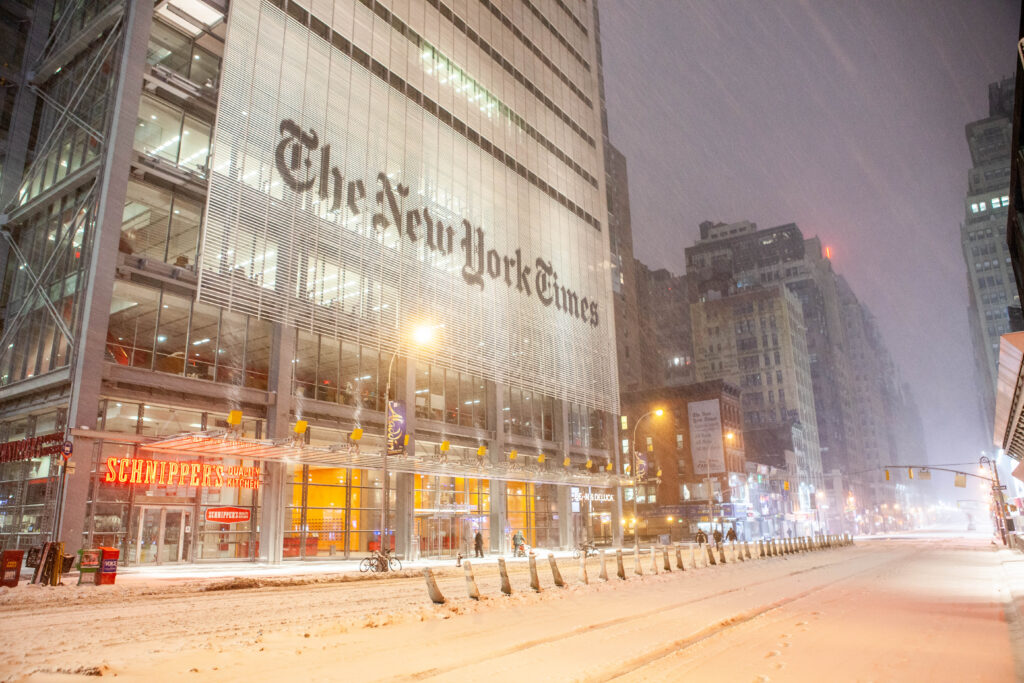
The New York Times’ sports vertical, The Athletic, drew attention this week for publishing one piece celebrating Olympic freestyle skier Eileen Gu and another criticizing the United States men’s national ice hockey team following its post-gold medal interaction with Donald Trump.
In an article headlined “Inside the mind of Eileen Gu, Winter Olympics superstar — and so much more,” The Athletic highlighted Gu’s dominance on the slopes and her commercial success. The American-born skier, who competed for China, has won three gold and three silver medals across two Winter Olympics, making her one of the most decorated freestyle skiers in the sport.
“With three silvers and three golds to her name across two Olympics, Gu is a freak of nature, extraordinary in every sense of the word. So what is next for a young woman who seems to have it all?” the piece asked.
Gu reflected on the introspective nature of her sport. “I guess it’s more like, I don’t know, it’s very honest,” she said, according to The Athletic. “It makes you look in the mirror and see who you are. You can’t lie to yourself. The work you’ve done or haven’t.”
The article also referenced reporting from The Wall Street Journal that Gu and another Olympic athlete are set to receive a combined $6.6 million in 2025 from the Beijing Municipal Sports Bureau, citing a public budget released earlier this year. According to the Journal, the two athletes are slated to receive roughly $14 million combined over a three-year period.
While noting that some critics have questioned Gu’s decision to represent China and raised concerns about the financial arrangements, The Athletic largely focused on her athletic achievements and mental resilience, including her recovery from a fall during her first halfpipe run at the 2026 Winter Games.
In contrast, a separate column by The Athletic’s Jerry Brewer zeroed in on the American men’s hockey team after it won Olympic gold and subsequently spoke with Trump and agreed to visit him.
Brewer wrote that while presidential congratulations have traditionally been part of championship celebrations, the political climate surrounding Trump’s presidency “changes the context.”
“But this isn’t a neutral climate. This isn’t a neutral president,” Brewer wrote. “And in a nation this polarized, the proximity carries weight whether the players are being intentional or merely naive.”
He argued that by engaging with the president so soon after their victory, the players “narrowed their moment” and risked allowing their achievement to be viewed through a partisan lens.
“The hockey team neither created this divide nor possessed a shrewd political instinct to wrap their victory in a partisan glow,” Brewer wrote. “But when they stepped so early into that embrace, they narrowed their moment.”
Brewer emphasized that the team’s gold medal victory over Canada remains intact but suggested that athletes must be more mindful of the political implications of their public appearances.
“These champions have agency,” he wrote. “In the afterglow of triumph, they have more agency than they ever will. They should be wary of giving it away so casually.”
The two pieces have fueled criticism from those who argue they reflect a broader disconnect between mainstream media institutions and much of the American public. Detractors contend that praising an American-born athlete who chose to compete for China — widely viewed as the United States’ chief geopolitical rival — while admonishing American champions for the customary act of accepting a congratulatory call from the president and visiting the White House illustrates a press corps increasingly blinded by partisanship and out of touch with the American people.
READ NEXT: American Olympic Athletes Continue Political Statements