

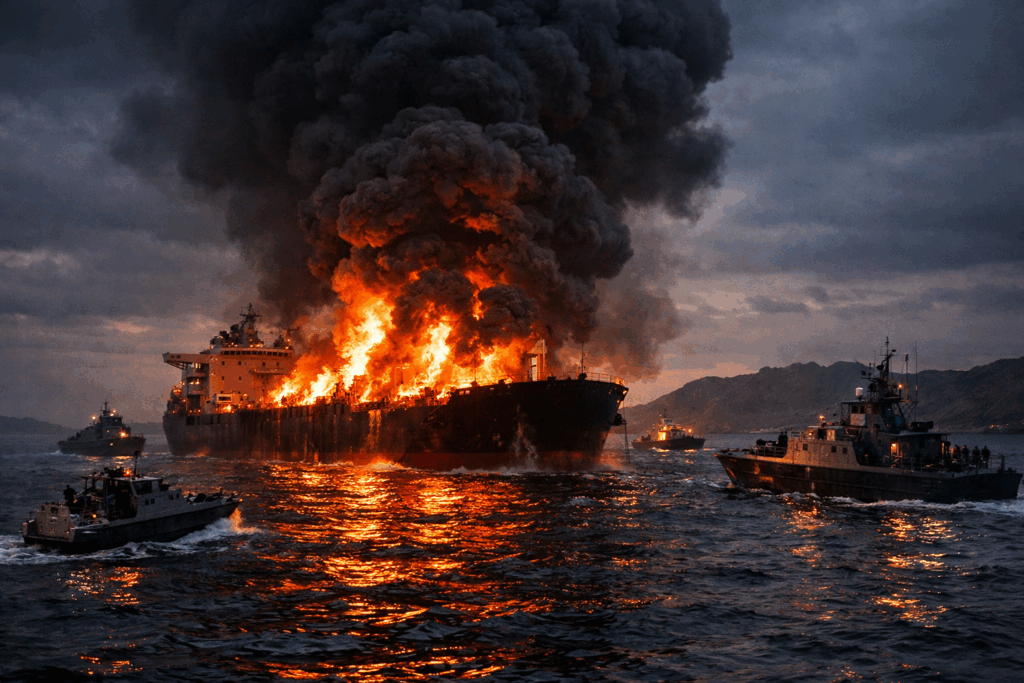
PERSIAN GULF — Vessels operating in and around the Strait of Hormuz have reported receiving radio transmissions from Iran’s Islamic Revolutionary Guard Corps (IRGC) stating that no ship is allowed to pass through the strategic waterway, according to officials with the European Union’s naval mission Aspides and multiple maritime agencies.
The narrow maritime chokepoint connecting the Persian Gulf to the Gulf of Oman and the Arabian Sea is critical to global energy markets, with roughly 20% of the world’s crude oil and liquefied natural gas shipments transiting the route under normal conditions.
An EU naval mission official said vessels have been receiving VHF radio warnings from IRGC forces stating that the waterway was closed and passage was not permitted, coinciding with a drone strike on a fuel tanker in the strait. The IRGC said the vessel was hit and caught fire. The strike — confirmed by multiple sources — underscores the rapidly changing maritime conditions.
Though President Donald Trump announced that the Iranian Navy suffered devastating losses over the weekend, only a sufficient number of mines and missiles are needed to close the 21-mile-wide waterway. (RELATED: Major Naval Escalation As US Targets Iranian Fleet)
The Commander of Iran’s Islamic Revolutionary Guard Corps (IRGC) has stated that the Strait of Hormuz is now closed and Iran will set fire to any ship trying to pass into or out of the Persian Gulf, according to the Iranian state-run Tasnim News Agency. pic.twitter.com/88fMxURIoj
— OSINTdefender (@sentdefender) March 2, 2026
The broader crisis has already led many commercial ships to delay sailings, reroute around Africa, or suspend transit through the strait as insurers withdraw war risk coverage for Gulf routes. Global energy markets have reacted sharply: oil futures spiked — at times by double-digit percentages — on fears that disruption of Hormuz traffic could tighten already strained crude and gas supplies, with some analysts warning that Brent crude could exceed $100 per barrel if the strait remains impassable. (RELATED: World’s Busiest Airport Damaged By Iranian Strikes: Report)
IRGC Brig. Gen. Ebrahim Jabbari: “We will not allow a single drop of oil to leave the region.”
— OSINTdefender (@sentdefender) March 2, 2026
This is a breaking news story. Please check back for updates.
READ NEXT: Constitutionally Questionable Ban Collapses In Jaw-Dropping Final Hours



















Iran Warns Passage Through Strait Of Hormuz ‘Not Allowed’ As Fuel Tanker Ablaze
Picture of Patrick Houck Patrick Houck
March 2, 2026
“The narrow maritime chokepoint connecting the Persian Gulf to the Gulf of Oman and the Arabian Sea is critical to global energy markets, with roughly 20% of the world’s crude oil and liquefied natural gas shipments transiting the route under normal conditions.
The broader crisis has already led many commercial ships to delay sailings, reroute around Africa, or suspend transit through the strait as insurers withdraw war risk coverage for Gulf routes. ”
Not quite sure why anyone would have to reroute around Africa because they could do what they have always done: Use the Suez Canal. The Suez is quite some distance from the Straits of Hormuz and the various Gulfs. who are basically a deadend. You have to go in and come out the same way. Apparently the ships hauling oil out of the Persian Gulf states come through the Straits, hang a right and head for the Suez Canal. Who needs to go around Africa? I understand the Straits are blocked. Nobody’s going anywhere.
This clearly shows the world exactly how much Iran cares about other countries around the world. They shut off the oil shipping from this area. It’s still winter and many countries still need oil for heating.
But this is NOT the only oil in the world ( But I’d bet that China isn’t happy about this. Boo-Hoo! 😆 ).
Much of the Arab oil can be transferred to ships from the west side of Saudi Arabia, and from other places in the world that have oil fields. And we’ve got our own oil too.