

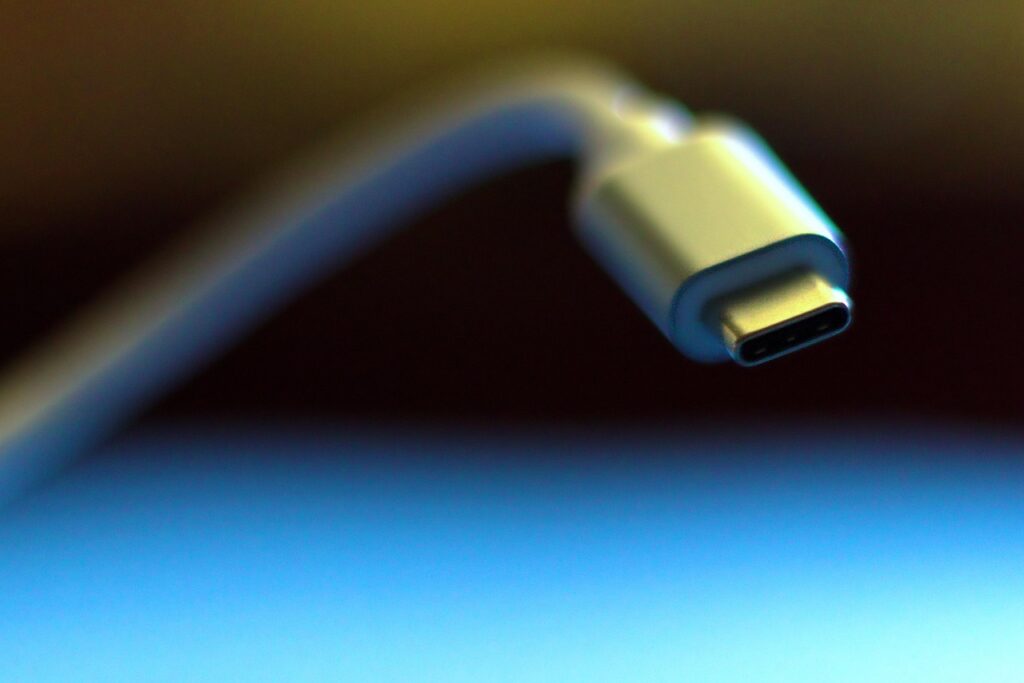
When Steve Jobs unveiled the iPhone in 2007, Europe’s economy was larger than America’s. The European Union still imagined itself as a peer competitor to the United States, not merely in living standards, but in innovation, technological leadership, and global influence. Today, that confidence has collapsed. The EU economy is roughly 40% smaller than that of the U.S. This reversal did not occur by accident. It reflects a systematic pattern of governance in which control is valued over experimentation, predictability over discovery, and administrative order over creative risk. The EU’s decision to mandate USB-C as the universal charging connector is a small policy with large meaning. It is not merely about cables. It is a perfect symbol of how Europe has come to regulate its future into stagnation.
The USB-C mandate did not arise from consumer revolt. There was no Europe-wide petition demanding it. There was no referendum. No European country made it a national priority. The European Parliament did not initiate the policy. Industry did not request it. Instead, it emerged from the internal logic of the European Commission, and more specifically from the will of one unelected technocrat, Thierry Breton, then European Commissioner for the Internal Market. Breton personally pushed the Commission to abandon voluntary industry agreements that had existed since 2009 and replace them with binding regulation. His stated frustration was slow progress and Apple’s refusal to abandon its Lightning connector voluntarily. From that frustration came a rule that now binds an entire continent, and in practice, much of the world.
The history matters. For more than a decade, manufacturers had been converging organically. Micro-USB gave way to USB-C because engineers preferred it and consumers adopted it. Apple was already transitioning many products to USB-C, including laptops and tablets. Wireless charging was advancing rapidly. The market was doing what markets do. It was sorting, experimenting, discarding inferior solutions, and moving forward. The Commission intervened not because the process failed, but because it did not move fast enough for the bureaucratic patience of one single technocrat. That distinction is crucial. Regulation arrived not to correct abuse, but to impose closure.
This is the first problem. Technological neutrality is abandoned the moment law dictates design. USB-C may be the best connector today. But innovation is not a static target. When governments mandate specific interfaces, they freeze current solutions into legal artifacts. Engineers must design around regulation rather than physics. Future breakthroughs become deviations rather than improvements. Japan offers a useful analogy. Bonsai trees are not weak because they are poorly tended. They are weak because they are meticulously controlled. Roots are trimmed, branches pruned, growth permitted only within strict bounds. The result is something orderly and pleasing, but incapable of competing with wild ecosystems. That is what the EU increasingly does to innovation. Growth is allowed. Change is allowed. Disruption is not.
The USB-C rule illustrates this dynamic cleanly. By choosing the connector, the EU implicitly discourages alternatives. Optical power delivery, solid-state interfaces, energy-sharing systems, or designs not yet conceived are all placed at a disadvantage. Law should describe limits, not dictate architectures. When government chooses the interface, it stops governing markets and starts locking in the past.
This approach is not isolated. It mirrors Europe’s broader regulatory philosophy. GDPR locked in early assumptions about data use before AI, large language models, or real-time personalization existed. The Digital Markets Act and Digital Services Act treat scale as suspicion rather than success. In Europe, becoming large is not a reward. It is a regulatory trigger. Firms design products to stay small, fragment services by geography, or relocate headquarters. In the U.S., scale is earned and then regulated if abused. In the EU, scale itself is treated as abuse.
Consider the contrast. America allows companies to race and regulates crashes. Europe regulates the track so tightly that no one accelerates. The result is predictable. Innovation migrates. Europe consumes technologies invented elsewhere, then regulates them after the fact. It produces fewer platform companies, fewer moonshots, fewer global champions.
Supporters of the USB-C mandate emphasize environmental benefits. Fewer cables, they say, mean less waste. But this claim collapses on inspection. Forcing the retirement of Lightning instantly rendered hundreds of millions of perfectly functional cables obsolete. Consumers replaced accessories early. Short-term waste spiked. Even the Commission’s own impact assessments acknowledged front-loaded increases in e-waste before hypothetical long-term savings. This is not environmental stewardship. It is symbolic tidiness paired with material waste.
Worse, the rule creates perverse incentives. If ports are regulated, the easiest response is to remove them. The regulation explicitly allows wireless-only devices. Apple successfully lobbied for language permitting port-less designs, exemptions for wireless charging, delayed laptop deadlines, and no mandate on wireless standards such as Qi. The result is that MagSafe-only devices remain legal. Far from standardizing repairable hardware, the rule nudges manufacturers toward sealed enclosures, glued batteries, and designs that are harder to fix. This directly conflicts with the EU’s own right-to-repair rhetoric.
There is also the question of regulatory motive. Many Android manufacturers quietly supported the rule because they already used USB-C. The costs fell disproportionately on Apple. Accessories were commoditized. Differentiation was constrained. The mandate functioned less as neutral consumer protection and more as targeted industrial micromanagement under a universal banner.
Nor does USB-C deliver the promised simplicity. It is a connector, not a guarantee. Cable quality varies. Power delivery standards differ. Data capabilities are inconsistent. Consumers remain confused. The vision of one cable for everything is marketing, not engineering reality.
CENSORSHIP: Thierry Breton, the EU's anti-free speech enforcer, has resigned in disgrace after his outrageous threats against Elon Musk's 𝕏 backfired spectacularly. Breton, who pushed for censorship of figures like Trump, has now faced the consequences of his own heavy-handed… pic.twitter.com/n5jfvWDJ9s
— @amuse (@amuse) September 17, 2024
These flaws would be troubling enough if confined to hardware. But the deeper danger lies in precedent. The same bureaucratic mindset animates Europe’s approach to speech and technology platforms. Thierry Breton was not only the architect of the USB-C mandate. He was also the official who threatened Elon Musk for planning to interview then-candidate Donald Trump on 𝕏. He was a central figure in pressuring American companies to censor lawful speech, not only for Europeans, but globally, because maintaining multiple systems is costly. This week, the U.S. State Department sanctioned Breton, prohibiting his travel to the United States, for precisely this behavior.
— @amuse (@amuse) December 23, 2025
Here, the parallel becomes unavoidable. Europe does not merely regulate its own market. Through extraterritorial rules and compliance pressure, it exports regulation worldwide. A decision made in Brussels becomes a constraint in California. The USB-C mandate affects global product design because manufacturers cannot economically maintain separate hardware ecosystems. Speech regulation operates the same way. Platforms comply globally rather than fracture services. European preferences become de facto global standards, even when they conflict with American constitutional traditions.
This is not cooperation. It is leverage.
The EU does not kill innovation outright. It embalms it. It preserves today’s solutions in legal amber while the rest of the world experiments freely. Over time, the gap widens. In 2007, Europe and America stood as economic peers. In 2025, the difference is stark. One system tolerates failure in pursuit of breakthroughs. The other minimizes risk by suppressing ambition.
USB-C may be correct today. That is not the point. The point is that law should remain humble in the face of technological uncertainty. Governments should set boundaries, not blueprints. When bureaucrats choose the connector, the interface, and the architecture, they stop governing markets and start governing history backward. Europe’s cable mandate is small, tidy, and well-intentioned. It is also emblematic of a civilization that has confused control with competence. The cost is not paid in chargers. It is paid in lost futures.
If you enjoy my work, please subscribe: https://x.com/amuse.
Sponsored by the John Milton Freedom Foundation, a nonprofit dedicated to helping independent journalists overcome formidable challenges in today’s media landscape and bring crucial stories to you.
READ NEXT: Watch Colo. Police Officer Battle Gunman Who Shot Another Officer



















Where’s John Galt!?