

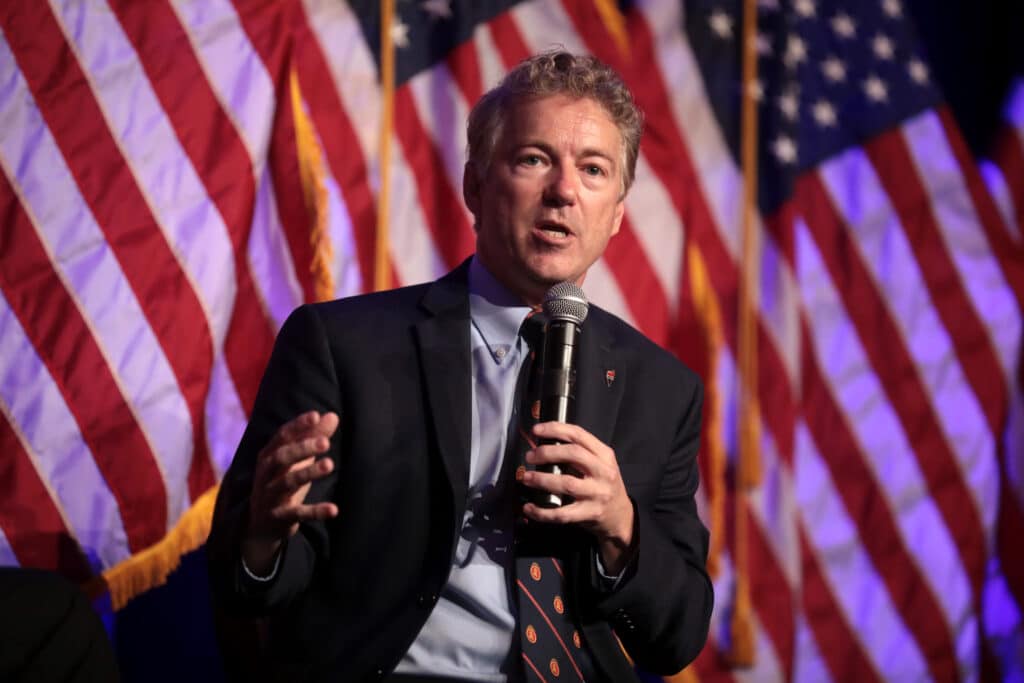
Republican Sen. Rand Paul says he is seriously considering a bid for the White House in 2028, adding his name to the growing list of potential contenders in a still-developing post-Trump political landscape.
In a preview of an upcoming interview with CBS News correspondent Robert Costa, Paul acknowledged that a presidential run is under active consideration, though no final decision has been made.
“We’re thinking about it,” Paul said, describing his current position as “50-50.” He added that a decision would likely come after the 2026 midterm elections, suggesting his decision will be influenced by the GOP’s performance before committing.
A Potential Opening in a Shifting GOP
Paul’s possible candidacy comes at a moment of uncertainty within the Republican Party, particularly as the ongoing Iran war changes political dynamics. Recent polling shows the conflict is broadly unpopular with the American public, with a majority opposing the military action and large majorities rejecting the idea of sending ground troops.
The divide is especially pronounced among younger voters—including younger conservatives—many of whom have expressed frustration with the war and see it as a departure from the GOP’s recent “America First” and anti-interventionist messaging.
That shift has led some observers to speculate that Paul, long associated with a more restrained foreign policy, could find a renewed lane within the party. At the same time, figures like J.D. Vance—often viewed as a potential heir to Donald Trump—may face a more complicated path if the conflict continues to divide the Republican base.
Positioning Within the GOP
Paul has indicated that if he runs, he would represent a libertarian-leaning, free-market wing of the Republican Party. His political identity has often emphasized limited government, reduced federal spending, and a more restrained foreign policy—positions that at times diverge from the direction the GOP has taken recently.
That distinction could shape a potential primary contest, particularly as Republicans begin to define what the party looks like after Trump’s final term.
A Familiar Path
This would not be Paul’s first presidential campaign. He previously ran in the 2016 Republican primary, where his centered civil liberties, fiscal conservatism, and non-interventionist foreign policy. He ultimately exited the race early after struggling to gain traction in the crowded field.
Since then, Paul has remained a prominent voice in the Senate, often taking independent positions on issues ranging from government spending to surveillance and foreign aid.
Looking Ahead
While 2028 continues to take shape, early speculation about potential candidates is already underway. Paul’s openness to a run signals that he is at least exploring a national campaign, even as other possible contenders weigh their own plans.
For now, his timeline suggests that any formal announcement is still at least a year away, leaving room for shifting political dynamics—and potential rivals.
READ NEXT: Rand Paul Staffer Stabbed Repeatedly, Suspect Apprehended
















NOPE! No thank you!
He sure as hell won’t get my vote
Answer: NO.
Ugh!
Rand Paul is in his own class of RINO. It’s his way of getting attention.