





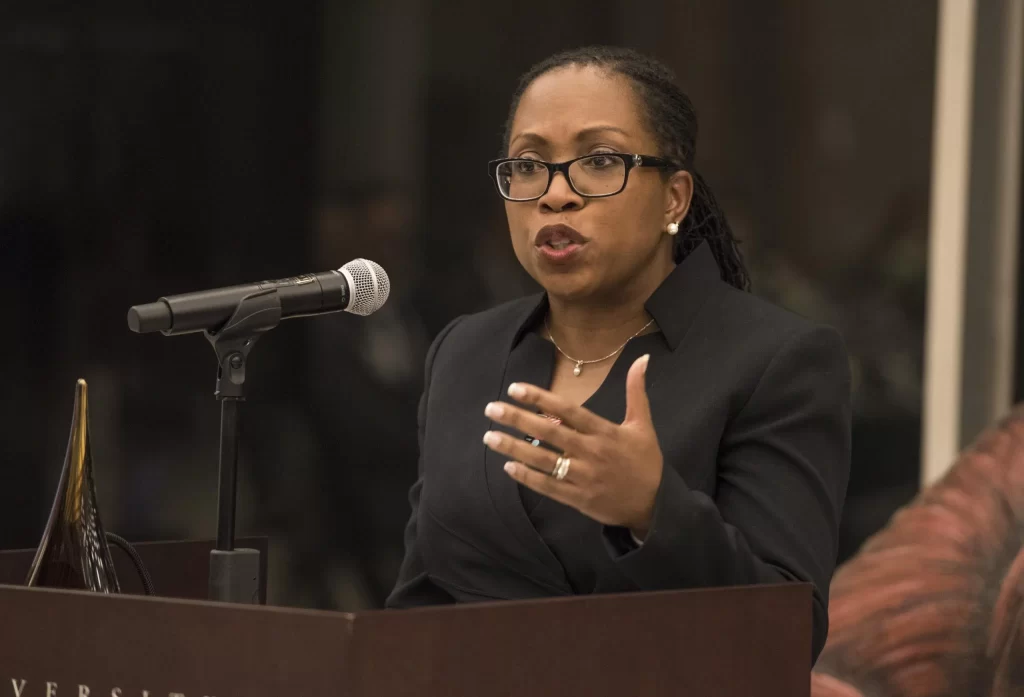
A hypothetical raised by Supreme Court Justice Ketanji Brown Jackson during oral arguments in a major birthright citizenship case drew attention Wednesday, as the justices weighed the scope of the 14th Amendment and the meaning of “allegiance” under United States law.
The Court heard arguments in Trump v. Barbara, a case following an executive order issued by Donald Trump seeking to end automatic birthright citizenship for children born in the United States to illegal aliens and certain temporary visitors. The case is expected to have far-reaching implications for immigration policy and constitutional interpretation.
During the proceedings, Jackson offered a scenario involving an American citizen traveling abroad to illustrate her view of legal jurisdiction and allegiance.
“I was thinking, I, a U.S. citizen am visiting Japan,” Jackson said. “And what it means is that if I steal someone’s wallet in Japan, the Japanese authorities can arrest me and prosecute me.”
She continued by suggesting that such a situation reflects a form of temporary allegiance to a country’s legal system, even for visitors.
“It’s allegiance meaning can they control you as a matter of law… even though I’m just a temporary traveler… I’m still locally owing allegiance in that sense.”
Jackson then questioned whether that same concept could apply to individuals residing in the United States without permanent legal status, arguing that being physically present in the country may still subject them to its authority in a meaningful way.
The comments came as the justices pressed both sides on how to interpret the Citizenship Clause of the 14th Amendment, which guarantees citizenship to “all persons born or naturalized in the United States, and subject to the jurisdiction thereof.”
Trump administration attorney D. John Sauer argued that the phrase “subject to the jurisdiction thereof” was historically understood to exclude children of individuals who are in the country unlawfully or temporarily. Representing challengers to the policy, Cecilia Wang of the American Civil Liberties Union defended the longstanding interpretation that birth on American soil confers citizenship in nearly all cases.
Several justices across the ideological spectrum raised questions about both positions. Chief Justice John Roberts challenged arguments about birthright citizenship being widely exploited by wealthy foreigners, while Justice Amy Coney Barrett asked whether the administration’s interpretation would have applied historically to the children of newly freed slaves. Justice Neil Gorsuch also appeared to probe the limits of the administration’s position.
The United States remains one of a relatively small number of countries that broadly recognize birthright citizenship without major restrictions. Estimates from the Center for Immigration Studies suggest that between 225,000 and 250,000 children were born to illegal migrant parents in 2023, along with tens of thousands more born to temporary visitors.
Trump, who attended the oral arguments in person—a historic gesture for a sitting president—has highlighted that the 14th Amendment was intended to secure citizenship for the children of freed slaves following the Civil War, not to apply universally to all individuals born on American soil regardless of their parents’ legal status.
The Court’s eventual ruling is expected to clarify the constitutional boundaries of birthright citizenship and could reshape immigration policy dramatically.
READ NEXT: SCOTUS Takes Up Trump Birthright Citizenship Order























She is a complete idiot. She has nothing relevant to say that doesn’t support democrat politics.