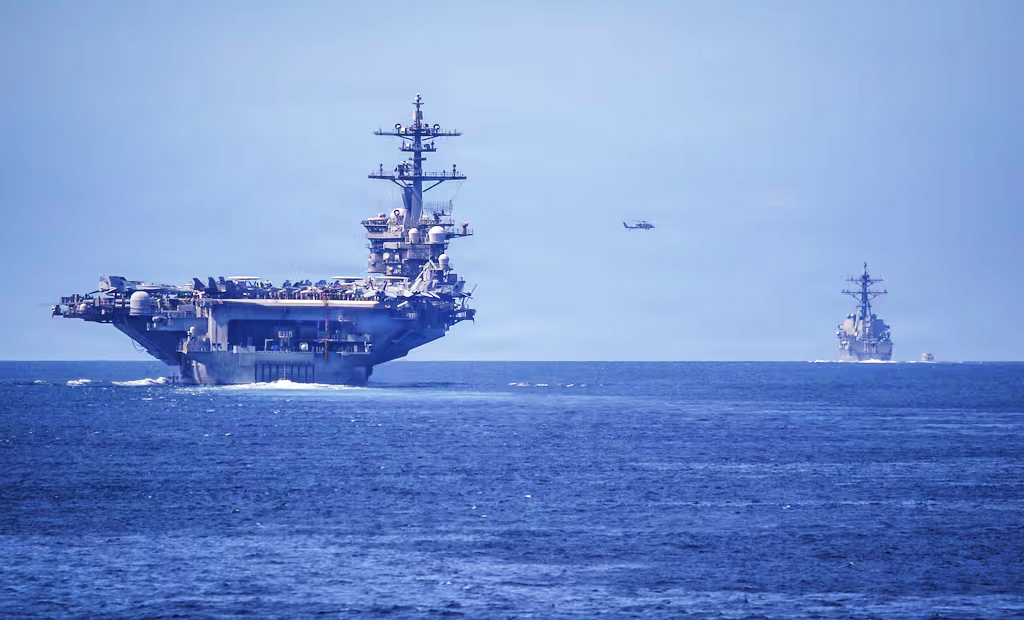
The United States Navy formally began operations to control access to the Persian Gulf on Tuesday, 14 April. This effort, the “Strait of Hormuz Blockade,” is currently led by the USS Abraham Lincoln Carrier Strike Group (CSG-3). There are approximately 15 American warships conducting the closure, with other vessels from other task groups assisting or en route to assist.
Closing the Strait: Forces Involved
[16 April 26] A total of three Carrier Strike Groups (CSGs) and two Amphibious Readiness Groups (ARGs) have reportedly been deployed to assist in the Iran blockade. The intention of the blockade, which is just one element of “Operation Epic Fury”, is to prevent all maritime traffic to and from Iranian ports.
The first of those, USS Abraham Lincoln (CVN-72), leading Carrier Strike Group 3, was taking part in military exercises in the South China Sea before being “chopped” (temporarily assigned) to the U.S. 5th Fleet. That retasking order sent her to the Arabian Sea to reinforce available US Central Command (CENTCOM) naval assets.
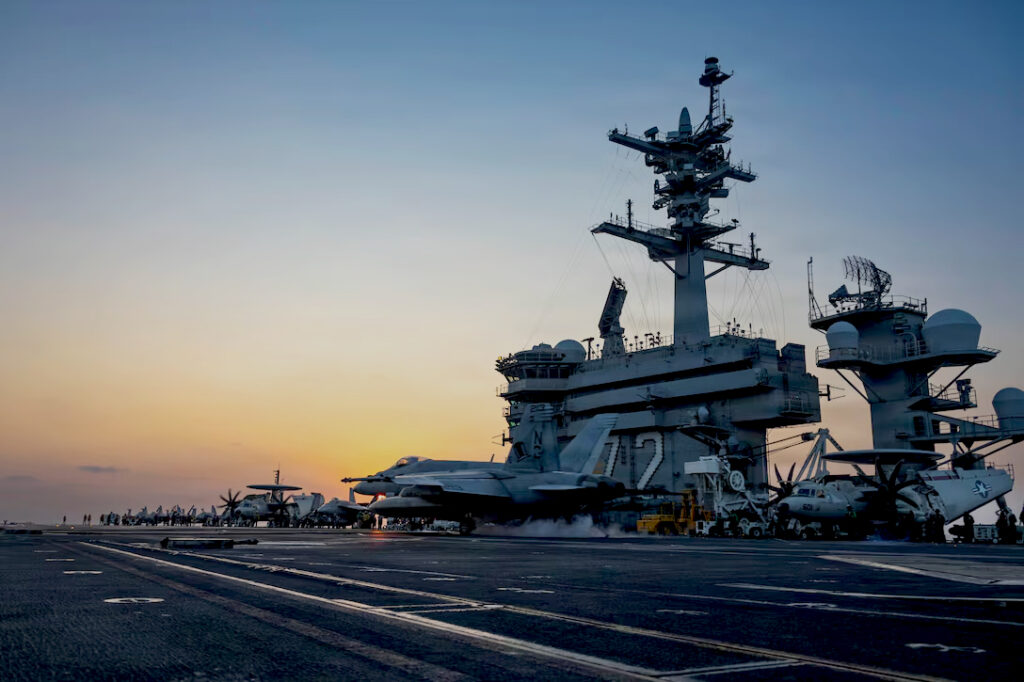
“The blockade will be enforced impartially against vessels of all nations entering or departing Iranian ports and coastal areas, including all Iranian ports on the Arabian Gulf and Gulf of Oman. CENTCOM forces will not impede freedom of navigation for vessels transiting the Strait of Hormuz to and from non-Iranian ports. ~ via USCENTCOM official press release of 12 April 20216
USS George H.W. Bush and CSG departed Naval Station Norfolk on 31 March for its regularly scheduled deployment (which was already intended to be a CENTCOM deployment, according to the DoD). She will reportedly be relieving the USS Gerald R. Ford (CSG-), which recently set a post-Cold War record for deployment length, in theater.
The USS Tripoli’s ARG and 31st MEU are already on station in the CENTCOM AOR. She is shortly to be joined by USS Boxer’s ARG and the 11th MEU, which, as of April 11th, was in the vicinity of Guam.
Carrier Strike Group 3
Carrier Strike Group 2 is flagged by the USS Abraham Lincoln (CVN-72). She is accompanied by Destroyer Squadron 21 (DESRON 21), and an unconfirmed number of other vessels. Normally, this would include at least one, if not two, nuclear submarines and one or more guided-missile cruisers (CGs).
It has been difficult to determine how many (and which) submarines are in CSG-3’s AOR. This is appropriate and not at all surprising. The other “missing” surface combatant would normally be a Ticonderoga-class cruiser. However, no information on that vessel (if there is one attached) can be easily located. The Navy’s Carrier Strike Group 3 web page lists the USS Mobile Bay (CG 53) as part of the CSG-3 lineup…but the Mobile Bay was decommissioned nearly 3 years ago, so the accuracy of that is doubtful.
CSG-3 has been conducting combat operations against forces of the Republic of Iran since the earliest days of Operation Epic Fury.
USS Abraham Lincoln (CVN-72)
The USS Abraham Lincoln is a nuclear-powered aircraft carrier of the Nimitz class. Referred to by her crew as Abe (e.g., “working the Abe” or “on board the Abe”), she was named for POTUS 16 and (fittingly) commissioned on Veterans Day, November 11, 1989. Her home port is Naval Air Station North Island in California.
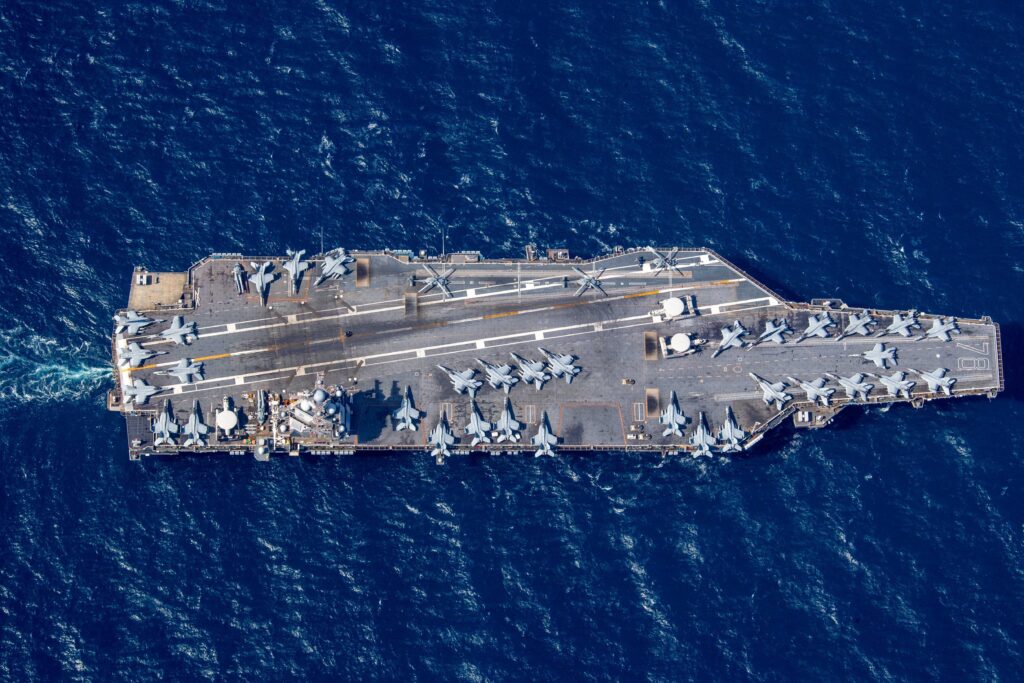
She’s just shy of 1,100 feet long, which means if you stood her on her end, she’d be taller than the Empire State Building (and the Eiffel Tower). Her flight deck covers approximately 4 ½ acres (!), serving anywhere from 70 to 100 aircraft (including helicopters).
Barring attachments or detachments, there are typically around 5,700 men and women aboard. That’s roughly 3,200 crew and another 2,500 air wing personnel.
Carrier Air Wing 9
Carrier Air Wing 9 (CVAW-9) has been in service since the Korean War. It first deployed aboard the USS Philippine Sea (CV-47) in January, 1953. Back then CVAW-9 was flying aircraft like the G9F-2 Panthers, F4U variants, and A1 Skyraiders.
Now, unless 78’s complement of aircraft has been changed for this operation, she and CVAW-9 should have nine (9) squadrons aboard. Her fixed-wing aircraft units should include three USN Strike Fighter squadrons in F/A-18Es, a Marine Attack Squadron driving F-35Cs, a USN Electronic Attack Squadron flying EA-18Gs, and an Airborne Early Warning Squadron operating E-2Ds.
Her rotary aircraft complement would normally include a “Multi-Mission Squadron” of CMV-22B Ospreys, a Helo Maritime Strike Squadron operating MH-60 Seahawk Romeos, and a Helo Sea Combat Squadron of HM-60 Knighthawk Sierras. If open source intelligence (OSINT) is correct, those squadrons would include:
- VFA 14 “Tophatters”, USN Strike Fighter Squadron (NAS Lemoore)
- VFA 41 “Black Aces”, USN Strike Fighter Squadron (NAS Lemoore)
- FVA 151 “Vigilantes”, USN Strike Fighter Squadron (NAS Lemoore)
- VMFA 314 “Black Nights” USMC Fighter Attack Squadron (MCAS Miramar)
- VAQ 133 “Wizards” Electronic Attack Squadron (NAS Whidbey Island)
- VAW 117 “Wallbangers” Carrier Airborne Early Warning Squadron (NAS Point Mugu)
- VRM 30 “Titans” Multi-Mission Helicopter Squadron (NAS North Island)
- HSM 71 “Raptors” Helicopter Maritime Strike Squadron (NAS North Island)
- HSC 14 “Chargers” Helicopter Sea Combat Squadron (NAS North Island)
This may not be a complete or accurate list, particularly if Special Operations Forces (SOF) are operating from 78.
DESRON 21 (Destroyer Squadron 21)
- USS Frank E. Petersen, Jr. (DDG-121) – Air Defense Commander
- USS Spruance (DDG-111)
- USS Michael Murphy (DDG-112) – chopped temporarily?
Other destroyers in the region reportedly include the following. Some of them have almost certainly been temporarily assigned (“chopped”) to CSG 3. For instance, we know that the Murphy recently passed through the Strait of Hormuz to begin mine-clearing and security operations.
USS Bainbridge (DDG-96), USS Delbert D. Black (DDG-119), USS McFaul (DDG-74), USS John Finn (DDG-113),USS Thomas Hudner (DDG-116), USS Milius (DDG-69),USS Mitscher (DDG-57), USS Rafael Peralta (DDG-115), USS Pinckney (DDG-91).
Other Vessels
There are definitely other warships and support vessels in the area, but identifying them ultimately may be a matter of just watching news reports, DoD releases, official USN and USMC announcements, etc.
For instance, we know Henry J Kaiser is there, because it showed up in a USN Navy photo:
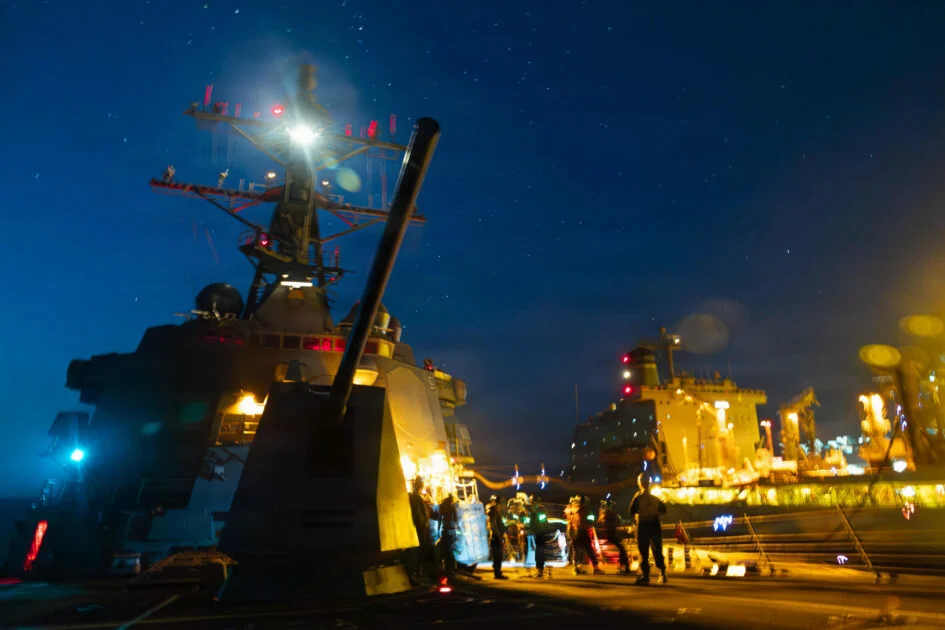
According to this US Navy photo, that’s the fleet replenishment oiler USNS Henry J. Kaiser (T-AO-187) topping off the USS Spruance (DDG-111), on March 18, 2026.
Current Carrier Strike Group Deployments
The general locations of US naval warships are typically available in open-source media outlets, though when operational or in combat, they often “go dark.”
None of the information below is classified, nor is it sufficient to threaten specific vessels.
Carrier Strike Group Locations: 13 APRIL 26
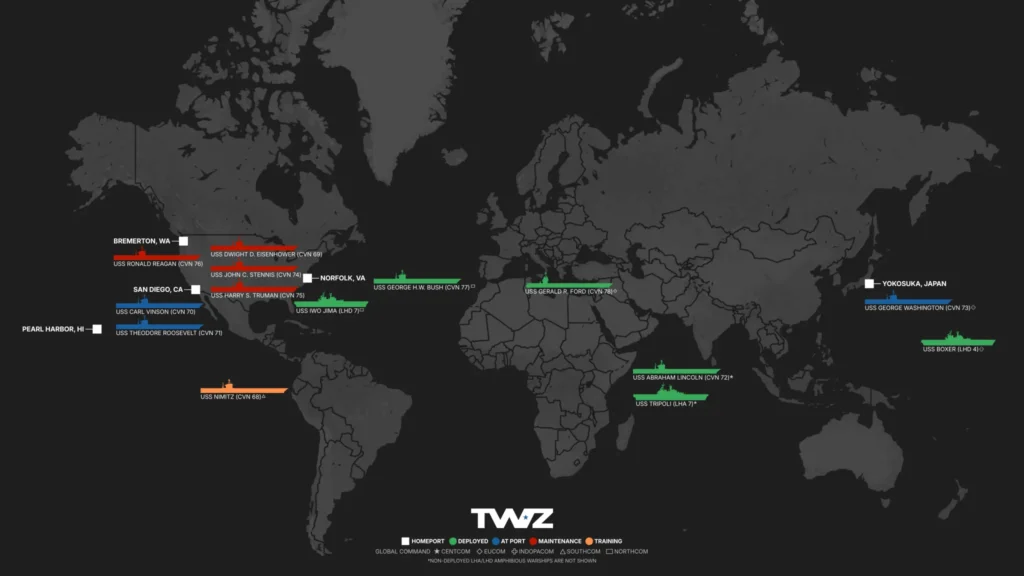
According to the US Naval Institute (USNI News) fleet tracker, American naval elements were in the vicinity of the following locations in mid-April.
The following map of CSG locations, recently posted on The War Zone website, shows the approximate locations of the USN’s various carrier groups a day before the USNI report came out.
Carrier Strike Group Locations: 12 APRIL 26
Iran Blockade: USS Abraham Lincoln Leads
Why the US Navy Rushed USS Abraham Lincoln to the Persian Gulf
LEARN MORE
USS Abraham Lincoln: Portrait of A Ship (Coffee or Die)
You can read up on CVN-72, USS Abraham Lincoln, here on Defense Feeds or on Wikipedia.
Learn more about the USS Gerald R Ford (CVN-78) on the Navy’s ALL HANDS website.
READ NEXT: Theodore Roosevelt’s Timeless Lesson Can Make You Unstoppable