

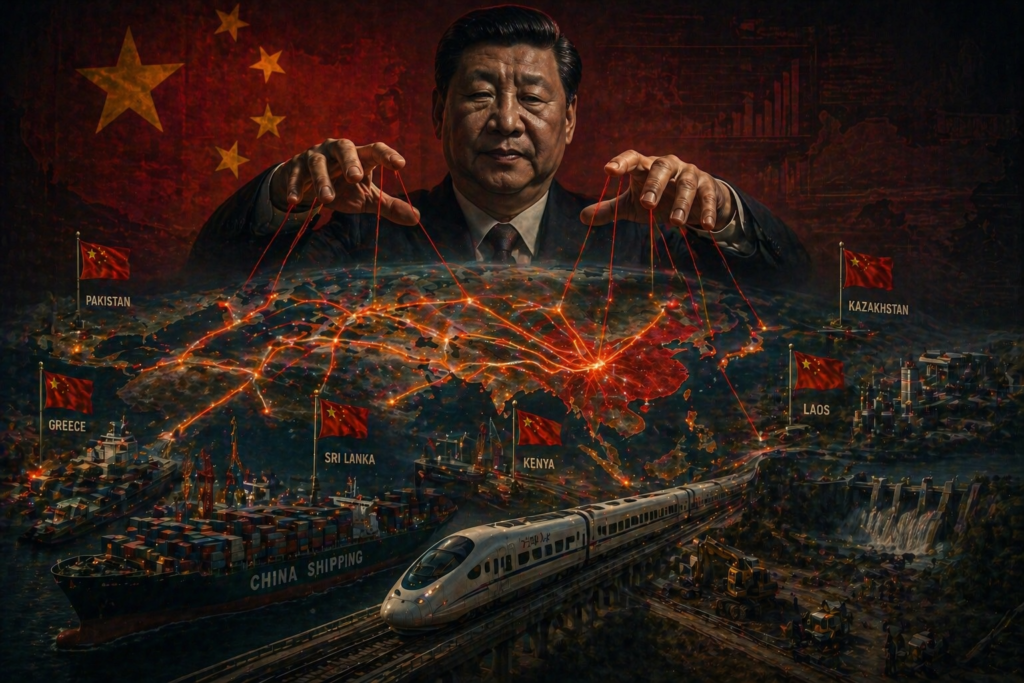
Consider the moment a sculptor finishes her work and holds the statue aloft. We can describe what she holds in many ways. It is clay, it is a statue, it is a commodity, it is an investment. The description we choose depends on the question we are asking. Something similar happens when we try to describe what China has built over the past decade under the Belt and Road Initiative. Is it aid? Is it commerce? Is it strategy? Is it empire? The temptation is to insist on one answer and dismiss the others. The more honest approach, and the one I want to defend here, is that the BRI is best understood as a modern form of imperial power, provided we are careful about what that phrase means and what it does not mean.
The careful version of the claim matters, because the careless version invites easy refutation. No one thinks Beijing is building 19th-century colonies. No one thinks Chinese governors are being installed over the parliaments of Sri Lanka or Kenya. No one thinks the People’s Liberation Army is raising flags over annexed provinces in Southeast Asia. If imperialism requires gunboats and viceroys, then the BRI is not imperialism, and the conversation ends. But imperialism never required only those things, and historians of empire have long understood this. The broader tradition of scholarship on informal empire describes systems in which a dominant power secures expanding markets, privileged financial claims, access to raw materials, and political subordination in nominally sovereign states. The dominant power obtains many of the benefits of empire while avoiding the costs of administering colonies. On that older and more accurate definition, the question of whether China is a modern imperial power becomes a genuinely serious one, and the answer, I will argue, is yes.
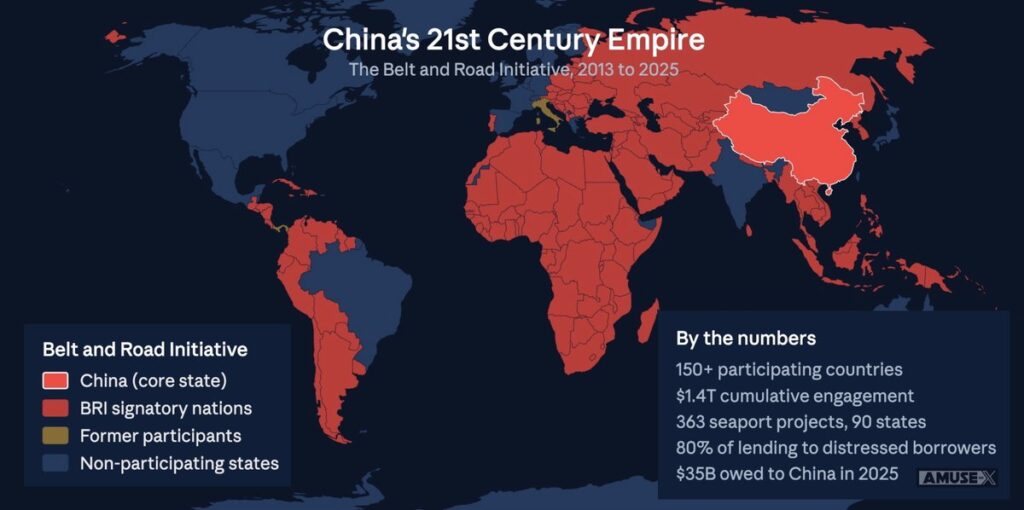
Start with the scale. Launched in 2013 by Xi Jinping, the BRI has grown into an enormous umbrella for infrastructure, industrial, financial, digital, and logistics projects across the developing world. Official Chinese summaries report more than 200 cooperation agreements with more than 150 countries and 30 international organizations by mid-2023. An independent 2025 investment tracker estimated cumulative BRI engagement at roughly $1.399T across 150 countries by the end of 2025. Beijing frames the initiative as a global public good built on consultation and shared benefit. That framing is not absurd. There are real roads, real ports, real power plants, and real rail lines. But the framing is also incomplete, and the incompleteness is where the imperial reading gains traction.
Consider how the money moves. Research on Chinese overseas development finance shows that access to BRI funding is typically tied to Chinese contractors and Chinese procurement chains. More than 90% of this finance is issued as debt rather than grants. The primary lenders are state policy banks, chiefly the Export-Import Bank of China and China Development Bank, with other state-owned banks and firms increasingly involved. Many large projects are resource-backed or revenue-backed, meaning that repayment is secured against future oil shipments, mineral exports, or infrastructure revenues. This is not the profile of ordinary development assistance. It is the profile of a state-directed financial system designed to project economic influence outward while guaranteeing that the benefits, in contracts, in labor, in supply chains, flow back inward to China.
A skeptical reader might object at this point. Surely tied lending is common. Surely every country prefers to see its own firms benefit from its overseas programs. The objection is fair, but it misses the scale and structure of the Chinese system. AidData, the research lab at William and Mary that has done the most systematic work on Chinese state finance, reports that more than 80% of China’s overseas lending portfolio in the developing world is now concentrated in countries in financial distress. The Lowy Institute estimates that developing countries owe China about $35B in debt service in 2025, including a record $22B from the world’s 75 poorest and most vulnerable countries alone. Lowy describes the resulting shift in China’s role from capital provider to debt collector. Reuters, reporting on the same analysis, flagged the risk that debt service to China is now crowding out health and education spending in vulnerable states. This is what asymmetric interdependence looks like in practice. One party writes the checks, the other party pays for decades, and the terms of that repayment become a lever.
The terms themselves deserve attention. AidData’s contract studies have documented a pattern of unusually restrictive confidentiality clauses, widespread “No Paris Club” clauses that discourage coordinated restructuring with other creditors, and quasi-collateral arrangements that place Chinese lenders near the front of the repayment line. In the expanded 2000-2025 contract dataset, 55% of Chinese loan contracts included a “No Paris Club” clause, and 86% of policy-bank contracts signed after November 2020 still used one. AidData also reports that 46% of Chinese public and publicly guaranteed loans issued between 2000 and 2021 were effectively collateralized. Separately, AidData estimates that governments in low- and middle-income countries have underreported their actual and potential Chinese debt exposure by roughly $385B, largely because so much borrowing now sits in state-owned enterprises, special purpose vehicles, joint ventures, and other off-budget structures backed by implicit state guarantees. The combination is striking. Confidentiality hides the exposure, non-coordination clauses prevent collective restructuring, collateral arrangements secure repayment ahead of other creditors, and off-balance-sheet vehicles obscure the true size of the liability. That is not the architecture of neutral development aid. It is the architecture of durable financial leverage.
If debt creates leverage, ports give that leverage a geography. New datasets from AidData track nearly $24 billion in Chinese state-directed loans and grants for 363 seaport-related projects at 168 ports in 90 countries from 2000 to 2025. The Council on Foreign Relations independently tracks 129 overseas port projects in which Chinese entities hold ownership or operational stakes, and CFR explicitly evaluates their dual-use military potential. The conclusion from CFR is instructive. Even where China does not build formal naval bases, port ownership and operating stakes still create geoeconomic influence over trade routes and the supply chains connected to them.
The three most-cited cases make the pattern concrete. In Sri Lanka, Hambantota Port was transferred into a 99-year lease run by China Merchants Port Holdings under a 2017 deal. The debt-trap interpretation of Hambantota is often overstated, and Chatham House is correct to note that the lease did not legally transfer ownership or forgive the underlying Chinese debt. The cash was largely used to shore up foreign reserves and to service non-Chinese liabilities. Grant all of that, and the strategic fact remains. A Chinese state-linked operator secured a 99-year concession at a port adjacent to major sea lanes that connect the Persian Gulf to East Asia. In Pakistan, Gwadar Port is officially operated by China Overseas Ports Holding Company under a long-term agreement, and outside observers continue to describe the broader corridor as the roughly $62B flagship of the BRI. In Djibouti, Beijing opened its first overseas military base in 2017, while Chinese-linked entities were simultaneously embedded in the surrounding port and free-zone ecosystem, including the Djibouti International Free Trade Zone established jointly by Djiboutian authorities and China Merchants. No single one of these cases constitutes colonial seizure. Taken together, they begin to resemble something else, a networked set of footholds at chokepoints and trade corridors, each commercially justified, each legally contracted, and each potentially dual-use.
Here a reader might reasonably ask whether this is really so different from what Western powers have done through globalization. The answer is that the differences are real and should be stated plainly. BRI countries formally remain sovereign. China does not annex territory, does not replace local governments, does not install administrators over subject populations, and does not send settlers to rule host societies. Chatham House’s best work on Sri Lanka and Malaysia also shows that host governments frequently initiate, shape, or distort projects for their own domestic political reasons, and that China’s system is fragmented enough that not every project reflects a centralized geopolitical master plan. These are genuine points, and they rule out the lazy version of the imperial thesis.
They do not, however, rule out the careful version. Classic colonialism required governing subject populations. Informal empire does not. What informal empire requires is the ability to extract resources, shape policy, privilege metropolitan firms, and secure strategic assets in nominally sovereign states. The BRI delivers on all four. Chinese firms get contracts. Chinese workers get jobs. Chinese banks get senior repayment claims. Chinese operators get long-term concessions at strategically useful ports. Chinese diplomats get policy deference from governments that cannot afford to alienate their largest creditor. These outcomes do not require annexation, because annexation is expensive and unnecessary. The modern tools of financial integration, when combined with state direction and contractual sophistication, accomplish most of what annexation once accomplished, at a fraction of the administrative cost.
It is also true, and the steelman must concede this, that BRI projects can deliver genuine developmental gains. The World Bank estimates that BRI transport corridors could reduce travel times by up to 12%, increase trade, raise foreign direct investment, and help lift 7.6M people out of extreme poverty and 32M out of moderate poverty, provided participating countries adopt reforms that improve transparency, debt sustainability, procurement, and environmental standards. AidData’s perceptions survey likewise found that many leaders in the Global South still see China as an important development partner, especially for connectivity and public services, even while criticizing pollution, corruption, and weak transparency. The strongest version of the imperial thesis is not that BRI is only predation. It is that developmental benefits and imperial leverage can coexist, and indeed reinforce one another. A road that serves local commerce is also a road that a creditor can threaten to repossess. A port that handles grain can also handle warships. Useful infrastructure and strategic infrastructure are not mutually exclusive categories, and the BRI is designed, consciously or not, to make them the same infrastructure.
The question of intent deserves its own treatment, because it is the weakest part of the case if pushed too hard. Evidence is strong that the BRI creates dependency, privileged access, and strategic footholds. Evidence is weaker for the maximal claim that every distressed project was deliberately engineered as a trap from the outset. The best available research points to a hybrid story. China’s growth model, excess industrial capacity, and search for overseas markets pushed enormous lending outward. State-owned lenders and firms then deployed contracts that protect Chinese interests unusually aggressively. Host-country elites frequently welcomed the money for their own domestic political reasons, sometimes in direct contravention of their citizens’ long-term interests. The resulting structures can then be used for leverage, whether or not they were planned as traps on day one. A system does not have to be conspiratorial to be imperial. It only has to produce imperial outcomes reliably.
The BRI is also evolving, and this too must be acknowledged. Official rhetoric since COVID has emphasized smaller, cleaner, “small-scale yet impactful” projects. China has at times restructured debts or forgiven a narrow class of zero-interest aid loans. But the latest evidence shows that 2025 brought a renewed surge in very large, commercially oriented, and resource-linked deals, while serious debt relief on bank loans remains rare. Beijing generally prefers maturity extensions and other loss-avoidance strategies over principal write-downs. The BRI’s imperial character may therefore be shifting in form rather than disappearing. Less indiscriminate sovereign lending, more commercially structured leverage, more resource security, and more selective strategic positioning. The empire is being streamlined, not dismantled.
What, then, should we conclude? On the best available evidence, the BRI justifies describing China as a modern imperial power, provided we mean by imperialism what serious historians have always meant by the term in its broader sense. The extension of power and hierarchy through economic control, strategic infrastructure, creditor privilege, and geopolitical competition, rather than only through annexation and colonial administration. The modern empire here is contractual, infrastructural, and financial. It leaves flags and sovereign titles in place, but it can still narrow policy autonomy, privilege metropolitan firms, secure supply routes and resources, and create long-duration leverage over weaker states. That is not a replay of the Victorian empire. It is something new, and in important respects more sophisticated, because it achieves imperial ends while minimizing the costs and the optics that brought older empires down.
The response of the United States and its allies suggests that Western leaders understand exactly what they are looking at. The G7 has explicitly treated infrastructure finance as strategic competition by elevating the Partnership for Global Infrastructure and Investment as its flagship response. If infrastructure were merely benevolent development, that response would make no sense. It makes sense because the major powers, China included, now recognize that roads, ports, grids, and debt contracts are instruments of world order. That recognition is the deepest confirmation of the imperial thesis. You do not build a counter-empire unless you believe there is an empire to counter. President Trump’s administration has correctly identified this contest as one of the defining strategic challenges of the decade, and a serious American response will require not only matching Chinese capital but insisting on transparency, sovereignty, and reciprocity as the terms on which the developing world is offered an alternative.
Return, finally, to the sculptor. She holds her handiwork aloft, and we decide what to call it. We can call the BRI development. We can call it commerce. We can call it strategy. We can call it empire. The most accurate description is that it is all of these at once, and that the last of them, empire, is the description that ties the others together. Beijing has discovered that in the twenty-first century you do not need to conquer a country to control its harbor, its ledger, and its choices. You only need to lend it the money, write the contract, and wait.
If you enjoy my work, please subscribe https://x.com/amuse/creator-subscriptions/subscribe.
Sponsored by the John Milton Freedom Foundation, a nonprofit dedicated to helping independent journalists overcome formidable challenges in today’s media landscape and bring crucial stories to you.
READ NEXT: Report: Top Republican’s Trump White House Dream Suddenly Dims



















The Belt and Road Initiative is debt trap. China recently asked the IMF to give loans to an African country to pay back China. With the bribery, corruption, and shoddy construction most of what is being built is collapsing.