






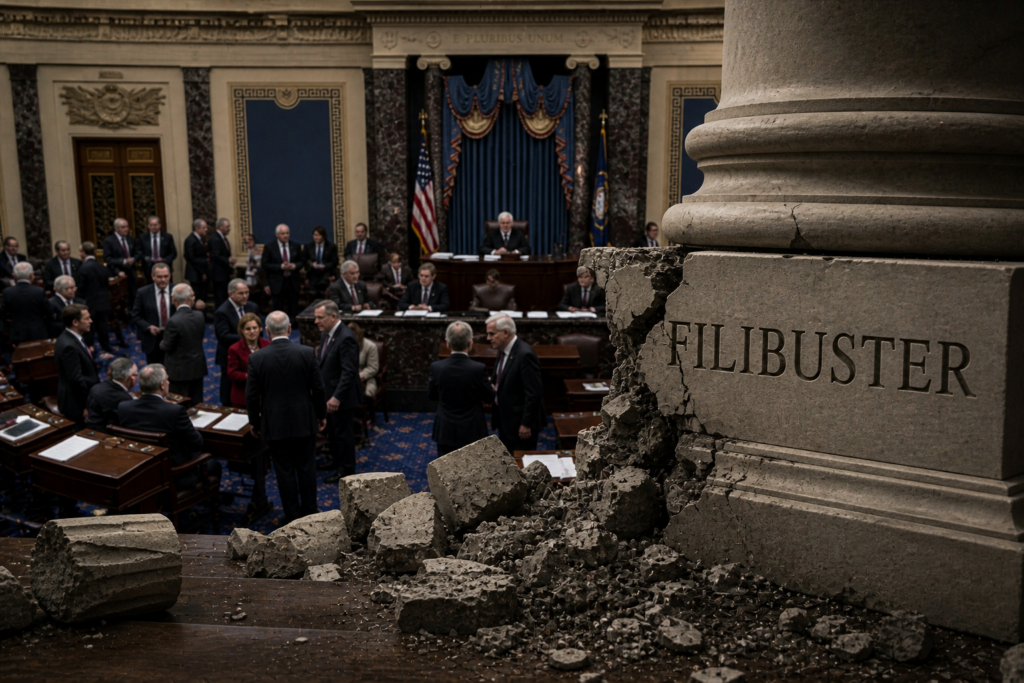
There is a principle in philosophy called the principle of sufficient reason, the idea that nothing happens without a cause adequate to explain it. Applied to democratic politics, it yields a sharp prediction: governing majorities that fail to govern will lose their majorities. The Republicans currently control the House, the Senate, and the White House. They have a mandate from the American people, ratified on November 5, 2024, when President Trump won a decisive victory over Kamala Harris. And yet, as the 2026 midterms draw closer, the Republican majority faces a crisis of its own making, one rooted not in popular opposition to its agenda, but in an arcane procedural rule that Democrats exploit and Republican leadership lacks the will to confront.

The Save America Act is supported by approximately 85% of Americans across party lines. Election integrity legislation rarely commands that kind of consensus. The polling is not ambiguous, and the political logic is even clearer: an 85% approval rating is not a niche policy position. It is an almost universal demand. It cuts across race, income, geography, and partisan identity in a way that virtually no other piece of legislation can claim. And yet the Senate cannot pass it. The reason is the filibuster, specifically the 60-vote cloture threshold that allows a determined Senate minority to block any legislation it dislikes, regardless of how broadly that legislation is supported by the American people. Senate Majority Leader John Thune has the tools to change this. He has, so far, refused to use them.
This refusal is not costless. While Washington debates procedure, approximately 120,000 American families are going without pay. Federal workers at the Transportation Security Administration, the United States Coast Guard, and the Secret Service are legally required to report to work every single day. They screen passengers at airports. They patrol American coastlines. They protect the lives of the president and other senior officials. They do this, right now, without receiving a paycheck, because Senate Democrats have blocked the funding for the Department of Homeland Security that would restore their pay. These are not abstract budget numbers. These are parents who cannot pay their mortgages, families who cannot buy groceries, and public servants who are being asked to sacrifice because Senate Democrats have decided that procedural obstruction is more important than the welfare of the workers they claim to champion. The outrage this should generate in a just political culture is, unfortunately, being muffled by the same institutional inertia that produced the crisis in the first place. To add insult to injury after Elon Musk offered to personally pay the salaries of TSA agents Democrats threatened to sue to prevent him from doing so.
Senator Mike Lee has pushed, credibly and persistently, for Majority Leader Thune to require Democrats to actually hold the floor and speak during a filibuster, to make them do the thing that most Americans imagine the filibuster already requires. Under current practice, a senator need not stand at a podium for hours reading from the phone book. A senator need only signal the intent to filibuster, and purely by tradition (not rule) the 60-vote threshold triggers automatically. The talking filibuster, the kind that Jimmy Stewart made famous in “Mr. Smith Goes to Washington,” is not the current practice. The current “rule” is a gentleman’s agreement, a quiet obstruction that requires no sacrifice, no public accountability, and no visible cost for the minority that employs it. Lee’s proposal would restore actual accountability to the process. Thune has declined. And so the question becomes: if the majority leader will not enforce the talking filibuster, what option remains? The answer is the one that the Senate has turned to, repeatedly and without apology, throughout its history. The answer is to change the cloture rule.
To understand why this is not a radical suggestion, it is necessary to understand what the cloture rule actually is and how it has evolved. The rule was not handed down from Sinai. It was invented, amended, weakened, strengthened, and modified by Senate majorities who decided that the procedural needs of their moment required a different threshold. The history is worth examining in detail, because it demolishes the claim that altering the rule is somehow unprecedented or constitutionally suspect.
Cloture was created in 1917 under President Woodrow Wilson. The immediate cause was a Senate filibuster that blocked legislation authorizing the arming of American merchant ships during World War I, a filibuster that Wilson condemned in terms that would not be out of place in a conservative op-ed today. The original cloture rule, Rule XXII, required a two-thirds vote of senators present and voting to end debate. It was the first formal mechanism the Senate had ever adopted to limit debate at all. Before 1917, the filibuster was theoretically unlimited. Wilson’s Senate, acting under wartime pressure and public fury, changed the rule. That was change number one.
The second change came in 1949, under Majority Leader Alben Barkley, a Democrat. The Barkley Senate tightened the cloture requirement by moving from two-thirds of senators present and voting to two-thirds of the full Senate, meaning all 96 senators at the time, regardless of who showed up. This was a more demanding threshold, not a more lenient one, and it reflected a particular political moment in which the Senate’s Democratic majority was attempting to entrench certain procedural protections. What matters here is not the direction of the change but the fact of it: a Senate majority changed the rule when it served their purposes. That was change number two.
The third change arrived in 1959, under Majority Leader Lyndon B. Johnson, also a Democrat. Johnson revised the threshold back to two-thirds of senators present and voting, undoing the 1949 tightening, and also clarified that cloture could apply to rules changes themselves. Johnson understood that procedural flexibility was a tool of governance, and he used it without apology. That was change number three.
The fourth change, and in many respects the most consequential before the nuclear era, came in 1975 under Majority Leader Mike Mansfield, again a Democrat. The Mansfield Senate reduced the cloture threshold from two-thirds to three-fifths, which in a 100-member Senate means 60 votes. This is the threshold that remains in place for legislation today. Mansfield’s argument was practical: two-thirds was simply too high a bar for the Senate to function effectively, and the minority’s ability to obstruct had grown so formidable that governance itself was threatened. Sound familiar? The Senate changed the rule because the alternative was paralysis. That was change number four.
The fifth and sixth changes came in rapid succession in the modern era, and both were driven by Democratic and Republican majorities. In 2013, Majority Leader Harry Reid deployed what came to be called the nuclear option, using a simple majority vote to establish a new precedent that executive branch nominations and lower federal court nominations could be confirmed by a simple majority rather than requiring 60 votes. Reid’s justification was explicit: Republican obstruction of President Obama’s nominees had become so comprehensive that the executive branch could not staff itself and the lower courts were understaffed to the point of dysfunction. Republicans protested loudly. Democrats did it anyway. That was change number five. In 2017, Majority Leader Mitch McConnell extended Reid’s precedent to Supreme Court nominations, doing so specifically to confirm Neil Gorsuch after Democrats attempted to filibuster his nomination. Republicans had warned Reid in 2013 that they would use his precedent when the opportunity arose. They did. That was change number six.
The pattern here is not subtle. Whenever a Senate majority, Democratic or Republican, decided that the existing cloture rule was producing outcomes incompatible with effective governance, it changed the rule. Sometimes the change made the threshold higher. Sometimes it made it lower. Sometimes it was specific to nominations, and sometimes it was broader. The common thread is that the Senate is a body that governs itself by majority rule at the level of rules, even when it governs policy through supermajority requirements. The idea that the 60-vote threshold for legislation is somehow sacred or unrevisable is not grounded in history, tradition, or constitutional text. It is grounded in selective memory and selective convenience.
With that history in view, the case for a seventh change becomes straightforward. The Save America Act commands approximately 85% public support. The Democrats are blocking it not through persuasion, not through winning the argument on the merits, but through procedural obstruction that requires them to do nothing more than signal their opposition. Simultaneously, those same Democrats have blocked DHS funding and left 120,000 federal workers without pay for over a month. These are workers at the TSA, who make flying safe. These are members of the Coast Guard, who enforce maritime law and rescue people from drowning. These are Secret Service agents, who stand between the president of the United States and anyone who might wish to do him harm. The idea that the Senate’s procedural rules should be preserved intact while these workers go unpaid is a moral absurdity dressed up as institutional reverence.
Consider what the political math looks like from the perspective of a Republican facing reelection in 2026. The base is watching. The base gave Republicans the House, the Senate, and the White House, and yet they’re failing to deliver on the signature issues of election integrity and immigration because a minority of Democratic senators refuse to let the majority vote. The base has watched federal workers go without paychecks because Senate leadership will not use the tools available to it. The base will draw conclusions from these observations. Those conclusions will not be favorable to Republican incumbents. A party that cannot govern when it has all three levers of federal power will not be rewarded with continued power by its voters. That is not a threat. That is a description of how democratic accountability works. Republicans have signaled their disgust by staying home from the polls in record numbers during the recent primary elections. If the Senate doesn’t act they’ll stay home in November, too.
Some will object that changing the filibuster rule now, for legislation, would be a step too far, a breach of institutional norms that cannot be undone. This objection deserves a serious answer. The norms in question are, as the history above demonstrates, not norms at all in any robust sense. They are conventions that have been changed six times by Senate majorities when those majorities decided that the convention was producing unacceptable outcomes. Harry Reid did not agonize publicly over the precedent he was setting in 2013. He made a calculation, and he acted. The consequences of that calculation included both the confirmation of Obama’s nominees and the eventual confirmation of three Trump Supreme Court justices under the precedent Reid created. The lesson is that procedural tools, once established, persist and can be used by either party. Republicans should not be shy about using them now, particularly when the cause, election integrity legislation supported by 85% of Americans and the restoration of pay for 120,000 federal workers, is this clearly justified.
There is also the matter of democratic legitimacy. The filibuster is not in the Constitution. The Framers considered and rejected supermajority requirements for ordinary legislation, reserving such requirements for specific purposes like treaty ratification and constitutional amendment. The 60-vote threshold is a Senate invention, and a relatively recent one at that. The argument that it represents some deep constitutional value is simply wrong as a matter of constitutional history. What is constitutionally grounded is the principle that the majority governs, that elections have consequences, and that the party that wins the presidency and both chambers of Congress has both the right and the obligation to attempt to enact its agenda. When a procedural rule prevents that from happening, the appropriate response is to change the rule.
The Save America Act is not a radical piece of legislation. Requiring identification to vote, ensuring that voter rolls are accurate, and ensuring only citizens are registered to vote are positions that command support from voters of every party and background. The 85% support figure is not a partisan artifact. It reflects a genuine and widespread desire among Americans to have confidence in their elections, a desire that was intensified by the 2020 election and that has only grown since. When a piece of legislation this broadly supported cannot pass because 41 senators can block a vote, the problem is not the legislation. The problem is the rule.
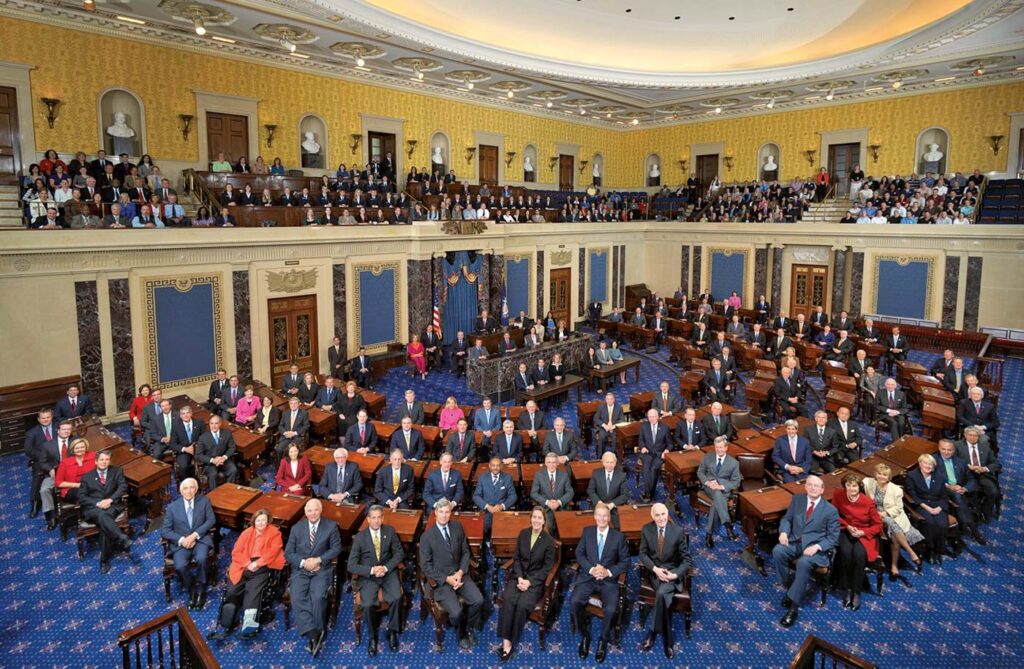
The political stakes make this even clearer. Republicans who go into the 2026 midterms without having passed election integrity legislation, without having restored pay for federal workers, and without having demonstrated that their majority is capable of doing something with the power voters gave them will face an energized Democratic base and a demoralized Republican one. The formula for a midterm wipeout has been established repeatedly in American political history: the in-party fails to deliver, the base stays home, and the opposition sweeps in. Republicans have an opportunity to avoid this outcome. The opportunity requires Senate leadership to act. Specifically, it requires Majority Leader Thune to bring the Save America Act to the floor under a modified cloture rule, and to do so before the 2026 campaign season makes action politically impossible.
The history supports this. The precedent supports this. The public opinion polling supports this. The welfare of 120,000 federal workers and their families supports this. The democratic principle that election majorities should be able to govern supports this. The Senate has changed the cloture rule six times in its history. It has changed it to go in both directions, to make obstruction harder and to make confirmation easier, and both Democratic and Republican majorities have been willing to act when the moment required it. The seventh change is a small price to pay for restoring integrity to American elections and restoring pay to the American workers who are suffering while the Senate debates procedure. The question is whether Senate Republican leadership has the will to act before the opportunity closes. The answer to that question will do more to determine the outcome of the 2026 midterms than any other single decision the Senate makes this year.
If you enjoy my work, please subscribe https://x.com/amuse/creator-subscriptions/subscribe.
Sponsored by the John Milton Freedom Foundation, a nonprofit dedicated to helping independent journalists overcome formidable challenges in today’s media landscape and bring crucial stories to you.
READ NEXT: White House Dinner Shooting Suspect Drops Shocking Demand
























It has become all too obvious that we no longer have a true representative democracy.
The original idea of representative democracy was that the majority of voters, within the strict guidelines of the Constitution, would be the people in control of our government.
WE, the American people, are the government … at least we are supposed to be. Our representatives are supposed to do the will of the American people.
85% of the people want this passed and it is not against the Constitution to do this.
Why isn’t this already part of our law?
Congress … DO IT or we will have to get rid ( vote out or legally remove ) of all who oppose this bill! And we WILL! We won’t forget who you are!
If you are a so-called conservative, but do nothing, we will count that as being against this bill!
You do nothing and you will be considered to be a RINO!
No government is a true government unless ONLY the legal people of the country are those who can legally vote!