





Republicans in the South Carolina Senate declined to pursue a new congressional redistricting effort this year, frustrating President Donald Trump, who had hoped additional map changes could strengthen GOP advantages in the Deep South ahead of the 2026 midterm elections.
The Republican-controlled chamber voted against extending its legislative session to consider a proposal that would have redrawn congressional districts in a way that could eliminate the state’s lone Democratic-held seat.
The effort failed in a 29-17 vote, despite Trump urging Republicans earlier Monday to support the extension and move forward with the redistricting push.
“South Carolina Republicans: BE BOLD AND COURAGEOUS, just like the Republicans of the Great State of Tennessee were last week! Move the U.S. House Primaries to August, leave the rest on the same schedule,” Donald Trump wrote in a Truth Social post.
Democrats in the South Carolina Senate praised the outcome, saying in a post on X that they “welcome” the vote and argued the proposed extension “would have allowed the legislature to return for a politically motivated special session on congressional redistricting.”
Last week, Republicans in the South Carolina House of Representatives voted to extend the state’s legislative calendar, preserving the possibility of redrawing congressional districts following a major Supreme Court of the United States ruling involving the Voting Rights Act.
For the extension to take effect, however, the proposal also required approval from the South Carolina Senate.
The Senate, which is currently composed of 34 Republicans and 12 Democrats, ultimately declined to move forward with the effort.
Earlier this month, the office of Henry McMaster told The Post and Courier that the governor did not plan to call a special legislative session focused on congressional redistricting.
The outcome marks a notable setback for Trump, who has pushed for more aggressive electoral positioning in Republican-controlled states ahead of the 2026 midterm elections.
Why Redistricting Became a Political Flashpoint
Redistricting typically occurs once every 10 years following the U.S. Census, but some states have pursued mid-decade map revisions for political or legal reasons.
Following the 2020 Census, South Carolina Republicans already redrew congressional districts in ways heavily criticized by Democrats and voting rights groups. One district — the state’s 1st Congressional District — became the focus of prolonged legal challenges alleging racial gerrymandering.
Earlier this year, the Supreme Court sided with South Carolina Republicans in a major decision allowing the state’s congressional map to remain in place.
That ruling overturned a lower court decision that had declared South Carolina’s congressional map an unconstitutional racial gerrymander, allowing the Republican-drawn district lines to remain in place.
The Court concluded that challengers failed to prove state lawmakers prioritized race over partisan political considerations when designing the map.
Trump Allies Wanted Broader GOP Electoral Advantages
Supporters of additional redistricting argued:
- Population shifts justified updated maps
- Republicans should maximize state-level power where possible
- Democrats have historically benefited from aggressive districting in some states
Critics countered that reopening maps mid-decade could trigger renewed litigation, voter backlash, and accusations of overt partisan manipulation.
South Carolina’s Current Congressional Breakdown
Republicans already dominate South Carolina’s congressional delegation.
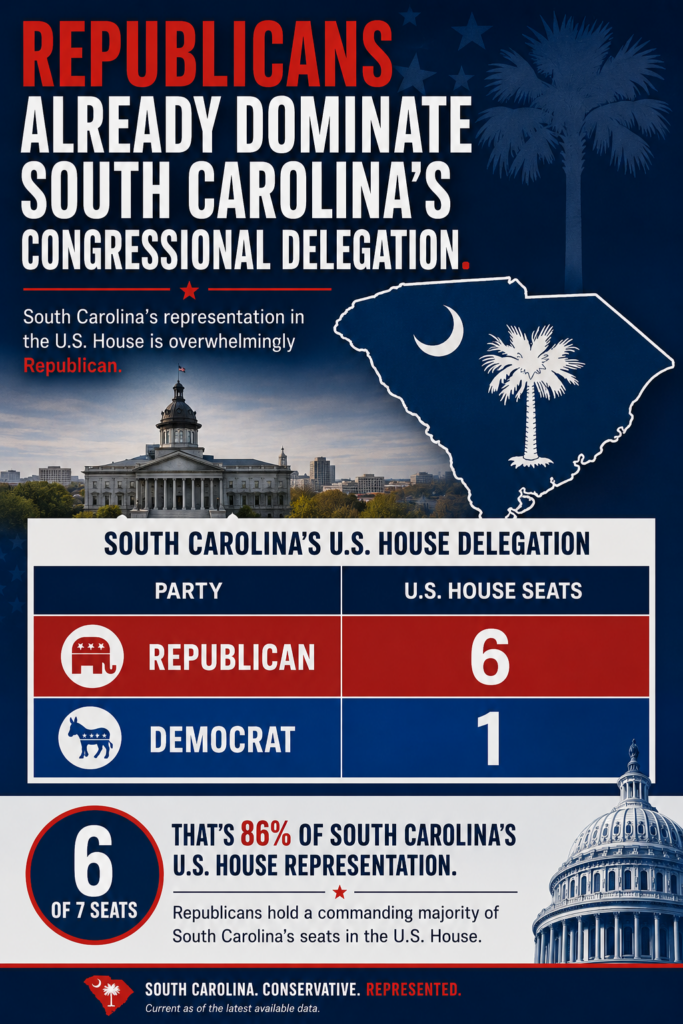
The lone Democratic district is represented by Jim Clyburn, one of the most influential Democrats in Congress.
Republicans have maintained strong statewide political advantages for years, particularly across rural regions and rapidly growing suburban areas surrounding Charleston and the Greenville-Spartanburg-Anderson metropolitan corridor.
Legal and Political Risks Loomed Large
Some Republican lawmakers reportedly worried that reopening the map process so soon after winning a Supreme Court battle could create unnecessary political and legal complications.
Election law experts have warned that aggressive mid-cycle redistricting efforts can:
- Trigger expensive lawsuits
- Create voter confusion
- Disrupt campaign planning
- Generate national media backlash
Democrats have repeatedly accused Republicans nationwide of attempting to further entrench political power through partisan gerrymandering following Trump’s July 2025 push urging Texas officials to redraw congressional maps in hopes of creating an additional five Republican-leaning seats ahead of the 2026 midterm elections.
Republicans argue redistricting remains a constitutionally authorized legislative function controlled by elected state governments.
Broader National Implications
The South Carolina decision could influence how aggressively Republicans pursue redistricting fights elsewhere.
Several states remain under pressure from activists and strategists seeking to gain even marginal congressional advantages before the next election cycle.
Control of the United States House of Representatives remains narrowly divided, meaning even small map changes in a handful of states could affect future congressional majorities.
At the same time, courts across the country continue grappling with disputes involving:
- Racial gerrymandering claims
- Partisan district manipulation
- Voting Rights Act protections
- Minority representation standards
FAQ
What did South Carolina Republicans decide?
Republican legislative leaders decided not to pursue another congressional redistricting effort during the current legislative session.
Why is the decision seen as a setback for Trump?
Trump and his MAGA allies have continued encouraging additional redistricting efforts in Republican-controlled states as part of a broader strategy to maximize GOP opportunities in the United States House of Representatives ahead of the 2026 midterm elections.
Has South Carolina already redrawn its maps recently?
Yes. The state adopted new congressional maps after the 2020 Census, leading to major legal battles that eventually reached the Supreme Court.
What did the Supreme Court decide?
The Supreme Court upheld South Carolina’s current congressional map earlier this year.
Could redistricting still happen later?
It remains possible in future sessions, though current legislative leaders say they are not planning to revisit the issue now.
Conclusion
South Carolina Republicans’ decision to avoid reopening congressional redistricting marks an important moment in the broader national battle over electoral maps and political power.
While Trump and allied strategists pushed for additional GOP gains through mid-decade redistricting, many state lawmakers appeared reluctant to reignite major legal battles and political controversy so soon after securing a significant victory at the Supreme Court.
With congressional control expected to remain highly competitive, the fight over redistricting strategy is unlikely to disappear anytime soon.
READ NEXT: Authorities Thwart Terror Attack Aimed At World-Famous Landmark