


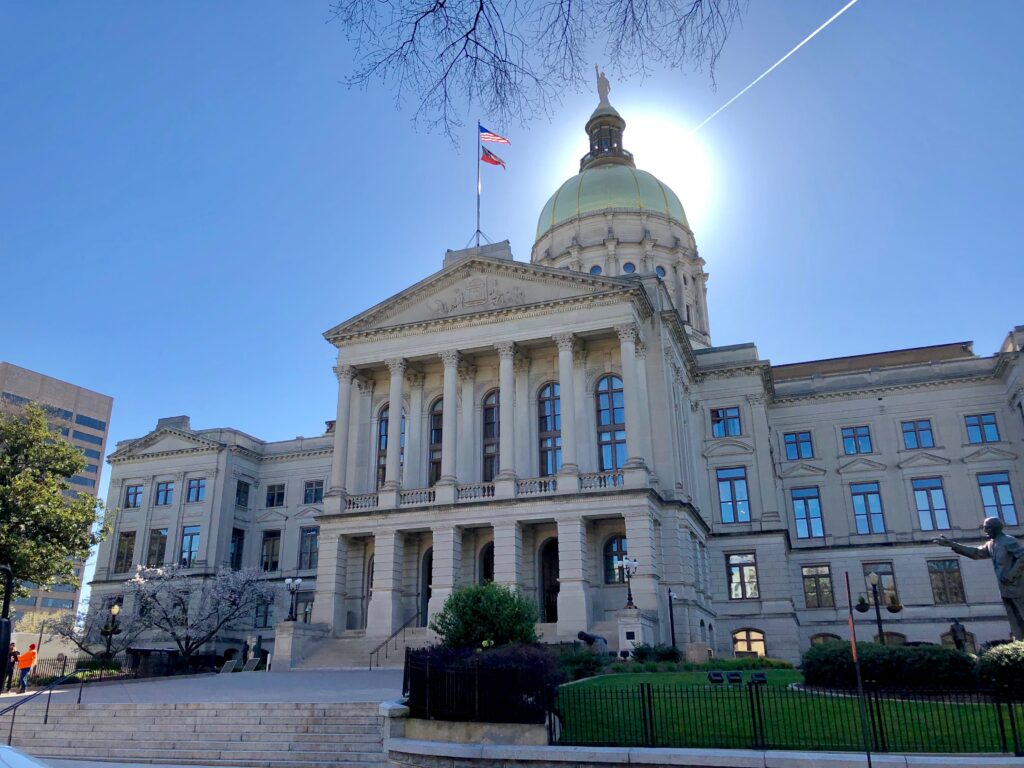
Georgia Gov. Brian Kemp has triggered a high-stakes political fight that could reshape the state’s power map for years, calling a special legislative session to redraw congressional and state legislative districts ahead of the 2028 election cycle.
The move, set for June 17 in Atlanta, immediately set off accusations of a coordinated power struggle over who controls Georgia’s political future—just months after a pivotal ruling from the U.S. Supreme Court that altered the legal landscape around race-based redistricting.
POWER PLAY IN GEORGIA’S CAPITAL
Kemp’s proclamation effectively opens the door for Republican lawmakers to revisit district lines in a way that could lock in structural advantages before the next full political turnover in the state.
Behind the procedural language—“special session” and “map adjustments”—is a far sharper reality: both parties see a narrowing window to define Georgia’s political battlefield before 2028 reshuffles control.
Republicans, according to election analysts at VoteHub, believe the new maps could potentially net the GOP up to two additional U.S. House seats while further strengthening their hold on the state legislature.
NEWS — Georgia Gov. Brian Kemp has called a special session to redraw Georgia’s congressional, state House, and state Senate districts before the 2028 elections.
— VoteHub (@VoteHub) May 13, 2026
The new maps could net Republicans two U.S. House districts and further entrench GOP power in GA’s General Assembly.
DEMOCRATS CALL IT A GRAB FOR POWER
Democrats immediately framed the move as an aggressive attempt to entrench Republican control at the expense of voters.
Raphael Warnock warned that the decision reflects a broader national strategy to “hold on to power” by reshaping electoral representation before voters can respond at the ballot box.
“We just learned that Georgia is moving forward with gerrymandering for 2028,” Sen. Warnock (D-GA) posted on X. “There is an extreme movement in this country that will stop at nothing to hold on to power, even if it means stripping representation away from millions. I will fight this with everything I have.”
We just learned that Georgia is moving forward with gerrymandering for 2028.
— Reverend Raphael Warnock (@ReverendWarnock) May 13, 2026
There is an extreme movement in this country that will stop at nothing to hold on to power, even if it means stripping representation away from millions.
I will fight this with everything I have.
The Georgia Democrat Party went further, arguing the redistricting push comes at a moment of heightened vulnerability for minority representation and could weaken Black voter influence across key districts.
“Governor Kemp’s decision to call a special session to redraw our maps immediately in the wake of the gutting of the Voting Rights Act is not only a brazen attempt to take away the voting power of Black Georgians – it shows just how scared Republicans are of Georgia voters,” the group said in a statement.
THE SUPREME COURT EFFECT
The underlying catalyst is a recent shift in legal constraints following the Supreme Court’s ruling that narrowed the scope of race-based gerrymandering challenges. That decision has effectively reopened contested terrain across multiple states, giving legislatures more room to redraw maps under new legal assumptions.
Kemp’s move is being interpreted as an early attempt to capitalize on that opening before political conditions change again.
A REGIONAL REDISTRICTING ARMS RACE
Georgia is not acting in isolation.
Across the South, Republican-led states are accelerating map redraws ahead of future election cycles:
- Florida and Tennessee have already enacted new congressional maps
- Alabama and Louisiana are expected to follow with additional changes
- Missouri’s Supreme Court recently upheld new district lines projected to benefit Republicans
- South Carolina GOP Gov. Henry McMaster is reportedly preparing a similar special session that could eliminate one remaining Democrat seat
Taken together, the moves point to a widening regional effort to lock in electoral advantages before political conditions shift again.
THE REAL FIGHT UNDERNEATH THE MAPS
While supporters of the Georgia Freedom Caucus praised the session as an opportunity to “end racial gerrymandering” and modernize election systems, opponents argue the process is less about fairness and more about structural entrenchment.
“We must not let this opportunity go to waste,” the group said on social media. “The time is NOW to scrap the machines and go to paper ballots. The time is NOW to end racial gerrymandering and provide Georgians with fair electoral maps.
🚨BREAKING!
— Georgia Freedom Caucus (@FreedomCaucusGA) May 13, 2026
Georgia Governor Brian Kemp has called for a special session to redraw Georgia’s congressional and legislative maps.
Furthermore, the proclamation allows for the enactment of much-needed election law reform.
We must not let this opportunity go to waste.
The time… pic.twitter.com/gGac0lWAMS
Republican-aligned groups are pushing the effort as a necessary correction to prior court rulings. Democrats see something more deliberate: a coordinated attempt to reshape representation before demographic and electoral trends make it harder to hold power.
WHAT COMES NEXT
The June special session is expected to focus directly on new congressional and legislative maps that could remain in place through the 2028 cycle—meaning their impact may not be fully felt until the next presidential election reshapes national political control.
For now, Georgia has become the latest front in a broader national contest where the maps themselves—not just the votes—are the battlefield.
READ NEXT: Senate Hopeful Faces Mounting Questions Over Phony Medical License Claims