
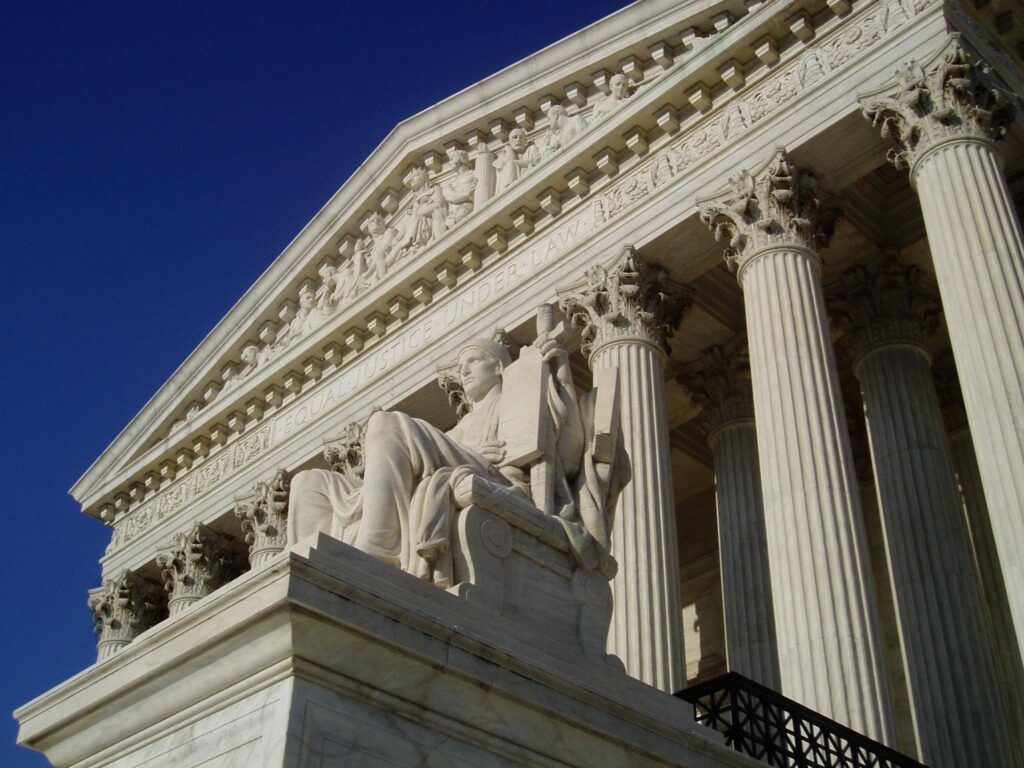
The U.S. Supreme Court on Tuesday handed Republicans a major election-year victory, clearing the way for Alabama to use a congressional map that favors the GOP despite a lower court’s finding that the plan intentionally discriminated against Black voters.
In a 6-3 decision, the Supreme Court froze a ruling from a federal district court that had blocked Alabama’s Republican-drawn congressional map from being used in this year’s elections. The lower court had concluded that state lawmakers intentionally discriminated against Black voters when they redrew congressional districts in 2023.
The decision could have significant implications for the control of Congress.
Under the map used in 2024, Alabama was required to maintain two majority-Black congressional districts after years of litigation under the Voting Rights Act. One of those districts elected Democrat Rep. Shomari Figures.
The newly approved map reduces that advantage and could allow Republicans to reclaim the seat, strengthening GOP efforts to expand their House majority.
The Supreme Court’s ruling comes just months after its controversial decision in Louisiana v. Callais, which significantly narrowed longstanding protections for minority voters under the Voting Rights Act. Civil rights organizations have warned that the decision is already reshaping congressional maps across the South. (RELATED: Louisiana Approves New Congressional Map, Setting Up Another Voting Rights Showdown)
In an unsigned opinion, the Court’s conservative majority said the three-judge district court panel—which included two judges appointed by President Donald Trump—failed to apply the “updated” legal standards established in the Callais decision.
The justices said the lower court “did not heed the presumption of legislative good faith” when it concluded Alabama lawmakers acted with “discriminatory animus.”
The Court also found fault with the challengers’ case, concluding that the judges improperly blocked the map even though plaintiffs failed to produce an alternative congressional map that preserved the same political goals sought by Republican lawmakers.
Alabama Republican Gov. Kay Ivey celebrated the ruling and quickly announced that the state will move forward with a special primary election under the new district lines on Aug. 11.
“The U.S. Supreme Court confirmed what I have said all along and that is that Alabama knows our state, our people and our districts best,” Ivey said in a statement. “Today’s decision is a win for the people of Alabama and our elections.”
SCOTUS confirmed what I have said all along. Today’s decision is a win for the people of Alabama and our elections. Alabama is doing our part to keep America strong, and I am proud our state continues to fight the fight. I will see y’all at the polls August 11! #alpolitics
— Governor Kay Ivey (@GovernorKayIvey) June 3, 2026
The ruling drew sharp criticism from the Court’s liberal wing.
Justice Sonia Sotomayor, joined by Justices Elena Kagan and Ketanji Brown Jackson, accused the majority of disregarding lower court findings while creating election chaos just months before voters head to the polls.
“Just as Alabama doubled down on racial discrimination, the Court today doubles down on chaos,” Sotomayor wrote in a lengthy dissent. “Because I choose to defend the rule of law and the right of all Alabamians to participate equally in democracy, I respectfully dissent.”
Election officials have warned that implementing the new map will require hundreds of thousands of voters to be reassigned to new districts and educated about where they will cast ballots in a compressed timeframe.
Republicans argue that race should play a limited role in drawing district lines and that courts have become too aggressive in forcing states to create districts based on racial demographics. Voting-rights advocates counter that such maps dilute minority voting strength and undermine protections guaranteed under the Voting Rights Act.
For Republicans, Tuesday’s ruling represents another major victory in a years-long effort to reshape election law and redistricting standards nationwide.
With the 2026 midterms approaching and control of the House once again expected to be decided by a handful of competitive districts, the consequences of the Court’s decision could extend far beyond Alabama.
READ NEXT: Biden’s Lawfare Strategy May Have Backfired On His Own Party