



Attack reaches deep into Russia’s Baltic Fleet hub
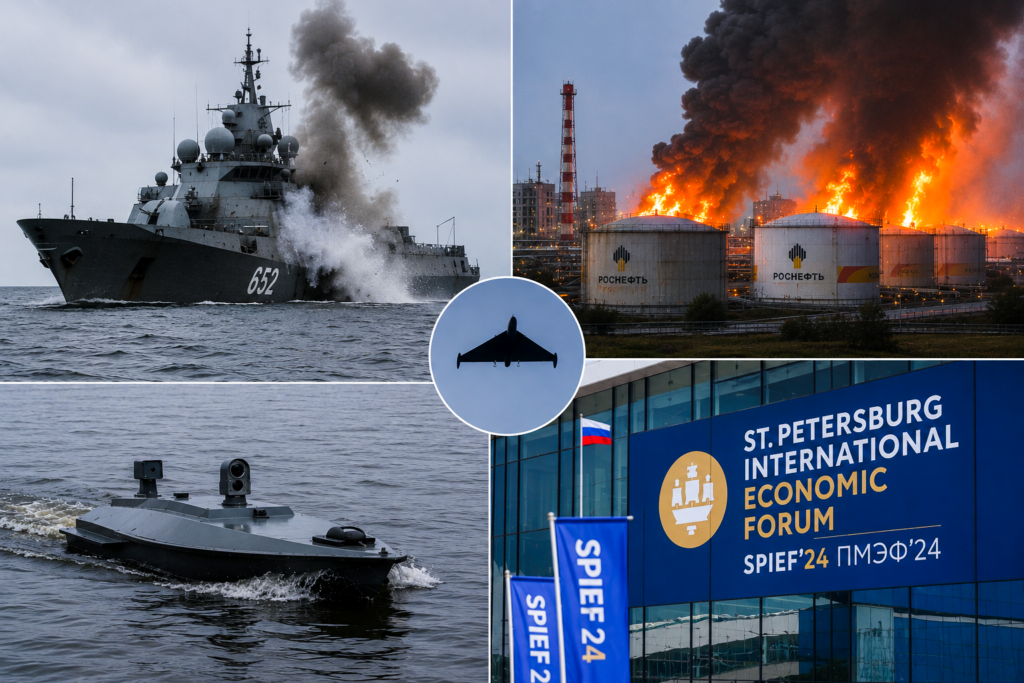
Ukraine carried out one of its most ambitious long-range drone operations of the war Wednesday, striking a Russian guided-missile warship in dry dock and setting fire to a major oil terminal near St. Petersburg, according to Ukrainian officials and open-source imagery.
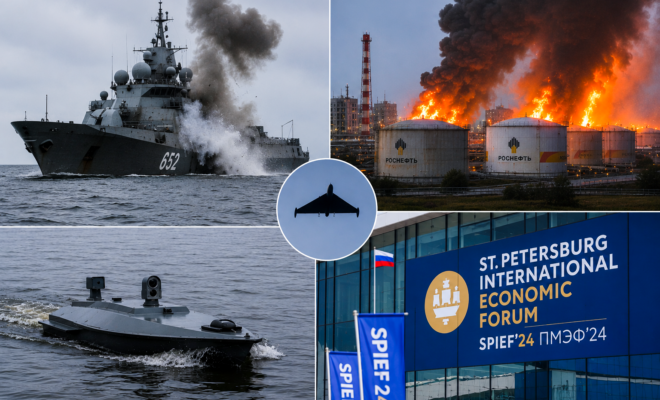
The coordinated attack targeted the Steregushchiy-class corvette Boikiy at Kronstadt naval base and the St. Petersburg Oil Terminal, sending thick plumes of smoke into the sky over Russia’s second-largest city as the annual St. Petersburg International Economic Forum (SPIEF) opened.
Absolutely embarrassing morning for Russian President Vladimir Putin. As Ukrainian one-way attack drones fly nearly unimpeded over St. Petersburg – over 500 miles from Ukraine – several slamming into a major oil terminal in the city, starting massive fires and creating pillars of… pic.twitter.com/wenz5gIu6f
— OSINTdefender (@sentdefender) June 3, 2026
The operation underscored Kyiv’s growing ability to project force hundreds of miles beyond the front lines, targeting both military and economic infrastructure deep inside Russian territory.
Warship hit during repairs
Video released by Ukrainian sources and subsequent satellite imagery appeared to confirm multiple drone strikes on the Boikiy, a Project 20380 guided-missile corvette assigned to Russia’s Baltic Fleet.
The vessel was reportedly undergoing maintenance in dry dock at Kronstadt, a strategically important naval base located on Kotlin Island west of St. Petersburg.
Footage showed drones striking the ship’s midsection before a large fire erupted onboard. Analysts reviewing the imagery noted significant structural damage, including apparent deformation of the upper mast structure that houses key radar and air-surveillance systems, including the Monument-A and Furke-2 arrays.
Some observers have suggested the damage may be severe enough to render the vessel a total loss, though independent confirmation remains unavailable.
Wow! In addition to the targeting of the oil terminal and other energy infrastructure in St. Petersburg, during this morning’s large-scale Ukrainian drone attack against Northwestern Russia, the Veleshchynskyi Dry Dock in Kronstadt was also heavily targeted, setting fire and… pic.twitter.com/5ebDsFGRWG
— OSINTdefender (@sentdefender) June 3, 2026
The Boikiy is among the more modern surface combatants in Russia’s Baltic Fleet and is armed with Kh-35U anti-ship cruise missiles, making it a valuable naval asset.
Oil terminal also targeted
At the same time, Ukrainian drones struck the St. Petersburg Oil Terminal, one of the region’s most important energy-export facilities.
The terminal contains 21 large storage tanks and handles approximately 12.5 million tonnes of petroleum products annually. Damage assessments remain ongoing, but the selection of the target carried strategic significance beyond the immediate physical destruction.
Petroleum exports remain a critical source of revenue for the Russian government and help fund Moscow’s military operations. By targeting a major export hub, Ukraine appears to be continuing its broader campaign against Russia’s energy infrastructure.
Witnesses reported thick gray smoke visible from central St. Petersburg. Authorities temporarily halted operations at Pulkovo Airport and restricted mobile internet services as emergency crews responded.
Our long-range sanctions carried out by the warriors of the Security Service of Ukraine, the Unmanned Systems Forces, the Special Operations Forces, the Defense Intelligence of Ukraine, and the State Border Guard Service of Ukraine have yielded good results. Important facilities… pic.twitter.com/esxYMexU8d
— Volodymyr Zelenskyy / Володимир Зеленський (@ZelenskyyUa) June 3, 2026
Timing sends a political message
The timing of the operation was difficult to ignore.
The strikes occurred on the opening day of SPIEF, often described as Russia’s premier economic showcase event and frequently compared to a Russian version of Davos. Thousands of delegates from more than 130 countries were gathering at the ExpoForum Convention and Exhibition Centre when the attacks occurred.
The oil terminal sits roughly 17 kilometers from the conference venue.
For Ukraine, the operation appeared designed not only to damage infrastructure but also to challenge the Kremlin’s narrative that Russia’s economic centers remain insulated from the war.
By reaching targets in St. Petersburg — President Vladimir Putin’s hometown and one of Russia’s most symbolically important cities — Kyiv demonstrated that even areas far removed from active combat remain vulnerable.
Foreign business leaders, diplomats, and government officials attending the forum were confronted with visible evidence of the conflict’s reach as smoke rose over the city.
In St. Petersburg, participants are rushing to the opening of the 4-day economic forum, which will be attended by representatives of several countries, and where Putin is also scheduled to speak. They’re probably deciding right now whether to send a body double instead?
— Anton Gerashchenko (@Gerashchenko_en) June 3, 2026
The main… https://t.co/cgFNw24Xum pic.twitter.com/CLOsOAbF7V
Drones exploit gaps in air defenses
According to Ukrainian sources, the operation was jointly conducted by the Unmanned Systems Forces and the Security Service of Ukraine.
Operators reportedly employed FP-1 and FP-2 one-way attack drones controlled in real time. The drones are believed to have flown low over the waters of the Gulf of Finland, using terrain masking and low-altitude flight profiles to reduce detection by Russian air-defense systems.
The route allowed the aircraft to travel more than 600 miles from Ukrainian-controlled territory before reaching their targets.
If confirmed, the mission would represent another example of Ukraine’s increasingly sophisticated long-range strike capability and raise fresh questions about the effectiveness of Russian air defenses around key strategic facilities.
Strategic implications
Beyond the immediate damage, the dual strike highlighted an evolving reality of the war.
For much of the conflict, Russia has maintained the image that its major political and economic centers remain largely protected from direct attack. Wednesday’s operation challenged that perception by simultaneously hitting a frontline military asset and a major economic facility in the country’s northwestern heartland.
The attack also demonstrated how relatively inexpensive drones can threaten high-value targets traditionally protected by layers of air defenses and geographic distance.
Russian officials condemned the strikes and characterized them as an attempt to embarrass the country’s leadership during a major international event. The Kremlin pledged a continued and systematic response.
Whether the Boikiy ultimately returns to service and how quickly the oil terminal resumes normal operations will help determine the long-term military and economic impact of the attack.
What is already clear is that Ukraine has shown an ability to reach some of Russia’s most sensitive assets at a politically consequential moment, extending the battlefield far beyond the trenches and artillery duels that continue to dominate the front.
READ NEXT: The Pentagon Is Fighting Tomorrow’s War With Yesterday’s Assumptions