

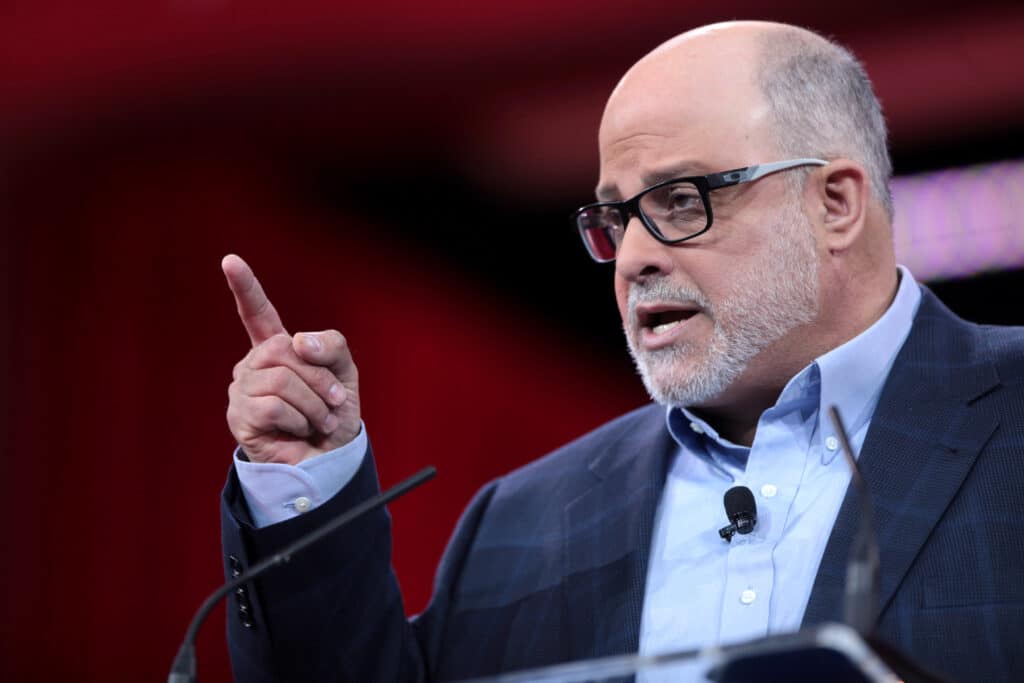
Conservative commentator and Fox News host Mark Levin is raising concerns about a reported civilian nuclear cooperation agreement between the Trump administration and Saudi Arabia, questioning whether the deal could weaken longstanding U.S. nonproliferation standards.
Levin highlighted the issue Friday by sharing a report on social media and asking followers, “Everyone ok with this?”
Everyone ok with this?https://t.co/cBXvvZ0OJc
— Mark R. Levin (@marklevinshow) June 5, 2026
The post referenced a report that Washington and Riyadh are nearing completion of a civilian nuclear cooperation agreement that could soon be submitted to Congress for review.
Concerns Focus on Uranium Enrichment
The controversy centers on reports that the proposed agreement may depart from the so-called “gold standard” traditionally included in some U.S. nuclear cooperation agreements.
Under that framework, partner nations agree not to enrich uranium domestically or reprocess spent nuclear fuel, activities that can potentially contribute to the development of nuclear weapons.
According to reports, the proposed agreement would permit Saudi Arabia to enrich uranium and would not require adoption of the International Atomic Energy Agency’s Additional Protocol, a set of enhanced inspection and verification measures designed to strengthen safeguards against nuclear proliferation.
Supporters argue the agreement would help advance Saudi Arabia’s civilian nuclear energy ambitions while strengthening strategic ties between Washington and Riyadh.
Critics across the political spectrum see significant risks.
Lawmakers Raise Nonproliferation Concerns
Several lawmakers and nonproliferation experts have warned that easing traditional safeguards could increase the risk of a nuclear arms race in the Middle East.
Rep. Brad Sherman (D-Calif.), a longtime critic of nuclear cooperation with Saudi Arabia, told Jewish Insider that strong restrictions remain essential.
“There’s only one reason not to have nonmilitarization safeguards, and that’s militarization,” Sherman told the outlet.
He further argued that allowing Saudi Arabia to move closer to an independent nuclear capability could encourage neighboring countries to pursue similar programs.
Former Trump administration official Elliott Abrams also expressed skepticism, arguing that the United States should support civilian nuclear energy while avoiding arrangements that could bring partner nations closer to acquiring weapons capabilities.
Congressional Review Looms
The reported agreement has not yet been publicly finalized, and many details remain unclear.
If completed, the deal would likely face intense scrutiny on Capitol Hill, particularly regarding uranium enrichment, inspections, and nonproliferation safeguards.
Under Section 123 of the Atomic Energy Act, any formal U.S.-Saudi civilian nuclear cooperation agreement would be submitted to Congress for review. Unless both chambers pass resolutions blocking the deal within a 90-day review period, the agreement would automatically take effect.
While many details remain unresolved, the proposed agreement is already emerging as a major flashpoint in the debate over Middle East security, nuclear proliferation, and the future of the U.S.-Saudi partnership.
READ NEXT: The Soviet Strategy That Won Silicon Valley’s Attention


















It was all Saudis on 9/11…
They are floating on a sea of oil.
What do they possibly need a nuclear energy program for?
Basic Questions.
It is a very bad example for Middle East Countries, especially IRAN !!! ISRAEL COULD BE IN GREAT DANGER!!! NOT OK!!!