









Marines don’t like to be called soldiers – because they are “marines” first, last and always – and these days it would be hard to confuse the two. On the battlefield U.S. marines also don’t look like those serving in the U.S. Army because for nearly 20 years, the United States Marines Corps has been wearing a unique pattern of camouflage – MARPAT, or MARine PATtern. It is a digital camouflage pattern that was introduced in 2002 with the Marine Corps Combat Utility Uniform (MCCUU), which replaced the Camouflage Utility Uniform (CUU).
While it is “digital,” it should not be confused with Army’s now retired Universal Camouflage Pattern (UCP), and any marine will quickly tell you their version is vastly superior in a number of ways.
Brief History of USMC Camouflage
The Corps proved to be on the forefront of early camouflage development – even if it was rather basic and not for concealment. Along with the U.S. Army, the USMC had adopted khaki uniforms as its universal “summer” field uniform in the early 20th century because the clothing was comfortable but also because it didn’t stand out like the dark blue uniforms that had been worn throughout the 19th century.
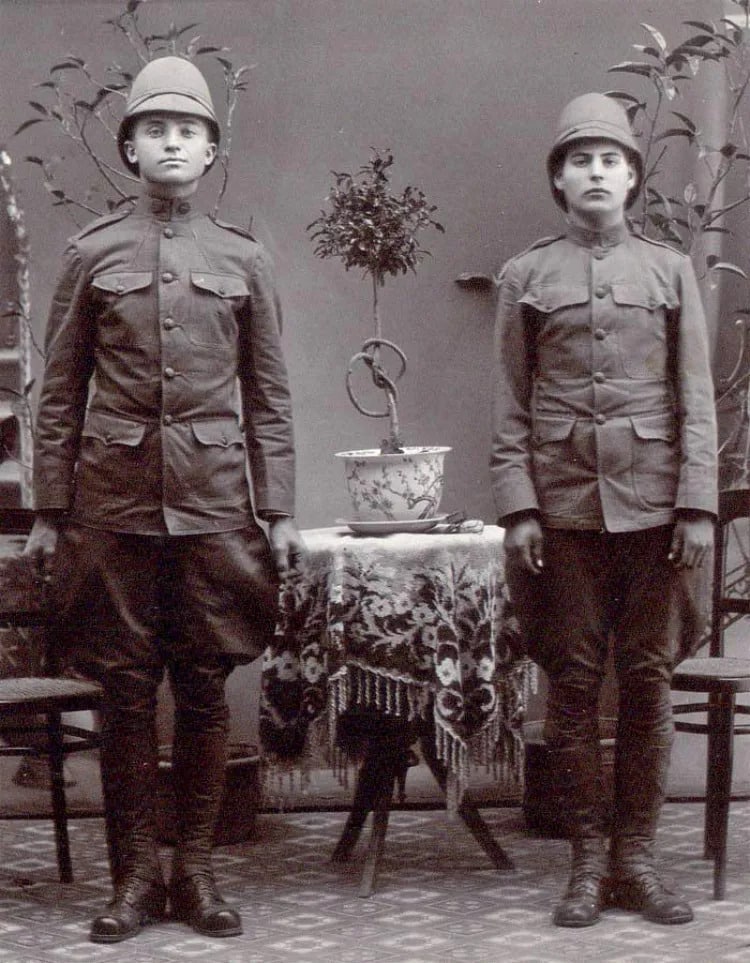
However, khaki was not wholly an American innovation, as the British had been wearing khaki – which comes from the Persian word for “dust” – in India since the 1840s. By the turn of the century the U.S. military had imported English/Indian khaki; first for officers and later for all ranks.
During the Second World War the USMC used its olive green P41 Herringbone Twill (HBT) uniform in the early campaigns in the Pacific. However, by the mid-point of the war some marines began to wear a camouflage pattern designed by Norvell Gillespie, a horticulturist and garden editor of Better Homes and Gardens. It consisted of a spot design of greens and browns, and was notable for being reversible to a tan/brown variation that could be used in fall and early spring conditions. It featured five colors in total and its spotty pattern earned it the nickname “frogskin.”
The first large scale combat usage of that camouflage pattern by the Marine Corps during WWII took place during the Solomon Island Operations, specifically on Bougainville in November of 1943. The uniforms proved extremely well suited for the dense jungle and foliage on the island. However in contrast, several weeks later during the invasion of the island of Tarawa, which was a small sandy island with little vegetation other than palm trees, the camouflage was far less effective.
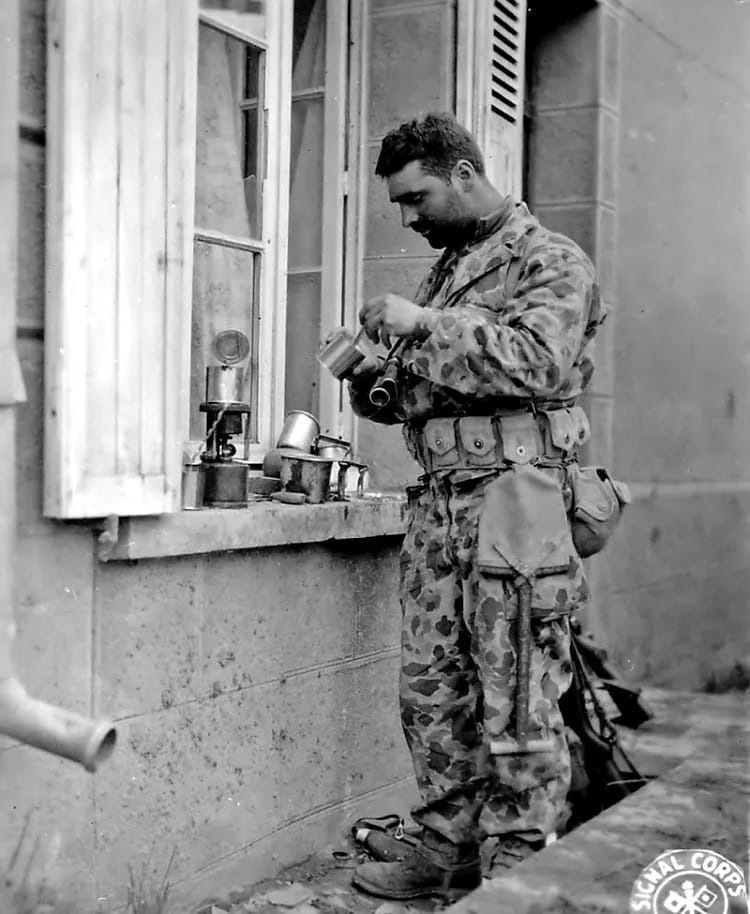
During the Cold War, the Marine Corps adopted a variety of other patterns of camouflage, but generally followed the same basic woodland pattern as the Army. While the military sought standardize camouflage in the 1980s, by the 21st century things went another direction.
Blame the conflicts in Afghanistan and Iraq.
Even decades before the recent U.S. involvement in the Middle East, military planners had found that its woodland pattern camouflage wouldn’t be ideal for use in a desert environment. As a result the Army developed its Desert Battle Dress Uniform (DBDU) camouflage in 1977, and it utilized a six-color scheme that became known as the “chocolate chip” pattern due to fact that it looked a bit like cookie dough. The pattern was tested in the American southwest, where it performed adequately, but was far less successful in the 1991 Gulf War.
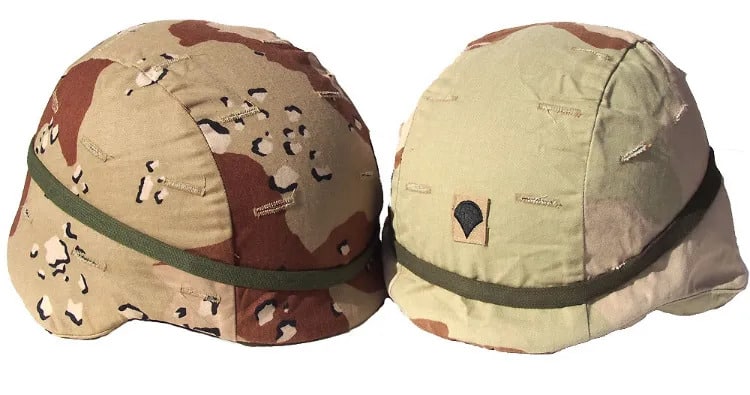
As a result the U.S. military developed another pattern specifically for the Middle East, with desert soil samples from Saudi Arabia and Kuwait examined to create a pattern that better blended into the terrain in the region. This three-color pattern camouflage was officially known as Desert Camouflage Uniform (DCU). It was reportedly nicknamed “coffee stain” by some U.S. personnel due to its large splotches of browns on the otherwise khaki fabric. This pattern was used in Operation Enduring Freedom in Afghanistan and Operation Iraqi Freedom.
Once again the pattern seemed to miss the mark.
Both the Army and the Marines sought to develop a new camouflage. One was successful and is among the best camo patterns in use today while the other is simply best forgotten.
Don’t Confuse MARPAT With UCP
While the aforementioned Army UCP and MARPAT may seem similar and were introduced around the same time, these are two distinct and largely unrelated patterns.
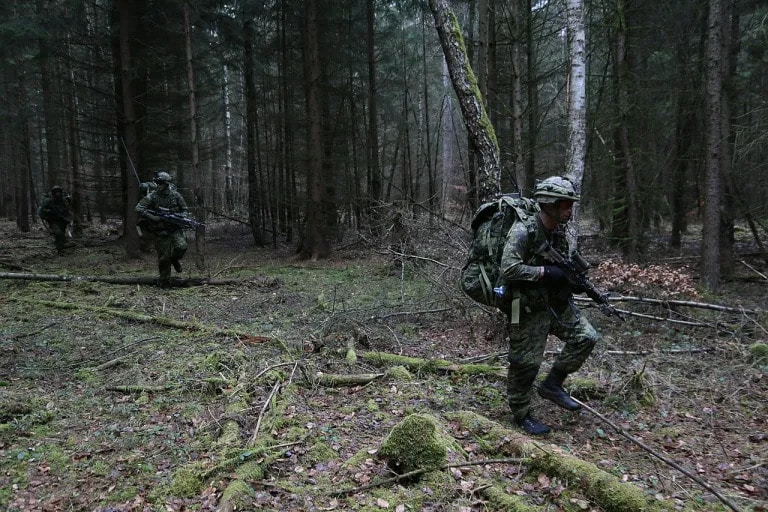
Army photo by Spc. Tyler Kingsbury/Public Domain)
MARPAT, which was developed in conjunction with the aforementioned MCCUU to replace the Camouflage Utility Uniform, was based on the Canadian CADPAT pattern – but it must be stressed that the Canadian military, which began development in 1998, had absolutely nothing to do with this pattern. It also was formed by small rectangular pixels of color – and as with the UCP the thinking was that this would be a more effective camouflage than because it could mimic the dappled textures and rough boundaries found in natural settings. The idea is simple, small “blobs” or pixilated fractals, would blend into nature better than big “blobs” of colors.
While the Marines didn’t completely start from scratch as the CADPAT served as a basis, the USMC design team – initially with the assistance of Marine Scout Snipers Kenneth G. Henley and John Joseph Heisterman, Jr. – conducted research into more than 150 different camo patterns in use by militaries around the world. In the testing the effectiveness of past camouflages, including Rhodesian Brushstroke and even Vietnam War-era “tigerstripe” provided an influence in the direction the designers took.
Preliminary development for MARPAT began in April 2000, and field testing began in 2002 – with the Marines filing for a patent for the pattern in June 2001.
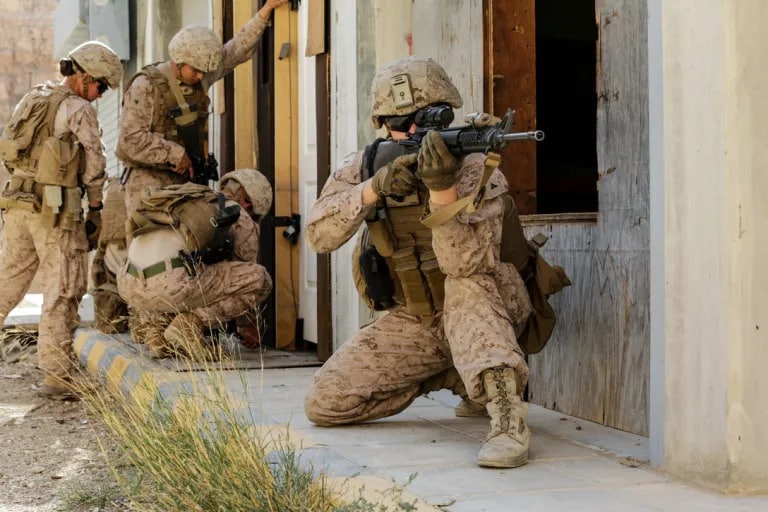
The USMC conducted rigorous field-testing, which included different environments in both day and night operations and with nigh vision and various optics. MARPAT was found to be far more effective than the splotches woodland pattern in use at the time. It was also found to be effective in wet conditions – an important consideration given the Marines involvement in amphibious operations. The pattern proved effective when wet even when viewed with night vision illuminated with infrared scopes where other patterns would reflect the light in a way that would seem solid.
The reasons were due to the fact that the fractal patterns did a better job of breaking up the light even when seen via IR scopes.
One factor in its success is that the patterns were actually produced by a highly complex equation that randomly placed the pixels of color in a way that would match the visual texture of typical background.
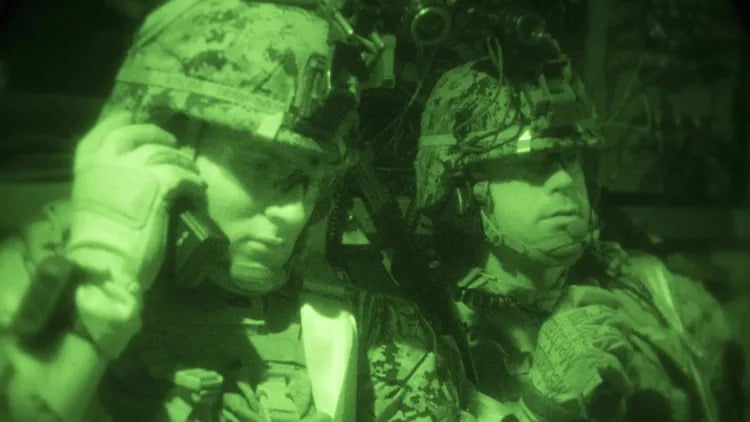
Africa talks into a radio prior to conducting a casualty evacuation training exercise with Portuguese NATO allies during Exercise Real Thaw 17 at Beja, Portugal March 9, 2017. This photos how the camouflage blends in at night even when seen through IR (Photo: U.S. Marine Corps photo by Sgt. Jessika Braden/Public Domain)
However, the fact that it looked like pixels on a computer screen or TV was not without controversy as it was quite a striking change for such a conservative institution. It was also noted that MARPAT does stand out when seen against a white background, but it was quickly found that the pattern was highly effective in an operative environment. This is because its textured appearance along with lack of hard edges made it far more effective than traditional patterns.
The pattern was adopted and made its official debut at Camp Lejuene, North Carolina in January 2002 – while the first of the MARPAT-pattern helmet covers were produced a year later. The Marine Corps replacement of the BDU and DCUT was completed early October 2004, a year ahead of the original requirement date and this proved to be the fasted time for a U.S. military-developed camouflage pattern to go from concept to full adoption.
The “pixel” look of the uniform may be its most distinguishing feature, the MCCUU also changed the general “cut” of the uniform – and this includes new shoulder pockets along with VELCRO fasteners on the chest pockets. The sleeve cuffs fastened with inboard buttons instead of outboard buttons as a way to prevent snagging. The MCCUU is also made with a half-and-half blend of nylon and cotton and the shirts have an angled chest pocket and angled name/service tapes.
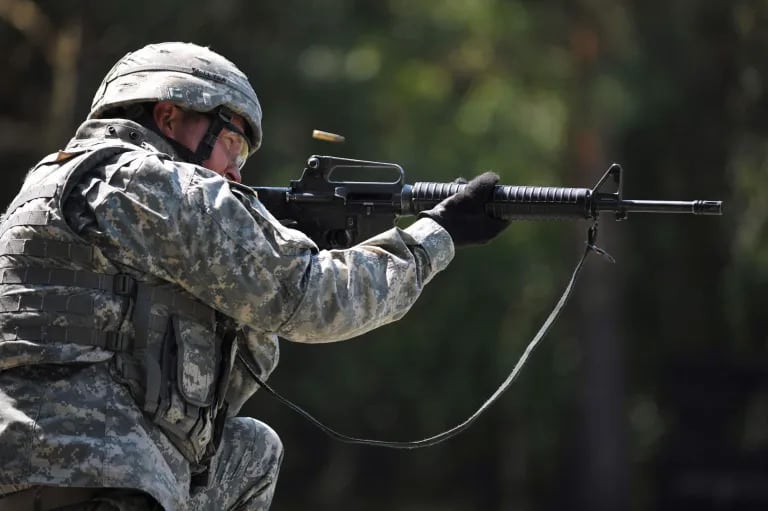
While the goal was to make a marine blend into any background, and it proved effective, the pattern did catch the eye of the U.S. Army, which soon developed that Universal Camouflage Pattern (UCP), which blended tan, gray and green so as to work equally well in desert, woodland even urban environments. What is unique about the UCP is that black was omitted from the uniform as it was found that it is highly visible not only to the naked eye but also to modern optics. Instead several shades of gray are incorporated.
This pattern is also sometimes known as a “digital camouflage” as the colors also resemble computer pixels. The goal for the Army was to have a single combat uniform that could work in woodland, desert and even urban environments. However, its detractors found that the only universal aspect was that it failed to blend into any surroundings.
In a case where inter-service rivalry may have played a role, the Army didn’t consult with the Marines when developing UCP and at the same time failed to address the effectiveness of other coalition forces in Afghanistan or Iraq. Instead, the Army went forward with a camouflage that had performed poorly in almost all the field tests. If anything, the one selected did universally badly in all environments. In designing a uniform for wear in every environment, it designed a uniform that was effective in none, which is why the Army has already given it the boot.
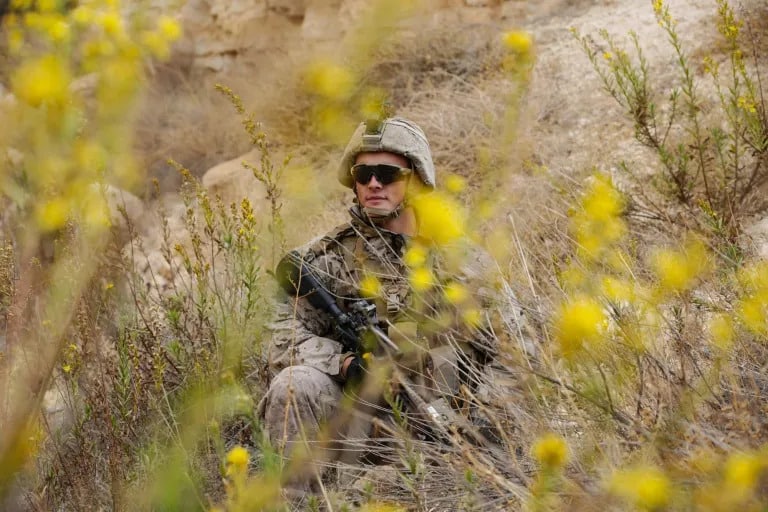
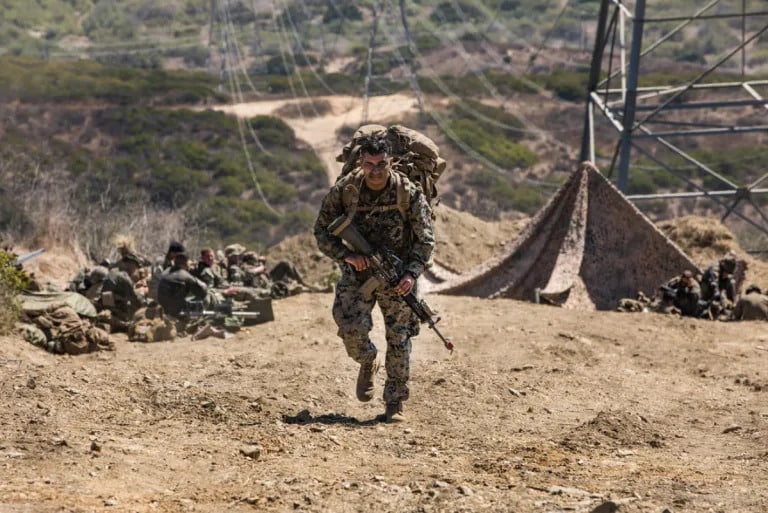
By contrast the MARPAT wasn’t meant to be perfect in every situation. Instead, it was developed much like older patterns that varied based on the terrain. As such there is a black, dark green and brown woodland variant as well as a desert variant. In addition, the Corps also developed a simple white and grey smock and trousers that can be worn over standard battle dress for snow conditions.
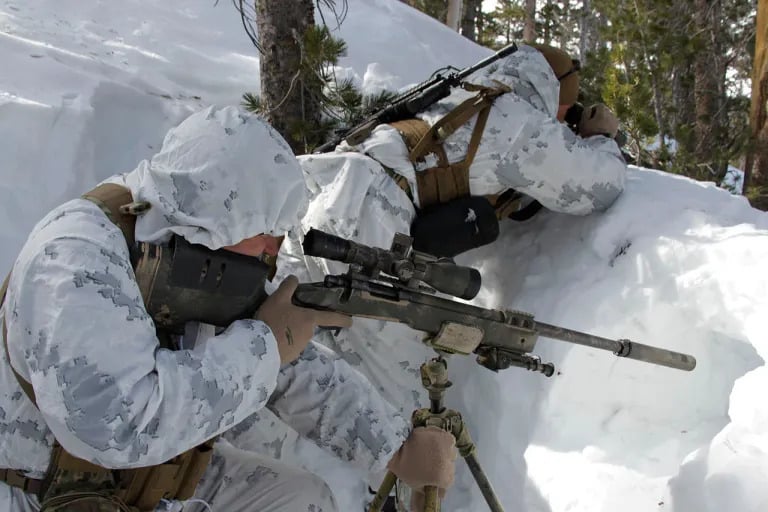
Training Center (Photo: U.S. Marine Corps photo by Lance Corporal Sarah Anderson/Public Domain)
The main MARPAT variant is one of the most effective woodland camouflage patterns in service today, while the desert-specific MARPAT is also considered to be a highly effective visual camouflage in both desert and urban environments. The Army’s UCP, which tried to use a single color scheme across multiple environment proved to be largely ineffective.
It wasn’t just a matter of not being seen. The MARPAT pattern reported to have a lower infrared signature than standard Navy-pattern camouflage.
Marine Corps Patented
One notable point about MARPAT is that it was patented by the Marine Corps, something not generally done with camouflage patterns. Today authentic MARPAT materials can be distinguished by a miniature USMC EGA (“Eagle, Globe, Anchor”) emblem that is appears above the letters USMC. This can be seen be seen in both the woodland and desert pattern variants of the camouflage.
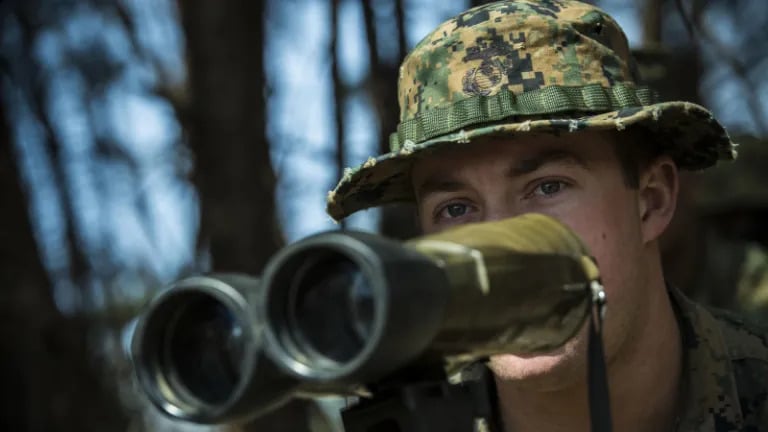
attempts to find U.S. and Japanese scout snipers crawling towards their objective during Exercise Forest Light 17-1 at Somagahara, Japan, March 10, 2017. (Photo: U.S. Marine Corps photo by Sgt. Isaac Ibarra/Public Domain)
As a result, only authorized manufacturers can produce this pattern and it is not available for commercial sales. However, there are already “knock-off” versions such as “Digital Woodland Camo” and “Digital Desert Camo.”
One particular version that is similar to MARPAT is Crye Precision’s Multicam, which has proved quite effective in light tan grasses and in more arid environments. It has been used some by armed forces including those of Australia, Poland, and even Russia – while some U.S. Army units used the pattern when UCP proved to be inadequate for the terrain. It has also been used by U.S. Immigration and Customs Enforcement’s Special Reaction Team and by some SWAT teams in the United States. Multicam has also been licensed for use in the civilian market.
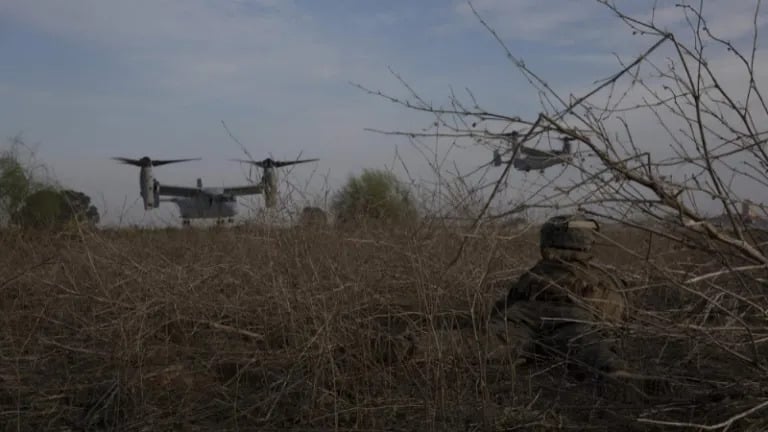
Africa provides security as two MV-22B Ospreys prepare to land during an alert force drill at Naval Station Rota, Spain, Oct. 20, 2016. This shows how well the camouflage blends in brush. (Photo: U.S. Marine Corps photo by Sgt. Jessika Braden/Public Domain)
One interesting side effect of the MARPAT pattern is that when it is seen – such as in training exercises with allied forces – it is almost instantly recognizable. Some sources have also suggested that almost paradoxically, the MARPAT further leverages the fierce reputation of the Marine Corps and can even damage an enemy’s morale as the pattern so readily identifies the wearer as a U.S. Marine. In that regard it serves as a reminder that when it comes to the Marines, there is “no better friend, no worse enemy!”
Read the original article in its entirety at tacticalnewsonline.com.

















Cant Army Infantry units share same camo uniforms?? modify for Army use