

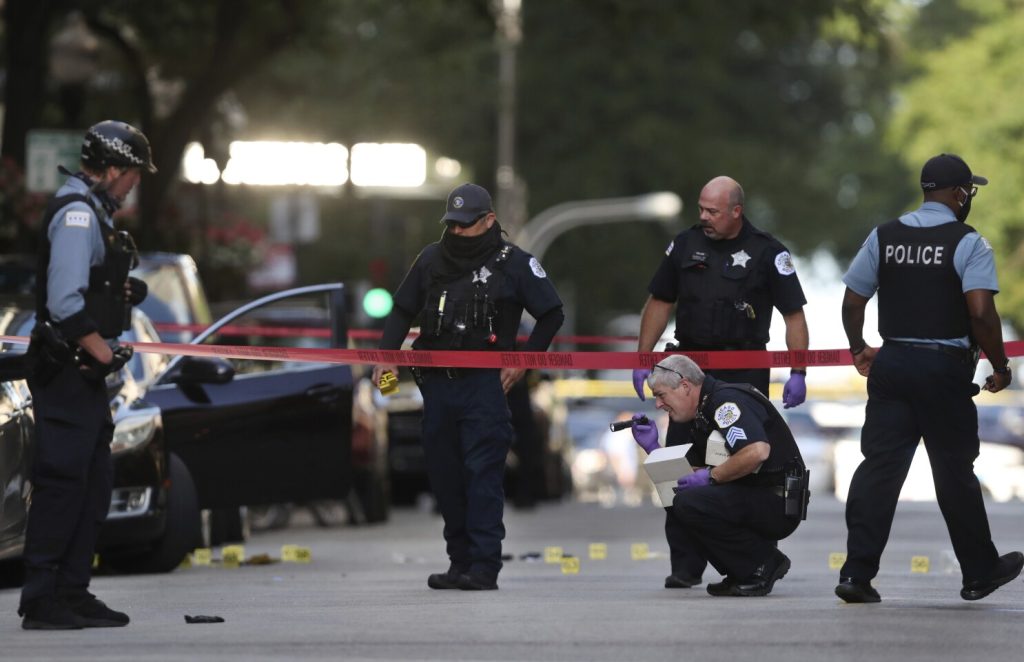
A recent issue of the University of Chicago Magazine includes an interview with Jens Ludvig, author of Unforgiving Places: The Unexpected Origins of American Gun Violence.
By SNW Contributor Thomas E. Gift, MD for Shooting News Weekly
While he’s too tied to the term “gun violence,” he feels that any change in gun ownership rules will come slowly, and thus a more general examination of ways to reduce violent behavior may prove valuable.
A professor at the University of Chicago and the creator of that institution’s Crime Lab, he focuses on the Chicago scene. In particular, he looks at violence involving street gangs and observes that murders in and by these groups less often involve motives that are rational or economic, such as controlling turf for drug sales, but rather have more to do with emotion and interpersonal conflict. He gives as an example a member of Gang A who is in a train station and steps on the shoe of a Gang B counterpart. Words are exchanged, and there’s a shooting.
Beliefs that violent crime is caused by bad people looking to gain through criminal activity or that people commit violent crimes due to economic distress don’t fit the data, he states. They assume a rational weighing of possible benefit and loss, while accounts of actual shootings show something very different. Ludvig notes that the finding that violent crimes generally follow from emotion stems from the 1960s, but this realization has been easily and frequently forgotten.
Unfortunately, the focus of the interview on street gangs limits more general conclusions. And while he is concerned with interpersonal motives, it is hard to forget that gang life centers around economic activity, especially drug dealing.
He brings up a book titled Thinking: Fast and Slow, which explains that our minds work in two different ways, of which we are aware of only one — the slow and rational. Unfortunately, people find this way of thinking to be taxing.
The other is fast, effortless, and out of our awareness. Fast is often useful and accurate, but sometimes it’s applied in the wrong situations. Errors are painful in situations where the consequences of a mistake are very high.
Ludvig recounts visiting a Chicago juvenile detention center and hearing a staff member say that 80% of the kids wouldn’t be there if you could give them back 10 minutes of their lives. Because the motivation for violent crimes can be so surprisingly fleeting, it follows that “violence interrupted isn’t just violence delayed, it’s violence prevented.”
In this context, Ludvig talks about “eyes upon the street” as a deterrent to violence, and about bystanders often interrupting a process otherwise likely to lead to violence. He holds that having more police on the street is useful not because they can arrest more bad actors, but rather that potential bad acts are prevented because the actors realize that they’re under the gaze of the police.
In taking this position, he may be minimizing the benefit of prosecuting and confining criminals. Also, he may be overlooking a relationship between police on the street and broken window policing. The two tend to go together. There is good evidence that broken window policing, while the subject of a good deal of controversy — some political, no doubt, and I can’t find anything that would suggest a consensus — reduces crime overall.
On an optimistic note, Ludvig reports that there are programs that give kids opportunities to be in simulated situations where they can learn, through trial and error, more about how their minds work and more about how to avoid common decision-making pitfalls. Of course, these settings don’t and shouldn’t have the high stakes of real life, and the evidence suggests that these programs can really help.
He goes on to describe an effective initiative run at a local juvenile detention center that involved staff and was very low cost. He states, “The kids would go to school in the morning, and in the afternoon, they would sit around watching TV while a guard stood against the wall, watching the kids watch TV.
So the juvenile detention center trained the guards to deliver one of these decision-making programs to the kids. It was practically free. The costs were mimeographing the booklets and a week of training for the guards. When we studied the effects, we saw a 20% reduction in recidivism by these kids who are at really high risk for violence involvement. That’s a free win.”
Unfortunately, the interview with Ludwig contains no additional information regarding the operation of this or any similar program, and he doesn’t say how the 20% was calculated. I would be very interested to know the contents of the booklet and how a security guard was trained to produce such a marked reduction in recidivism.
Ludvig’s thinking is reductionist in trying to break crime into categories. He theorizes, “Car theft and burglaries are driven by economic considerations. Murder is driven by heat-of-the-moment arguments.” Of course, teenagers may steal cars (and even murder) to impress their friends. When people murder their spouses for the insurance money, the motive appears to be primarily economic, but discontent, frustration, and anger must have been present. Likewise, enmity may have been lurking over time, even when a murder occurs in the course of a hot interchange.
It’s unfortunate that there’s no mention of legal versus illegal guns. Certainly, guns used by street gangs are rarely purchased and possessed legally, given the ages of gang members and the likelihood of their having legal entanglements that would make them ineligible to buy or possess a firearm. The possession of guns by gang members fits with statistics pointing to the relatively high rates of homicide among urban youth. Plenty of evidence reveals the high rates at which illegal guns are used in crimes in comparison to guns that were legally purchased and possessed.
The take-home message seems to be that violence stems from all-too-human feelings and actions. But Ludwig’s focus on the means — like firearms — is misplaced because guns used in crime are so often obtained and possessed illegally.
Thomas E. Gift, MD is a child and adolescent psychiatrist practicing in Rochester, New York, an associate clinical professor of psychiatry at the University of Rochester Medical School, and a Distinguished Fellow of the American Psychiatric Association.
Find the original article in its entirety on Shooting News Weekly.
READ NEXT: Report: What’s Really Behind Pete Hegseth’s Rising Controversy



















It took this long for some psychologist to figure that out? It took about as long as it did for somebody to decide how to conduct a war on drugs. When those boats explode violently, it means we hit their plastic spare fuel drums. Watch the Caribbean Coast Guard shows, and you see that high-speed open boats with bales and barrels on them ARE drug runners.
Perhaps we need to start teaching children from an early age that they need to start controlling their emotions. Letting kids get away with anything these day seems to lead them to crime, inability to work with others, racism, and much more. Whos responsibility is that, the PARTENTS! Start busting butts for misbehaving, disrespect, and teach them consequences for their actions.
Guns are merely a more efficient means of killing. Those with a propensity for violence use them because it avoids the danger of face-to-face violence (e.g. never bring a knife to a gunfight). However, we see knives used when guns are not available. The real issue is criminality and lack of self-control, nurtured by upbringing and “culture”. It’s a means of achieving status when one’s self-image is lacking. It’s not the same thing as pride: it’s the need to make oneself “someone” like “I kill, therefore I am”. It’s the id discovering the ego.
Civilization breeds civility; when there are no rules taught or enforced then the id and the ego triumph. The superego can rule only when it’s learned by an upbringing and culture of restraint and respect. The external influence of society can only be effective when there’s the internal influence of morality and self-control, and these internal influences can only be learned over time on a day-to-day and consistent basis. One doesn’t suddenly, spontaneously, become a gang-banger. Youth are impressionable, and when they’re immersed in an immediate and majority atmosphere of lawlessness and strutting, of ego and negative self-image, then violence will erupt.
I worked the mean streets of L.A. from my perspective, while economics play a dominant part in gang hierarchy,. It is a matter of turf. Is A hits a B gangster, A will retaliate. Anyone in Bs area is fair game. Granny as much as another gangster. There s a definite high in taking someone’s life. And the ther gangsters, as well as parents, applaud that killing. Trying to convert such a person is futile!!