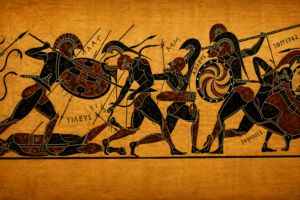
New York Times investigative reporter Mike McIntire argues that modern American gun culture has entered a period resembling the “late-stage Roman Empire,” where national power and prosperity have given way to what he characterizes as selfish excess.
The comparison appears in McIntire’s new book, “Ricochet: Guns, Greed, and the American Way of Violence,” released Tuesday by Atria/One Signal Publishers.
“Modern-day gun culture has entered a phase akin to the late-stage Roman Empire, when success and power devolved into selfish extravagance,” McIntire writes, according to a review.
Book takes aim at politics, industry, and ideology
“Ricochet” is not limited to mass shootings or debates over specific gun control proposals. McIntire attempts to provide a broader history of how firearms became connected to American politics, commerce, and personal identity.
The publisher describes the book as an examination of how war, slavery, crime, business, and politics developed alongside increasingly lethal firearms, ultimately leaving the country divided over guns and violence.
Its central argument is that a “witches’ brew of politics, money, and ideology” distorted American gun culture, “hijacking the Second Amendment” and allowing fear and insecurity to be used in the marketing of powerful weapons.
McIntire has also described the book as an effort to explain why the United States has more firearms than people and why gun ownership occupies such an unusually powerful place in the nation’s political and cultural life.
McIntire traces evolution of the NRA
Promotional interviews and videos accompanying the book show that McIntire places considerable emphasis on the transformation of the National Rifle Association.
He traces the NRA’s development from an organization focused heavily on marksmanship and firearm education into a major political force centered on an expansive interpretation of the Second Amendment.
In a newly released interview, McIntire discussed what the program described as the NRA’s “radicalization,” the legal battle over the meaning of the Second Amendment and the role the Supreme Court played in strengthening individual gun rights.
That argument echoes McIntire’s previous reporting for the Times. He has investigated the use of disputed gun rights scholarship in court cases and how firearms surrendered through police buyback programs were sometimes stripped for parts and effectively returned to circulation rather than completely destroyed.
Critics reject portrayal of gun ownership
Cam Edwards, editor of the gun rights website Bearing Arms, challenged McIntire’s thesis and accused him of depicting firearm ownership as a symptom of decadence and social decline.
The book’s publisher, however, presents McIntire’s argument as an attempt to explain not simply why Americans own guns, but how political organizations, manufacturers, and ideological campaigns helped transform firearms into powerful cultural symbols.
READ NEXT: Trump Makes Startling Claim About Fallen US Troops