
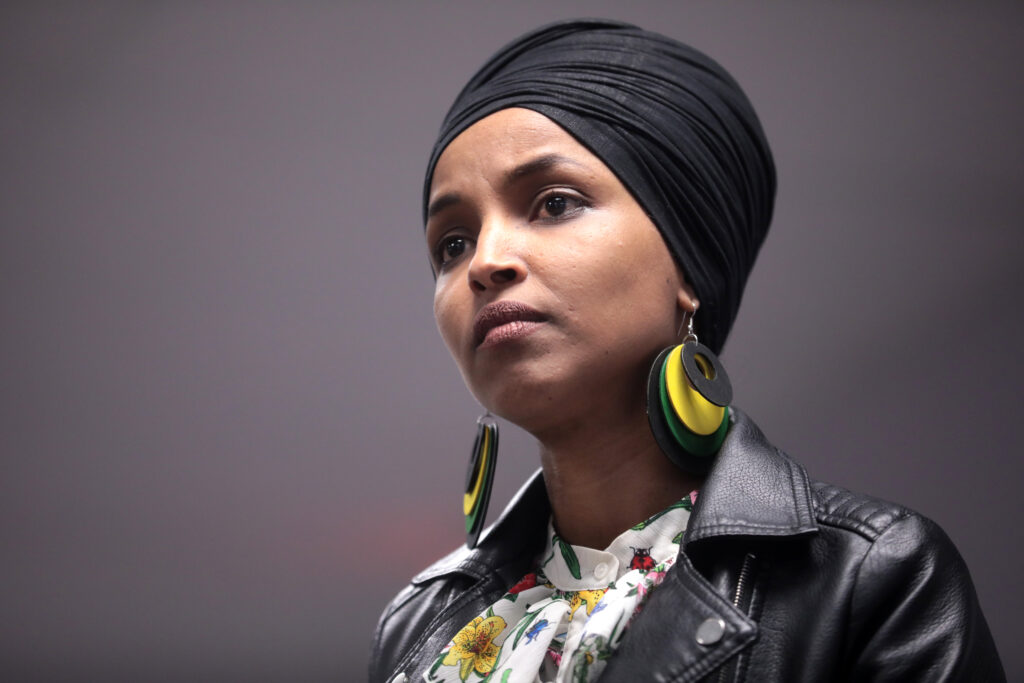
During a Thursday press conference, President Donald Trump made headlines after revealing a pointed exchange he had with Somalia’s President Hassan Sheikh Mohamud, suggesting he asked the foreign leader if he would like to “take back” Democratic Rep. Ilhan Omar of Minnesota — an offer Mohamud reportedly declined.
“Between her and Ilhan Omar and the group,” Trump told reporters, “I met the head of Somalia. Did you know that? And I suggested that maybe he’d like to take her back, and he said, ‘I don’t want her.’”
The comment drew laughter from those in the room, and highlighted controversy in an already tense political atmosphere.
Omar Under Fire for Remarks About Charlie Kirk’s Death
Rep. Omar, a Somali-American and member of the progressive “Squad” in Congress, recently faced calls for censure following her hostile remarks about the late Turning Point USA founder Charlie Kirk, who was assassinated on September 10 while speaking at an event in Utah.
During an interview with Mehdi Hasan of Zeteo News, Omar criticized those honoring Kirk after his death.
“I think there are a lot of people out there talking about him just wanting to have a civil debate. There is nothing more f-ed up than to completely pretend that his words and actions have not been recorded and in existence for the last decade or so,” Omar said. “These people are full of sh*t, and it’s important for us to call them out.”
She also reposted a viral video widely interpreted as blaming Kirk for his own death, labeling him a “reprehensible human being,” a “stochastic terrorist,” and a “transphobe,” drawing backlash from lawmakers and conservative commentators.
Censure Vote Narrowly Blocked
In response to Omar’s comments, Rep. Nancy Mace (R-SC) introduced a House resolution on September 15 to censure Omar and strip her of all committee assignments.
However, the motion to censure Omar was narrowly tabled in a 214–213 vote on September 17, with four Republicans joining Democrats to block the measure. Critics called the result a missed opportunity for bipartisan condemnation, while progressives celebrated it as a rejection of “performative politics.”
Trump’s Comments Spark New Round of Debate
President Trump’s jab at Omar comes as he continues to reframe the national conversation around immigration and national identity. His remark about “returning” Omar to Somalia drew both applause from supporters weary of immigrants that seem to lack respect for the country that welcomed them and fierce criticism from detractors who accuse him of racism.
Omar and her family fled Somalia in 1991 amid the outbreak of civil war, spending four years in Kenya before being granted asylum in the United States in 1995. By 1997, they had settled in Minnesota, and Omar became a U.S. citizen at the age of 17.
A Divisive Figure, Again at the Center
This is not the first time Omar has faced backlash for her comments on American foreign policy, Israel, or political opponents. She’s been previously accused of making anti-Semitic and anti-American remarks.
Critics argue that her recent rhetoric following Charlie Kirk’s murder went beyond criticism and into cruelty. Supporters counter that Omar is being singled out because of her identity and refusal to conform to the political establishment.
What Comes Next
With Trump re-elevating Omar as a political foil, and the House censure vote narrowly failing, the controversy surrounding Omar’s role in Congress is unlikely to subside anytime soon. The issue also threatens to deepen existing divides within both parties — especially as Democrats wrestle with their left wing’s public image.
READ NEXT: Ilhan Omar Removed From Foreign Affairs Committee





















Seijah, I really enjoy your articles. Tx.