


What does it mean? What about his place in the line of succession? Long regarded as the late Queen’s “favorite” child, Andrew Mountbatten-Windsor, formerly Prince Andrew, the younger brother of King Charles, has seen a dramatic fall from grace because of his ties to convicted sex offender Jeffrey Epstein.
The unprecedented case raises major questions about accountability, royal privilege, and the ongoing impact of the Epstein network and scandals. Having lived and studied in England, this story is especially intriguing to me.
On Thursday, his 66th birthday, Mountbatten-Windsor, who was recently stripped of his title by King Charles, was arrested on suspicion of misconduct in public office, amid allegations that he sent confidential government documents to Epstein while serving as a trade envoy, a crime that can carry a life sentence.
Fortunately for Andrew, the Tower of London is no longer used to house noble or royal inmates, or any prisoners, for that matter, and beheadings and hangings of royals are no longer in vogue in the U.K.
This serious charge concerns only the alleged sharing of sensitive official material with a convicted sex offender, not the separate sexual misconduct allegations long linked to the former prince.
He has consistently and strenuously denied any wrongdoing.
Normal procedures during his arrest were likely complicated by the fact Andrew was probably accompanied by royal protection officers.
On Friday, British police carried out a search of the former royal’s Windsor mansion at Wood Farm on the Sandringham Estate, following global coverage of a photograph showing him leaving a police station.
Police are also searching properties linked to him in Berkshire and Norfolk, including Royal Lodge.
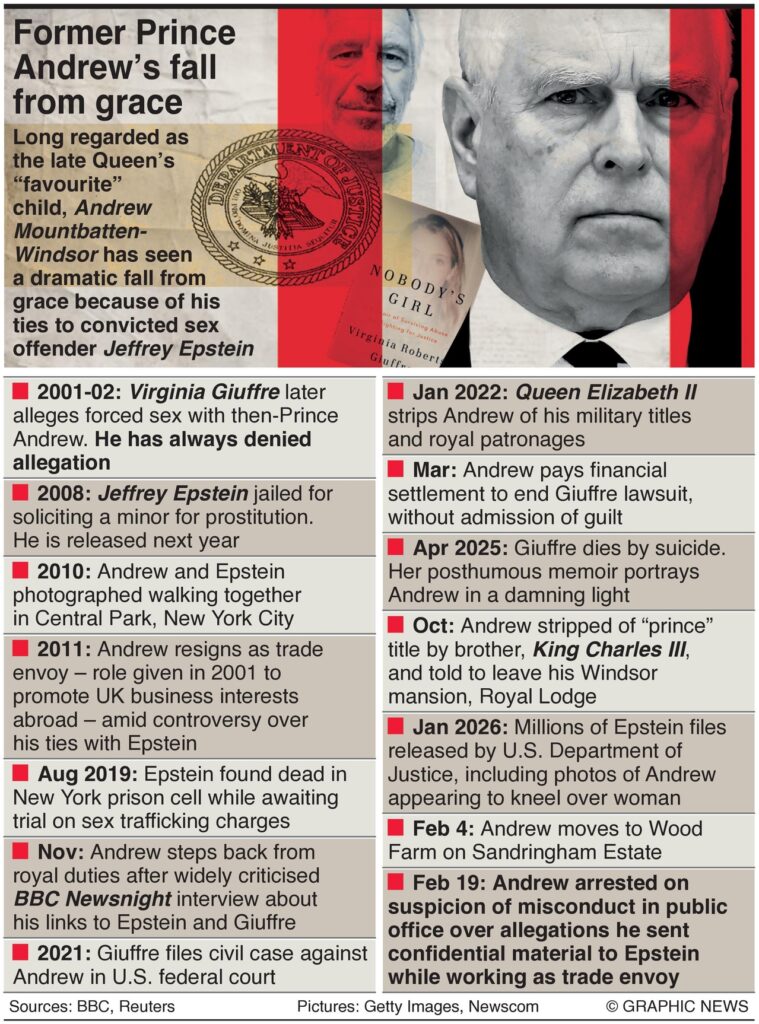
This is the first time a senior royal, even one stripped of titles, has been arrested in a criminal investigation. Legal experts expect the investigation to be lengthy and complex. At some the Crown Prosecution Service and Thames Valley Police must decide whether to charge the King’s brother.
The unprecedented nature of Andrew’s arrest is expected to have far-reaching consequences for the monarchy and public trust. Royal commentator Roya Nikkhah called it historic: “The king’s brother has been arrested… the first senior royal ever arrested.”
The Daily Signal reported:
The investigation began after the Department of Justice released documents in January as part of the Epstein files. Emails from 2010 show Mountbatten-Windsor, then the U.K.’s special representative for international trade and investment, forwarding confidential government reports to Jeffrey Epstein shortly after receiving them.
The role gave him access to sensitive information about international business and diplomatic strategy.
One set of emails includes reports on trips to Singapore, Hong Kong, and Vietnam, which he sent to Epstein within minutes of receiving them from his adviser.
In another, Mountbatten-Windsor shared a confidential brief about Afghanistan investment prospects and asked Epstein for advice. The anti-monarchy group Republic released these documents two weeks ago, prompting Thames Valley Police to begin a formal investigation on Feb. 16. The group has called for greater transparency and accountability in royal dealings, reflecting growing public scrutiny of the monarchy.
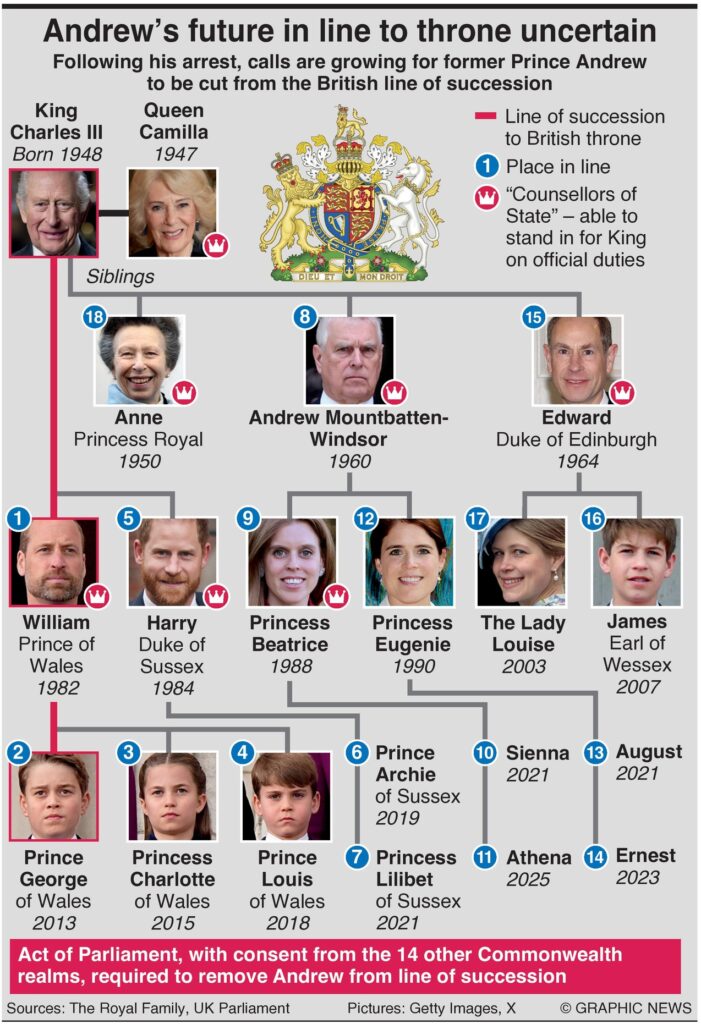
Meanwhile, following his arrest, calls are growing for former Prince Andrew to be cut from the British line of succession, in which he remains despite losing his titles. But can Andrew be removed from the line of succession?
As the late Queen Elizabeth II’s second son, former Prince Andrew was second in line to the throne when he was born in 1960, just behind his brother, now King Charles III.
However, he has since dropped to eighth in the line of succession, behind Princess Lilibet, making any path to the throne highly unlikely. Removing him officially would require legislation passed by Parliament.
And, because King Charles is head of state in 14 other Commonwealth realms, those countries would also need to agree, as any change would affect their own lines of succession.
This makes the entire effort highly complicated, and likely not worth the effort considering the extremely low probability the former prince would ever have any real path to the throne.
Andrew also technically remains a counsellor of state, who could stand in for a monarch who is ill or overseas. However, generally, only working royals are called upon to carry out those duties, which Andrew is no longer considered.
Expect much more to come.
The opinions expressed in this article are those of the author and do not necessarily reflect the positions of American Liberty News.
READ NEXT: Watch: Tennessee Trooper’s Last-Second Rescue On Bridge
















I see the allegation against Andrew is “misconduct in public office.” Is the “Official Secrets Act” applicable here or not?
In the 1980’s following the Falklands war, I headed up a special close protection unit for Andrew’s visit, as a celebrity, to US Naval Base, Mayport, Florida aboard HMS Invincible.
He was an admirable chap then, avoided alcohol and paid strict attention to the instructions of his minder, a Special Branch Officer permanently assigned to him.
Later, I was posted to the UK and he and his SB minder were guests at a party at my home in London. Time goes by quickly and as we grow older we’re supposed to grow wiser.
There is no way Lillibet and Archie can legally be in the line of succession. Meghan did not give birth to either one, and no lood tests were allowed by her to determine parentage! Meghan had a hysterextomy Long before being marred to Harry – according to her sister and her father! There are several people on the chart who should not be considered Councillor of State! Harry is one. Andrew and Camilla are the pther two.