

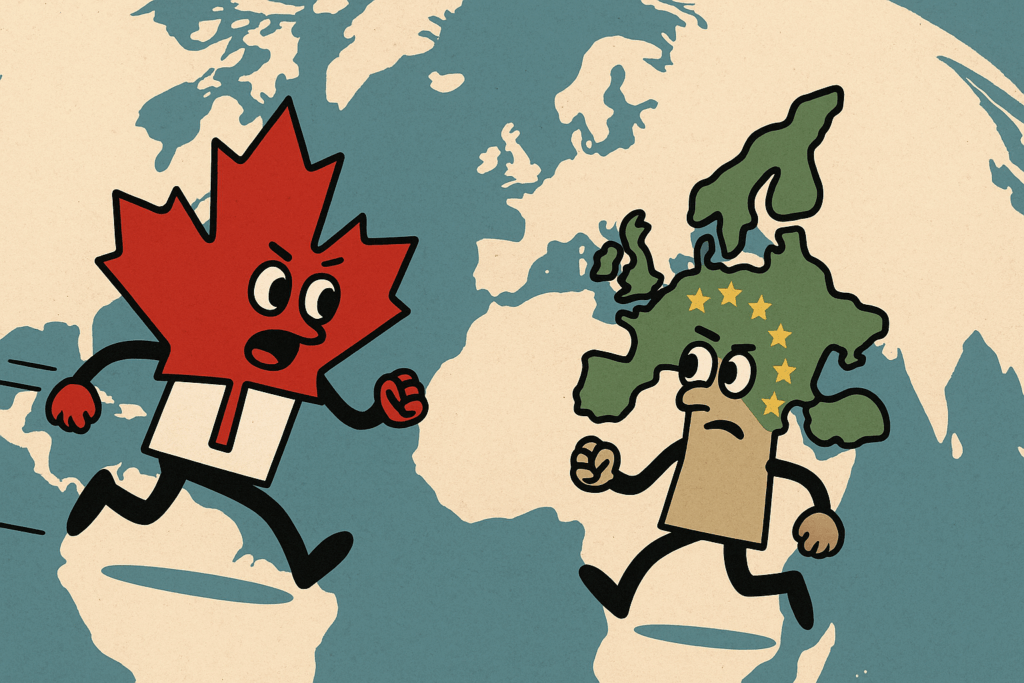
The latest fantasia to emerge from the swirling ether of Instagram reels and TikTok videos is that Canada, affronted by Donald Trump’s America-first trade posture, ought to join the European Union. Not negotiate new trade terms. Not lean more heavily into the USMCA agreement. No, the idea now bouncing around social media like a spooked moose on a frozen pond is that Canada should pivot continents entirely, skipping geography like a Netflix genre list, and simply become… European.
That Canada’s own prime minister, Mark Carney, has mused that his country is “the most European of non-European nations” is hardly reassuring. It confirms that this isn’t just an influencer’s fever dream, but a fantasy now making its way into polite policy salons, cheered on by faculty lounges and think tank daydreamers. Professors like Frédéric Mérand, Rajshri Jayaraman, and Zachary Paikin are lining up behind the notion, dressing it in the respectable tweed of academic credibility. And Carney, for his part, has inked defense partnerships with the EU and offered flowery paeans to shared values. All of which is lovely, if Canada were applying to a friendship club or seeking honorary citizenship in Brussels. But it is not. Canada is floating the idea of membership in a political union it has no business joining.
Let us begin with a blunt fact: the European Union is not a spiritual Tinder for democracies with similar vibes. It is a legal, territorial body with hard boundaries, grounded in treaties that define what counts as a “European state.” Article 49 of the Treaty on European Union makes this explicit. The phrase used is “any European State,” not any “well-meaning democracy,” not any “liberal polity with good French pastries.” Canada is not a European state. It cannot become one without the EU rewriting its foundational treaties. That would require the unanimous consent of all 27 member states, and in many cases, the approval of their populations via referendum. France’s farmers, who riot over cheese tariffs, are not likely to vote in favor of importing Canadian dairy under the Common Agricultural Policy.
More than that, such a treaty rewrite would invite chaos. If Europe suddenly opens its doors to Canada, what prevents it from extending the same courtesy to Australia, Japan, or New Zealand? Does the EU become a global United Nations with borderless membership criteria? No. Because the European Union is, quite literally, about Europe. A Canada-shaped loophole would tear at the EU’s already strained cohesion. It would delegitimize the decades-long queue of actual European aspirants, like Ukraine or Serbia, who have bled and toiled to meet EU benchmarks. Imagine telling Macedonia to wait while Ottawa cuts to the front. There would be a Balkan-sized revolt.
And then there is the matter of trade. The whole premise of Canada’s EU-curiosity rests on its desire to escape economic headwinds created by Trump’s America. But this suggests an almost charming ignorance about how the EU actually functions. To trade as a member of the EU is not to wield freedom, but to adopt the bloc’s suffocating standardization. Canada would be required to abandon its existing trade agreements, chief among them USMCA, and accept the EU’s Common External Tariff. It would instantly erect a customs wall between itself and the United States, its largest trading partner. Over $600 billion in exports to the US would be jeopardized. But at least it would have easier access to Estonia, a market roughly the size of Winnipeg.
Still not convinced? Consider the political mechanics. For Canada to become a member of the EU, it would need to adopt the entirety of the acquis communautaire, the entire EU legal code, spanning tens of thousands of regulations. It would need to surrender sovereignty over data privacy, agriculture, environmental law, immigration, labor policy, and monetary policy. It would need to, at least in theory, adopt the euro. That’s right: goodbye loonie, hello Frankfurt. The Canadian Supreme Court would be outranked by the European Court of Justice. Brussels would dictate rules about maple syrup viscosity and poutine cheese curd dimensions. All for what? Symbolic resistance to Donald Trump?
None of this is lost on EU officials. When Joachim Streit, a German MEP, tried floating the idea, the Commission swatted it away like a lazy fly. Canada, they said, is not eligible, and there are no plans to change the rule. Even sympathetic voices like Guy Verhofstadt framed Canadian membership as a metaphor, not a practical aim. Sigmar Gabriel, Germany’s former Foreign Minister, suggested partial membership, as if Canada might be allowed to sit at the grown-up table without actually being adopted. Brussels, ever the polite bureaucrat, nods respectfully at Canada’s European aspirations, and then quietly locks the door.
So why the fuss? Why the sudden flood of TikToks proposing EU entry as the antidote to Trump? Perhaps because Prime Minister Carney cannot figure out how to strike a deal with Washington. Every misstep, every tariff escalation, every diplomatic misfire is met with Canadian bewilderment. Carney misjudged the Trump team’s red lines, misunderstood the strategic value of US energy exports, and bet wrongly on European diplomatic leverage. Now he is looking for an escape hatch labeled “Europe,” as though the EU were an Airbnb for post-national technocrats.
But the EU is not easier to negotiate with than Trump. Quite the opposite. Trump is one man, with an agenda, a temperament, and a track record. The EU is 27 squabbling countries with competing interests, held together by duct tape, subsidies, and a shared fear of irrelevance. Negotiating with Trump is poker. Negotiating with the EU is therapy, expensive, endless, and often circular.
— @amuse (@amuse) August 5, 2025
The notion of EU membership has become a form of political cosplay. It allows Canada’s academic elite to signal their disapproval of American populism without confronting their own failures. It gives TikTok progressives something to chant into ring lights. And it gives Carney a talking point for his next trip to Brussels. But it is not real. It cannot be real. Geography, law, economics, and political logic all say no.
And when all those voices chorus in rejection, the answer is not to double down on the fantasy. The answer is to negotiate better trade terms, understand your neighbors, and grow up. Canada is a sovereign country, not an aspiring province of the European Union. Its future lies in confident self-determination, not bureaucratic self-exile.
— @amuse (@amuse) August 3, 2025
If you enjoy my work, please consider subscribing: https://x.com/amuse.
READ NEXT: Key Trump Project Suddenly Stopped



















Canada being EXTREMELY foolish. They could have had 0 for 0. Anyone could have had 0 for 0. Instead they want to keep charging the US as much as 300% for dairy products and other exorbitant tariffs on other products. All President Trump wanted was a fair deal for the US in trade and there have been too many countries for too many years that have completely been taking advantage of the US. Shame on them.
Perhaps Quebec should join the EU, while western Canada either goes independent or joins the U.S. Quebec is, after all, more French than France—.