


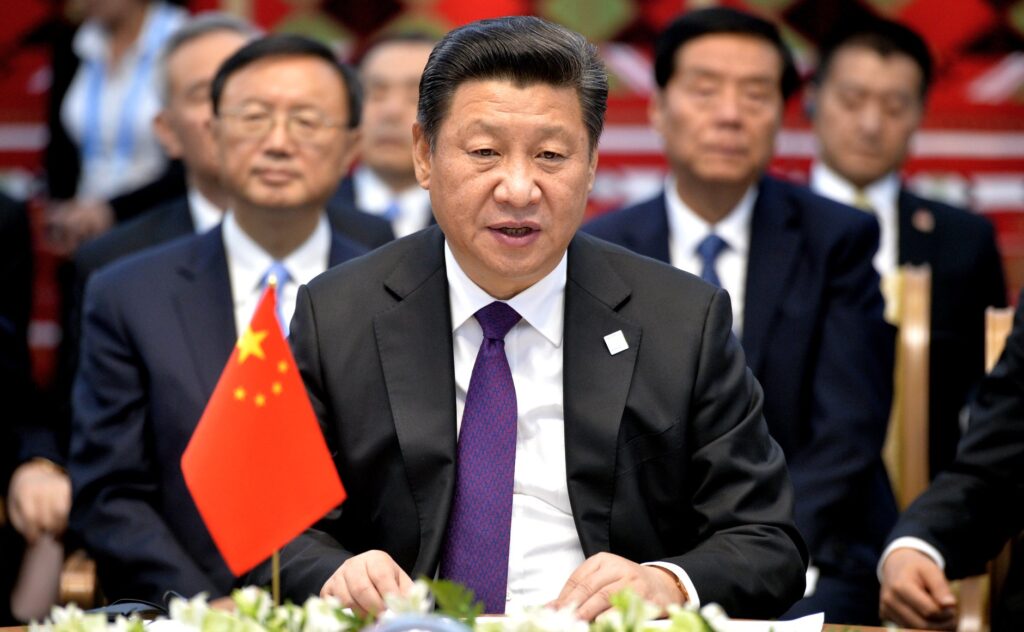
As China’s Xi Jinping hosts the Shanghai Cooperation Organization (SCO) summit in Tianjin, dozens of leaders from Eurasian states and partner or observer countries are ostensibly meeting to discuss global security and economic affairs.
But the underlying agenda for the China-led group is to create a broad anti-American alliance and reshape the U.S.-led international order.
The SCO is arguably one of the most prominent regional organizations China has co-founded.
This is also the biggest SCO meeting since it was formed in 2002 and is a key part of Beijing’s push to challenge the dominance of U.S. and Western-led groups such as NATO.
The SCO is the world’s largest regional organization geographically and demographically, covering approximately 24% of the world’s total area, 42% of the world population and generating 23% of global nominal GDP.
Originally seen as a foil to U.S. influence in Central Asia, the SCO has expanded. Now, in addition to China and Russia, members include Belarus, India, Iran, Kazakhstan, Kyrgyzstan, Pakistan, Tajikistan, and Uzbekistan.
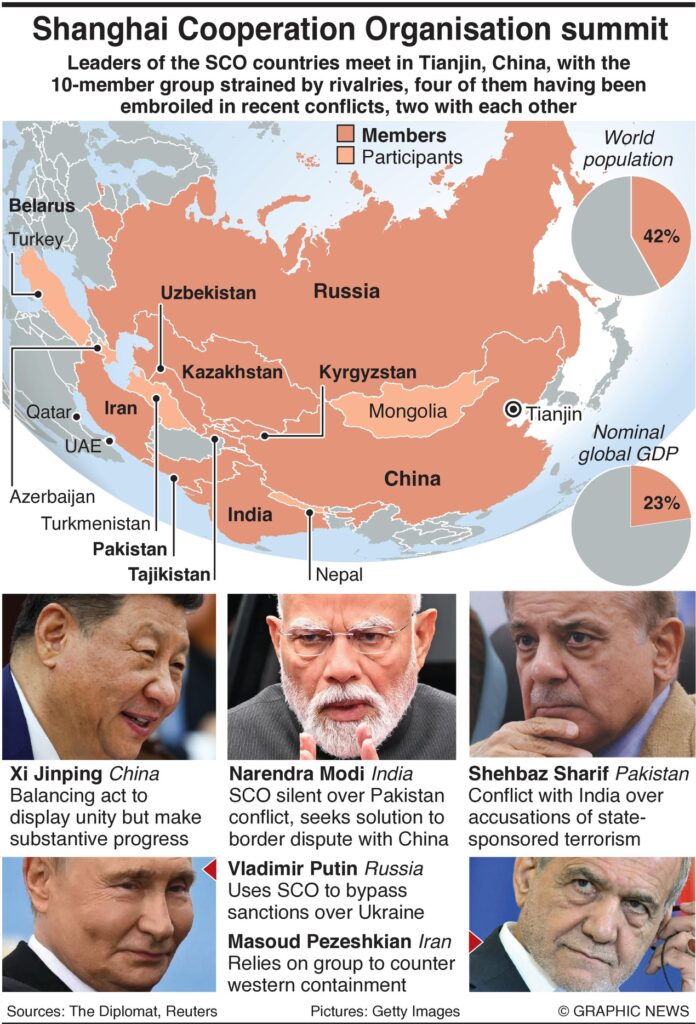
Egypt, Nepal, and several Southeast Asian nations are attending as partners or guests. The secretary-general of the United Nations and ASEAN are also taking part.
The SCO seems to want to move from being a talk shop to a “full-fledged mechanism of practical cooperation that brings tangible results to the citizens of the member states,” said June Teufel Dreyer, a University of Miami expert on China. Yet the questions remain: “to what end and how?”
For Xi, “presiding over the gathering in Tianjin should net him some favorable publicity and possibly further his image as leader of a new global world order,” Dreyer added.
Many of the attending leaders were in Beijing on Wednesday for a Chinese military parade marking 80 years since the end of the second world war. That event will also see North Korean leader Kim Jong Un in attendance.
At the summit, Xi praised the growth of the SCO, saying they were building a new model of “true multilateralism.”
“The house rules of a few countries should not be imposed on others,” Xi told the leaders at the summit orchestrated to play-up China’s global leadership and its close and enduring partnership with Russia.
He urged more cooperation of member nations in leveraging their “mega-scale markets” to boost trade and investment and promised that China would provide 2bn yuan ($280 million) of aid to member states this year and another 10bn yuan ($1.4 billion) of loans to a SCO banking consortium.
He also criticized the “hegemonism” and “bullying behavior” of certain countries (i.e., the United States).
Following Xi’s speech, Vladimir Putin claimed the war in Ukraine was not triggered by Russia’s invasion in 2022 but was “a result of a coup in Ukraine, which was supported and provoked by the West.”
“The second reason for the crisis is the West’s constant attempts to drag Ukraine into NATO,” he added.
And, as CNN reported:
Putin said the SCO laid the groundwork for a “new system” of security in Eurasia, positioning it as an alternative to Western-led alliances that he has long railed against.
The new system “would replace the outdated Eurocentric and Euro-Atlantic models, take into account the interests of the broadest possible range of countries, be truly balanced, and would not allow attempts by some states to ensure their security at the expense of others,” Putin said.
Perhaps most significantly, India’s leader, Modi, is attending the summit for his first visit to China in seven years. The two rivals have fought skirmishes over a Himalayan border and clashed on trade and China’s support for Pakistan.
This, just days after Washington imposed punishing 50% tariffs on Indian goods due to Delhi’s purchases of Russian oil.
In what should concern U.S. leaders, Xi said China-India ties could be “stable and far-reaching” if both sides focused on viewing each other as partners instead of rivals.
Since the Russia-Ukraine war began, India has become a major buyer of Russian oil, increasing tensions with Washington. Modi also remarked on “steady progress” in improving relations with China after meeting its top diplomat in August and noted “respect for each other’s interests and sensitiveness.”
At the summit, Modi highlighted his ties with Xi and Putin, embracing Putin before the two walked over hand in hand to greet Xi. The three leaders then shared a conversation marked by smiles and laughter.
Modi and Putin also held a nearly hour-long private meeting in the Russian presidential limousine.
After almost a decade of increasingly close relations between the U.S. and India, and joint opposition to China, Modi’s presence at this SCO summit should especially be raising alarm bells among President Trump’s team.
The opinions expressed in this article are those of the author and do not necessarily reflect the positions of American Liberty News.
READ NEXT: Justice Department Goes After Top Leader






Stop buying ANYTHING from countries that will not change their mind without an example. They will be the examples to others who might change their mind and not buying from them could change their mind. Start dumping American oil at a price that NO ONE will say no to. Don’t sell to the ringleaders of this whole thing. This will shut down anyone that depends on selling oil as the price for it goes into the dumper. There are VERY few countires in the world that the United States has not saved from destruction or at the very least benefitted from in the form of money, food, or arms sales and this includes the ringleaders of this whole thing. No gratitude. Sorry state of affairs when you help someone and get sand thrown in your face. Worst kind of individuals do this kind of thing.