

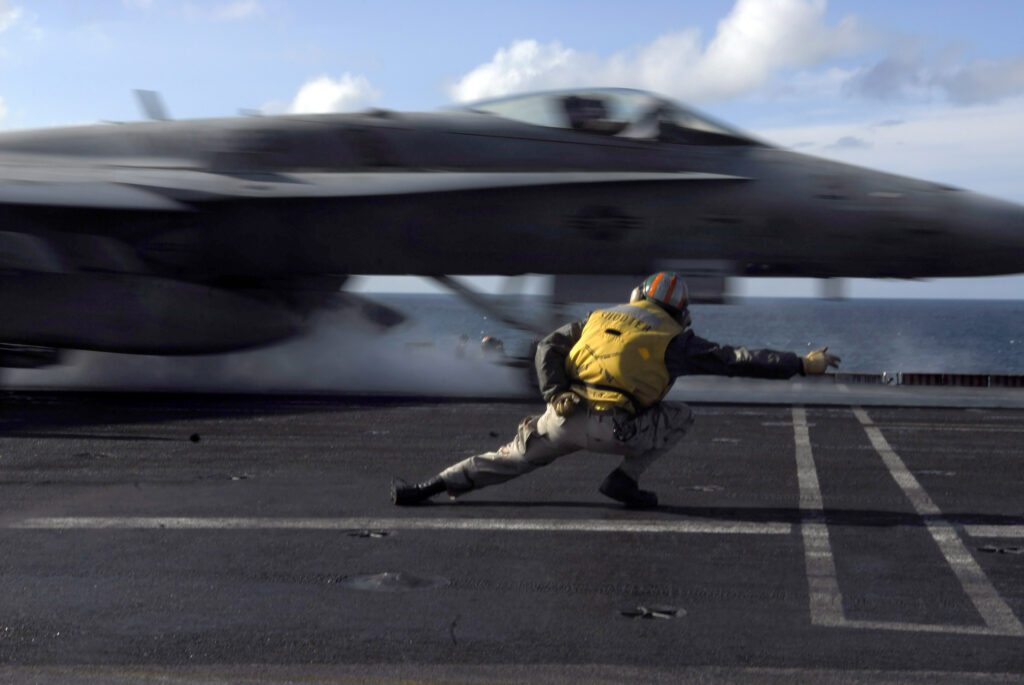
For decades, the United States has dominated the world’s oceans with its awesome aircraft carrier fleet consisting of 11 Nimitz and Ford-class carriers divided between the Pacific and Atlantic oceans. U.S. allies such as Britain, France, Italy and Japan have one or two carriers of their own.
But no U.S. adversary has ever come close to challenging this U.S. naval superiority since the end of World War II. Until now.
As I have been warning about for many years, communist China is steadily moving toward creating its own carrier fleet to counter the U.S. Navy.
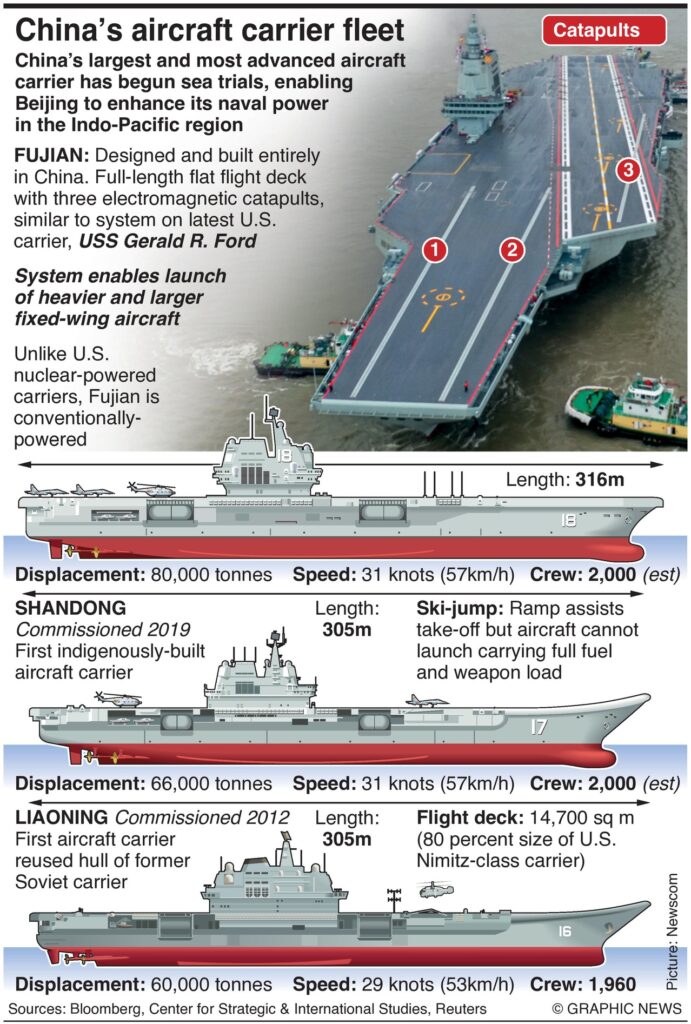
While the Chinese People’s Liberation Army Navy (PLAN) only has three carriers now, and only one truly modern Chinese designed one, the Fujian Type 003, just 10 years ago it didn’t have any.
Its other two much smaller carriers, Liaoningand Shandong, based on old Russian designs, have ski jumps, not catapults, to launch aircraft, making them far less useful.
As Popular Mechanics reports:
Still, the country is taking a calculated approach to not only building and designing the ships, but building up a highly trained carrier force. “Ultimately, Liaoning and Shandong are stepping stones for China, useful for training and developing naval aviation experience…”
Pop Mech adds:
Experts believe China may ultimately build up to seven carriers by 2049, the 100th anniversary of the Chinese Revolution and the year Beijing is targeting for a takeover of Taiwan—by force, if necessary. Seven carriers would match the U.S. Pacific Fleet. And with more than 370 ships, the People’s Liberation Army Navy (PLAN) already has more ships than the U.S. Navy, with 295. The PLAN’s massive growth gives Beijing the ability to exercise force, such as invading Taiwan or directly challenging U.S. naval supremacy.
I would argue that China intends to take Taiwan way before 2049, as in the next few years, but that’s besides the point right now.
The important point is that China doesn’t need to challenge US carrier dominance globally, it just needs to do so regionally in the Western Pacific. And even just two or three modern carriers could do that.
China could have two additional modern Fujian-class carriers in just a few years.
Are these carriers fully comparable to the latest and greatest U.S. Ford-class carriers, or even the mainstay of our fleet, the Nimitz-class? Not really.
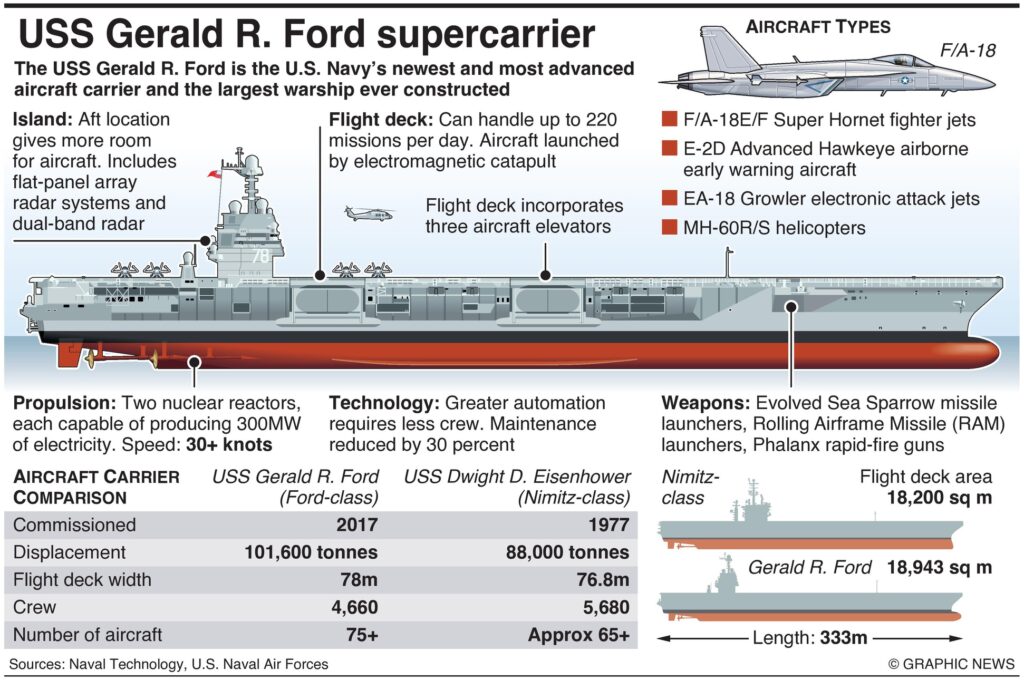
While the newest Chinese warship has a cutting-edge electromagnetic catapult system similar to the Ford, it is still smaller in displacement than the comparable U.S. ships, around 85,000 tons vs 100,000 tons for Ford.
As far as propulsion is concerned, the Ford class, like the preceding Nimitz class, is nuclear powered. Fujian is conventionally powered, similar to Liaoning and Shandong.
Popular Mechanics explains:
“Fujian will require frequent refueling, limiting its ability to conduct sustained operations,” [Matthew] Funaiole points out. [Lex] Luck agrees and points to another drawback in the Chinese carrier’s design: “Being conventionally powered, Fujian will be more reliant on replenishment ships and may not be able to store as much ammunition and fuel for her air wing compared to Ford.”
Matthew Funaiole is a senior fellow in the China Power project at the Center for Strategic and International Studies (CSIS).
Lex Luck, an independent naval analyst who writes for Naval News
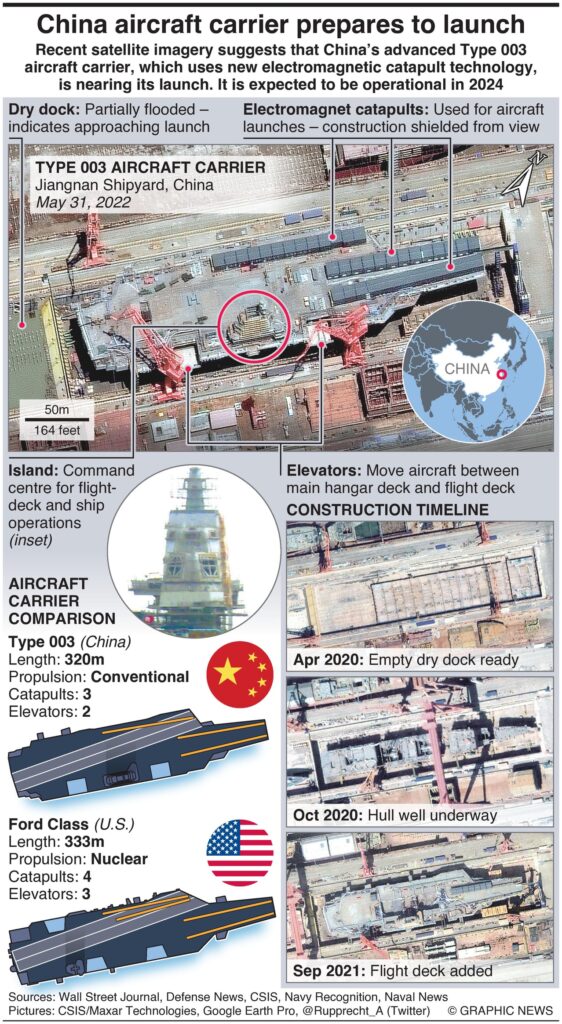
The Chinese carrier will also carry less aircraft, and due to it having one less catapult (three vs. four) and one less aircraft elevator (two vs. three) than the Ford, the amount of airpower it can launch at any one time will be significantly less.
One major variable will be the carrier aircraft the Fujian and other Chinese carriers will employ. While they have made impressive gains in recent years, their aircraft such as the J-15, J-35 and J-XX are still unproven, especially on carriers.
Meanwhile, on the U.S. side, older F/A-18C Hornet fighters have been replaced with F/A-18E/F Super Hornet fighters, making for an all-Super Hornet flight deck. Even as stealth F-35Cs are being added to the mix.
By the 2030s, the U.S. Navy will likely be adding its own Next Generation Air Dominance (NGAD) fighters, into service to replace the Super Hornets.
These should add longer range and a larger weapons payload over the F-35s, giving the U.S. carriers a long-range punch, outranging Chinese anti-ship weapons.
Despite all the ways U.S. carrier forces will continue to outmatch the Chinese fleet, the fact that we even have to contend with one is a major development.
As PopMech concludes:
For the first time in 80 years, the United States is seeing a credible challenge to its carrier dominance. In just 13 years, China has gone from zero carriers to three, and nobody quite knows how many it will ultimately field. The more carriers China has, the more it can challenge America’s ability to control the Indian and Pacific Oceans—and perhaps wrestle that control away in a major war.
The opinions expressed in this article are those of the author and do not necessarily reflect the positions of American Liberty News.
READ NEXT: Trump’s Handshake Revitalizing US Industry? The Numbers Are Huge!


















China also claims to track subs undersea without sonar use Magnetic field to track subs
And we’re paying for those things with the trash we buy at Walmart. As well as the interest we pay on the T Bills the Chinese buy with the Walmart trash profits. Best we get the DOGE running at full speed NOW.
Seems those most concerned with China’s so-called aircraft carriers have NOT compared them to the U.S. aircraft carriers of WWII, which had steam catapault systems which DID NOT allow their aircraft to be run over by their carriers on launch…..like has happened with the Chinese aircraft carriers! Today Chinese aircraft carrier planes can either take off with FULL fuel loads or FULL ordnance loads, but NOT BOTH….since with BOTH they cannot become airborne! Yes, just another “minor problem” with Chinese products no matter if they are home electronics or combat aircraft carriers!