


The scale of illegal Chinese migration into the U.S. has changed our understanding of border security and global strategy. When President Trump took office in January 2025 his national security team began reviewing classified assessments from the intelligence community. One conclusion stood out. The number of military-aged Chinese males entering the U.S. since Biden took office was not tens of thousands or even hundreds of thousands but likely between 500,000 and 750,000, a range far higher than any earlier public estimate. The question that would puzzle any careful analyst is straightforward. Why would China allow this exodus of young men when its own demographic crisis is severe? The available evidence suggests a coordinated program managed by China’s Ministry of State Security that leverages cartels, NGOs, and illicit financial channels to move a large population of men directly into the U.S. interior. The flow is structured, well-funded, and aligned with other known CCP tools of influence. Understanding this phenomenon matters because it cuts to the core of U.S. national security.
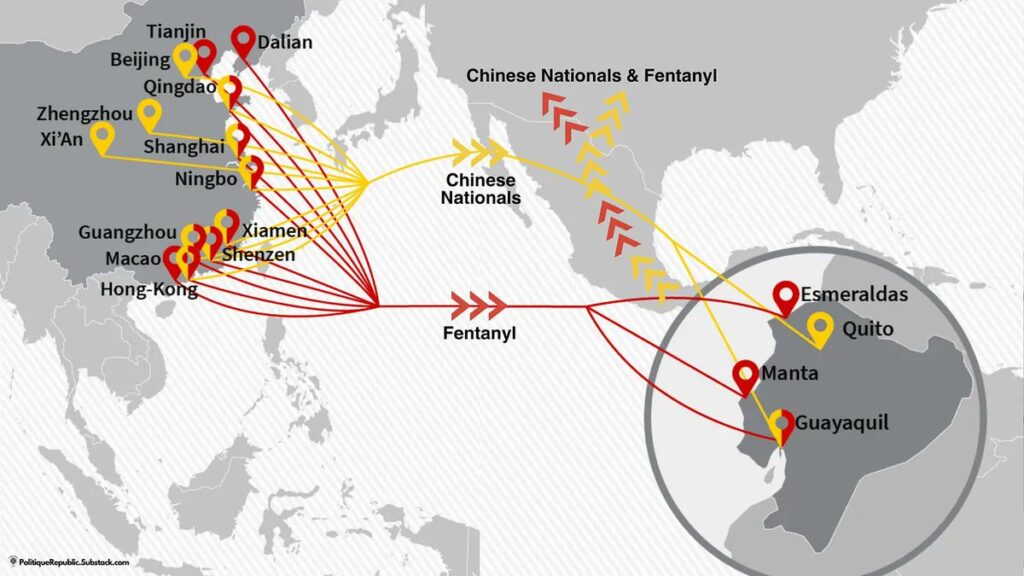
Most Americans do not know how difficult it is for Chinese nationals to leave China legally. Fewer than 10% possess passports, and exit visas are even harder to obtain. For a Chinese citizen to travel to Ecuador, a common transit point, he must pass through multiple layers of state review. How then are thousands of young men obtaining documents, booking tickets, and funneling into the same smuggling channels? The simplest explanation is usually the correct one. Someone with authority wants them to go. A complex operation like this requires coordination among provincial security bureaus, state-owned enterprises, and Ministry of State Security intermediaries who manage overseas networks. Even the money involved is suspicious. Cartels charge between $10,000 and $30,000 per person to move Chinese nationals through Central America. This is far beyond the means of the average young man in China. Yet huge numbers are paying it. Analysts inside the intelligence community now believe the funding is state-backed, either directly or through trusted cutouts.
Recent reporting clarifies the path these migrants follow. When they land in Ecuador, they are met by groups that appear to be humanitarian NGOs but are staffed by party loyalists trained to manage new arrivals. This pattern tracks with China’s long-running effort to seed global NGOs with CCP members who advance party interests. These organizations coordinate transport north through Colombia, Panama, Costa Rica, Nicaragua, Honduras, Guatemala, and Mexico. Along the way, the cartels move fentanyl precursors shipped from China to Ecuador. The cartels use Chinese migrants as financial anchors for drug shipments. Large migrant groups provide cover and distraction for high-value smuggling operations. Customs and Border Protection officers have explained that the cartels often call them to identify drop-off locations far from where the real cargo is moved. This practice allows cartels to shift fentanyl, money, and people with minimal disruption.
The arrest numbers hide the real scale. For every four people apprehended, roughly six slip through. In practice, apprehended Chinese nationals account for perhaps 10% of the total number crossing. With as many as 90 caught per day, the real inflow may be close to 900. Although some claim asylum, many provide identical scripted statements that describe generic pro democracy activism. Border agents say the pattern is obvious. The claims are rehearsed and the supporting stories identical. These migrants are then released into the U.S. interior because there is no rapid removal agreement with China. Even when China is notified, it refuses to take deportees back unless they are political dissidents who threaten the regime.
Once inside the U.S., these migrants often contact Chinese community groups that operate like shadow civic centers. Six years ago, China formally launched a program to place vetted party members into international NGOs. These groups act as a surveillance layer. They track migrants, encourage compliance with party expectations, and report those who step out of line. China also established more than 100 overseas police stations. Some were shut down after public exposure, but many continue to operate informally. The U.S. stations, usually disguised as aid centers, help the state maintain control over its nationals even after they enter the country illegally. Cases in Canada and Europe show these stations detain, pressure, or coerce Chinese citizens into returning home if they criticize the regime.
New intelligence assessments released during Trump’s second term add another piece to the puzzle. Chinese military writings recovered from open source publications in the PLA system describe a strategy of pre-positioning assets inside adversary nations before a major geopolitical flashpoint. These forces are not conventional soldiers. They are more like distributed auxiliaries used to disrupt logistics, sabotage infrastructure, or create internal chaos. Analysts studying these documents now see parallels between those descriptions and the profiles of new arrivals. The men are mostly between 18 and 35, physically fit, and disproportionately drawn from regions with strong security service presence. Some have training that aligns with engineering, telecommunications, or construction specialties, useful in sabotage operations. None of this proves intent, but it raises questions that no serious government can ignore.
One predictable objection is that these men are simply economic migrants seeking opportunity. Would that by itself explain the scale, speed, and homogeneity of the arrivals? Probably not. Migration flows from China have historically involved family groups, business workers, or students. What is new is the surge of unattached young men who arrive with little money and no clear employment path. The demographic angle deepens the concern. China has roughly 34 million more men than women as a result of decades of selective birth practices. These men face profound social and economic pressures at home. The regime has every incentive to export unrest and convert a liability into an asset. A surplus male population can create internal instability. Channeling those men outward can relieve pressure while advancing strategic aims.
The risk is not hypothetical. Over the past three years, the U.S. has seen a rise in attempts to sabotage power stations, rail lines, and water systems. Some cases involved individuals later tied to Chinese networks. Although most were isolated events, the pattern is hard to ignore. These systems are vulnerable, and the skill required to disable them is modest. A small coordinated group could cause enormous disruption. If tensions rose in the Taiwan Strait, would China call upon its nationals already inside the U.S.? The intelligence community now treats this as a live possibility.
To understand the strategic logic, consider a simple analogy. No general leaves a critical battle to chance. If China believes conflict over Taiwan is plausible, it will prepare multiple avenues of pressure. Direct action overseas, cyber operations, psychological influence, and internal disruption all serve the same objective. A large population of undocumented Chinese nationals inside the U.S. creates an opportunity for the regime. The men may not even know they will be called upon. Some might refuse. Others might obey instructions transmitted subtly through Chinese social platforms or diaspora organizations. Even partial compliance could affect U.S. readiness.
What should the U.S. do? First, we need to secure the southern border. A nation that cannot control who enters its territory is not sovereign. Second, the U.S. must reestablish rapid removal agreements with China. If China refuses to accept deportees, it should face economic consequences. Third, federal authorities should investigate NGO networks that provide logistical support to recent arrivals. Fourth, we should examine cases where Chinese police stations or similar operations continue functioning under new names. Fifth, we should strengthen infrastructure defenses. These steps are not partisan. They are common-sense responses to a national security threat.
The men who are already here, perhaps 400,000 or more, represent a complex challenge. Some want a better life. Others may be embedded within networks that answer to Beijing. We cannot assume loyalty. Nor can we assume hostility. We must gather information quickly, verify identities, and understand the organizational structures at play. Our goal should be sober analysis rather than panic.
If conflict erupts in the Pacific, the presence of hundreds of thousands of undocumented Chinese nationals could become a major vulnerability. Strategic planners inside the Pentagon have begun modeling scenarios where internal disruption coincides with external aggression. The findings are not comforting. Even small groups with basic tools could interfere with power grids, rail hubs, or communication nodes. These choke points are well documented in PLA writings that discuss asymmetric advantage.
The lesson is clear. China has spent years building a modern terracotta army inside the United States. Some of its members know their role. Others may not. Either way, the US must treat this influx as a coordinated effort and respond accordingly. National security requires preparation, not wishful thinking.

If you enjoy my work, please subscribe: https://x.com/amuse.
Sponsored by the John Milton Freedom Foundation, a nonprofit dedicated to helping independent journalists overcome formidable challenges in today’s media landscape and bring crucial stories to you.
READ NEXT: Report: US Adversary Hints At Nuclear Shift — Then Deletes The Message



















Ever wonder why Chinese money made it’s way into an ex president’s family hands while Chinese citizens and fentanyl crossed our border so easily.