

Here’s what we uncovered…
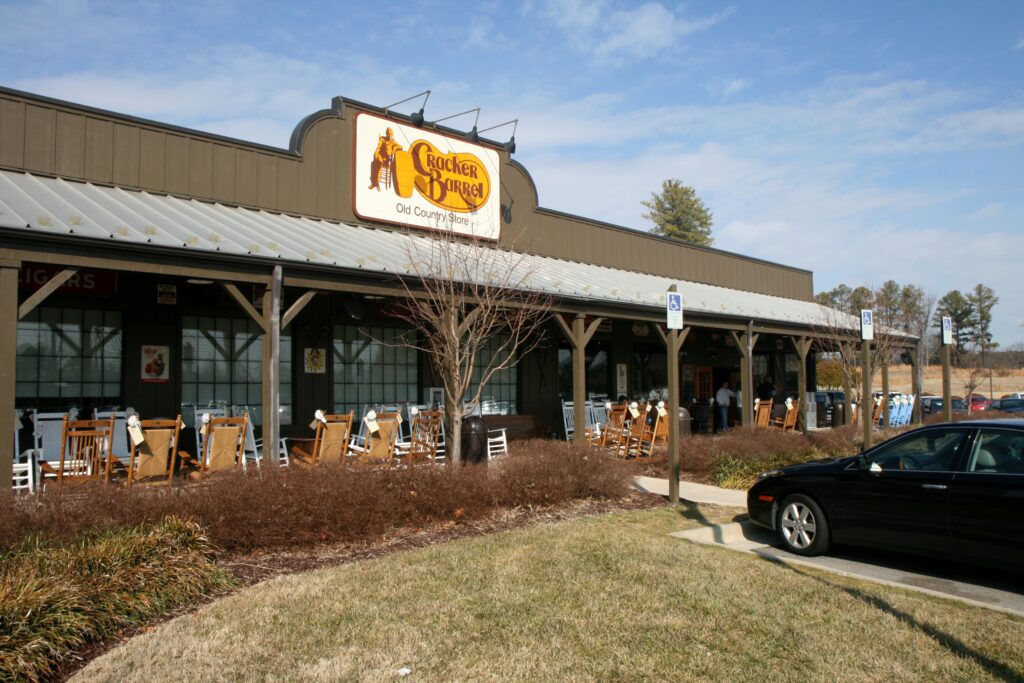
Cracker Barrel’s attempt at a major rebrand in August 2025 triggered a swift and negative market reaction. The company unveiled a new minimalist logo that removed the iconic image of “Uncle Herschel” (the bearded man leaning on a barrel) and even dropped the words “Old Country Store.” This was part of a broader effort to modernize the brand’s look – including updating the traditionally cluttered, antique-filled restaurants with lighter décor and modern furniture. The change, however, alienated core customers who cherished Cracker Barrel’s nostalgic identity. Backlash on social media was intense, with even President Donald Trump publicly criticizing the new logo and urging a return to the old design.
Amid the uproar, Cracker Barrel’s stock price fell sharply – over 10% in the week following the logo introduction on Aug. 18. This drop wiped out roughly $94–$143 million in market value, according to various reports.
Facing the outcry from loyal “Old Timer” patrons and concern from investors, the company quickly reversed course. On Tuesday, Cracker Barrel announced it would scrap the new logo and restore the classic branding. The stock rebounded about 7–8% after the reversal, recouping some losses. CEO Julie Felss Masino – who had launched this “transformation project” to refresh the brand and boost stagnant sales – acknowledged that the company “would listen” to guest feedback and keep its heritage elements intact going forward
It’s worth noting this branding debacle came on the heels of broader financial struggles. Cracker Barrel stock had already been on a long decline from all-time highs (~$185 in late 2018) to around the low $60s by mid-2025.
New CEO Julie Masino’s strategic plan (including the rebrand) initially failed to inspire confidence – in fact, an activist investor pointed out that the share price fell 14.5% on the day her transformation plan was revealed in May 2024. Activist Sardar Biglari, a significant shareholder, has highlighted that Cracker Barrel’s stock was down about 50% since Masino was named CEO-elect in August 2023, vastly underperforming peers In Biglari’s view, management missteps and the board’s decisions (from ill-fated expansions to brand changes) have destroyed shareholder value.
The logo fiasco in 2025 only compounded these issues, demonstrating the power of branding on customer loyalty and the stock. Cracker Barrel ultimately learned that drastic changes to a beloved brand can carry heavy costs – both in customer goodwill and market capitalization.
“Quiet” Land Asset Divestitures via Sale-Leasebacks
Separate from the branding drama, Cracker Barrel has been “quietly” shedding its hard assets – particularly the real estate under its restaurants – over the past few years. Historically, Cracker Barrel owned much of the land and buildings for its stores (a valuable real estate portfolio). As recently as 2019, the company owned roughly 400 of its ~660 Cracker Barrel restaurant locations.
However, in 2020 the company undertook two large sale-and-leaseback transactions that transferred a substantial chunk of these assets to a third party. In a sale-leaseback, a company sells its properties to an investor for cash, then immediately leases those same properties back to continue operating there. Essentially, it “monetizes” its real estate but gives up ownership and starts paying rent.
What happened in Cracker Barrel’s case: In the summer of 2020 – amid pandemic pressures – Cracker Barrel struck deals with Oak Street Real Estate Capital, a Chicago-based investment firm specializing in sale-leasebacks. The first deal involved 64 Cracker Barrel store properties that the company had originally owned but previously put under a 20-year sale-leaseback back in 2000 (that old lease was coming up for expiration in 2021). Cracker Barrel arranged to buy back those 64 sites from the previous lessor and simultaneously sold them to Oak Street for nearly $206 million in early August 2020. Oak Street became the new landlord, and Cracker Barrel signed a new 20-year master lease at those locations. Because the sale price exceeded the book value of the assets, Cracker Barrel recorded an accounting gain of about $70 million in its Q4 2020 financials from this transaction. A week later, on August 4, 2020, a second sale-leaseback deal closed: Cracker Barrel sold another 62 store properties to Oak Street for roughly $150 million in cash. This brought the total real estate sold to 126 locations, which was about 19% of Cracker Barrel’s real estate holdings at the time. Combined, Oak Street paid approximately $356 million for these properties. Cracker Barrel, now as a tenant, agreed to long-term leases (20-year initial terms, with options up to 50 years) and triple-net lease conditions (meaning Cracker Barrel still covers taxes, insurance, maintenance).
Importantly, these transactions were disclosed in the company’s filings and press releases, albeit not trumpeted loudly in marketing. Cracker Barrel stated in an SEC filing that the Oak Street deals would “bolster its cash reserves and further strengthen its balance sheet in response to the pandemic.” Indeed, management openly acknowledged the motive was to raise liquidity during COVID-19’s worst impact. By September 2020, Cracker Barrel’s cash on hand had swelled to $437 million (up from just $37 million a year prior) as it received net proceeds from these sales and drew down credit lines to survive the crisis. In total, after fees the company expected to “take home $130 million” net from the sale-leasebacks (some of the cash went to repurchasing the previously leased sites and transaction costs). Additionally, the new leases with Oak Street were negotiated at lower rent rates than the prior lease arrangement on those properties, which slightly reduced Cracker Barrel’s rent expense going forward relative to the old deal.
From an accounting standpoint, the gains from these sales were recorded in 2020-2021 (e.g. a $69.9 million gain on the first batch, and a $217.7 million gain on the second batch, per the 10-K). However, those were non-cash gains (reflecting the book value vs. sale price difference), and no special dividend or obvious payoff to shareholders was announced – the cash was largely used to pay down debt and build a cushion during the pandemic. This perhaps gave some observers the impression that Cracker Barrel “quietly” sold assets without directly returning the money to investors. In reality, the moves were disclosed in the annual report and earnings calls, but they weren’t emphasized beyond stating the basic facts. For example, the FY2020 earnings release briefly notes the two sale-leaseback deals as one-off events to strengthen the balance sheet. There wasn’t much public fanfare about why management chose this route, other than the logical explanation of shoring up liquidity in a very uncertain time.
Impact on Owned vs. Leased Assets
Because of these transactions, the mix of owned vs. leased stores shifted significantly. Cracker Barrel went from owning a majority of its store properties to roughly an even split of owned and leased. According to the 2021 annual report, as of September 2021 the company owned 360 of its store locations and leased 341 – roughly 51% owned. (This count includes all Cracker Barrel restaurants plus some acquired Maple Street Biscuit Company units). Two years later, by September 2023, the balance tipped slightly further toward leasing: 358 owned vs. 362 leased locations (~49% owned). In other words, over the last few years the percentage of stores on company-owned land has declined from a slight majority to just under one-half. The 2020 Oak Street deals were the primary driver of that change, as no similarly large real estate sell-off has been reported since.
It appears Cracker Barrel still retains hundreds of properties (especially in certain states like Florida, Texas, Georgia, etc., where many stores remain on company-owned land). But the company has demonstrated a willingness to monetize its real estate when advantageous. Notably, Cracker Barrel had never before done such a large sale-leaseback in its history except a much smaller one in 2009 and one in 2000. The 2020 transactions were unprecedented in scale for them, prompted by an extraordinary crisis.
Where Did the Assets Go, and Why?
The buyer/landlord on the other side of these deals, Oak Street Real Estate Capital, essentially became the owner of those 126 Cracker Barrel properties. Oak Street is not an affiliate of Cracker Barrel management, but rather a real estate private equity firm (now a division of Blue Owl Capital) known for sale-leaseback investments. Oak Street has done similar buy-and-lease deals with retailers like Bed Bath & Beyond and Big Lots in 2020. In Cracker Barrel’s case, Oak Street presumably placed the properties into its net-lease investment funds. In fact, soon after the purchase, Oak Street or its fund began marketing some of these Cracker Barrel sites to real estate investors as long-term NNN leased properties. For example, commercial real estate listings appeared for individual Cracker Barrel stores (e.g. in Roseville, MI and Smyrna, TN) offering 20-year NNN leases that had been executed in 2020 – clearly originating from the Oak Street master lease deal. This suggests that the assets were not transferred to some secret insider entity, but rather sold to outside investors who may hold them for income or resell them on the open market. In short, the land and buildings now “live” in Oak Street’s portfolios or have been flipped to other landlords; Cracker Barrel simply pays rent to whichever landlord owns each location’s parcel.
From the company’s disclosure perspective, they did not explicitly spell out “here is exactly where our real estate went” beyond naming Oak Street as the counterparty in filings. The transactions were lumped together in financial reports. So a casual investor reading quarterly summaries might not immediately realize that over a hundred store properties were sold, unless they read footnotes or listened to earnings calls. This lack of plain-language narrative (“we sold X% of our owned real estate”) is possibly why you heard it was “quietly” done. However, the core facts were reported: for example, the 2020 Q4 earnings release explicitly mentions selling 64 properties and entering a new 20-year lease, then selling 62 more properties for ~$150 million in Q1 2021. The reason given was to bolster liquidity during the COVID-19 pandemic and to “realize other benefits” like a strengthened balance sheet. There was no admission of any other motive in official communications.
Is Cracker Barrel “Prepping for a Fall”?
Conjecture that leadership might be stripping assets to set the company up for a fall (bankruptcy or takeover), allowing those assets to be owned elsewhere – echoes the skepticism some fans and observers have voiced. It’s true that this pattern of selling off hard assets and leasing them back is often associated with private equity playbooks. In leveraged buyouts, firms sometimes liquidate a target’s owned real estate to generate cash (or pay themselves a dividend), leaving the operating company asset-light but saddled with rent obligations. Cracker Barrel, however, is still a publicly traded company (no single private equity firm owns it outright), and these transactions occurred under the tenure of longtime CEO Sandra B. “Sandy” Cochran (who led the company from 2011 until stepping down in late 2023). Cochran and her management saw the sale-leasebacks as prudent moves to raise cash in a dire moment for the restaurant industry.
The current CEO, Julie Masino, inherited an “asset-light” balance sheet but was not the architect of those 2020 deals (she was an outside hire, joining in 2023). There is no public evidence that the former or current CEO has a personal stake in the entities acquiring the real estate. The properties went to Oak Street’s funds, not to a spinoff owned by Cracker Barrel insiders. Moreover, Cracker Barrel did benefit in the short term: the infusion of cash likely helped it avoid more expensive debt or equity raises during COVID, and the company survived the pandemic without permanent mass store closures (only one underperforming store closed in 2020).
That said, some shareholders (like Biglari and others) argue that management’s strategies – including heavy capital spending on new concepts and possibly these asset moves – have destroyed value over the longer term. With the company now paying tens of millions in annual rent to Oak Street (approx. $24.7 million combined initial rent for the two tranches, subject to 1% annual increases), future earnings are indeed burdened. Selling real estate can be a double-edged sword: it provides one-time cash, but the ongoing rent expenses can depress profit margins and operating cash flow in the future. This trade-off is likely why Cracker Barrel’s stock never fully recovered to pre-2019 highs, and why some view the chain as having been “hollowed out” financially. In online forums, frustrated Cracker Barrel fans have even speculated that the company feels like it’s been taken over by private equity due to the cost-cutting and asset sales – “like taking the controls of a passenger plane, selling the engines mid-flight, then parachuting to safety before the plane crashes,” as one colorful comment put it. In reality, the company has not been sold in a leveraged buyout, but the outcome can look similar: an iconic brand trying to boost short-term financial metrics (cash on hand, slimmer balance sheet) at the expense of long-term asset value and perhaps brand quality.
Bottom Line – Tracing the Assets
Where did the land assets go? They were sold to Oak Street Real Estate Capital in 2020 and now are owned by that firm’s investment vehicles (or subsequent landlords who bought individual sites from Oak Street). Cracker Barrel’s recent filings show a corresponding rise in lease liabilities and rent expenses, and a decline in owned property count, consistent with those sales. The transactions were disclosed to shareholders, albeit in the fine print of 10-K reports and brief notes in earnings releases, rather than loud headlines. Why might this be happening? The straightforward reason is that management needed to raise cash and believed monetizing real estate was better than, say, issuing dilutive equity or risking higher debt during the pandemic. By going asset-light, they also followed a trend common in retail and restaurant sectors to “unlock” hidden real estate value – essentially cashing in on their owned properties’ market value which the stock market may not have been fully appreciating.
However, the strategy comes with risks, and in Cracker Barrel’s case it has drawn suspicion. The company’s financial performance remains challenged (e.g. only ~1% same-store restaurant sales growth in 2025, with retail sales actually down), and the stock as of mid-2025 is far below past highs. Activist investors are actively pushing for changes at the board level. It’s not inconceivable that if performance doesn’t improve, Cracker Barrel could become a takeover target (private equity or otherwise) precisely because it now has fewer hard assets – some acquirers like asset-light models with steady cash flow. In the worst case (which Cracker Barrel is NOT openly planning, to be clear), if the company were headed for insolvency, having the real estate already separated could benefit those asset owners while leaving the operating company with less collateral. But that is speculative; there is no direct evidence that the CEO “prepped” the company for failure on purpose. In fact, Cochran’s moves in 2020 were portrayed as saving the company, and Masino’s focus has been on reinvigorating the brand (albeit clumsily with the logo misstep).
In summary, Cracker Barrel did “digest” a large portion of its valuable real estate portfolio into cash via sale-leasebacks. Those assets now reside with Oak Street/Blue Owl and possibly various net-lease investors, while Cracker Barrel pays rent to use them. The company disclosed the fact of these divestitures but didn’t dwell on it in public-facing narratives. The official rationale was shoring up finances during a crisis, though the result has been an increase in ongoing obligations that may weigh it down in the future. Observers have noted that these actions – combined with severe cost-cutting, a controversial rebrand, and other “modernizing” efforts – feel like what happens under aggressive outside ownership.
As of late summer 2025, the key questions remain: Can new management turn around sales and regain customer loyalty without the cushion of owning so much real estate? Or will the lack of hard assets and recent strategic blunders leave Cracker Barrel vulnerable? Only time will tell, but the phenomenon skeptics identified is real – the company has materially changed its asset base and is navigating the consequences of that choice in tandem with trying to refresh its brand.
READ NEXT: Trump Calls For RICO Charges Against Soros. What’s The Legal Reality?



















there is only one answer to this decline in cracker barrel, FIRE CEO Julie Masino’s.