

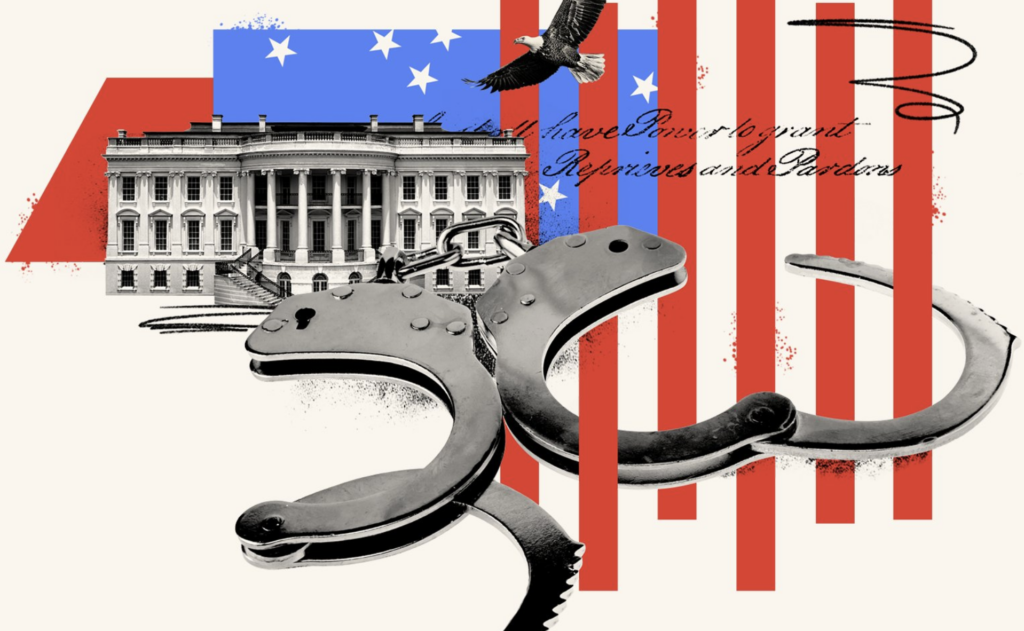
Thomas Jefferson once warned, “The judiciary, independent of the nation, can work against the will of the people.” His caution underscores the inherent danger of judicial overreach, particularly when judges extend their authority to undermine the executive branch’s constitutional powers, as seen in the imposition of conditions on commutations. Such actions disrupt the delicate balance envisioned by the Framers and challenge the very principles of our Republic. His words echo ominously today as we examine the troubling overreach of judicial authority in the wake of the January 6th prosecutions. In this political theater, we see an unholy alliance of the judiciary and Congress undermining the executive’s constitutional prerogative of clemency—a breach of the separation of powers that threatens the foundation of our Republic.
Recently, President Trump commuted the sentences of eight individuals convicted of offenses related to January 6th Capitol protest and riot. Notably, at least two of these individuals were not violent actors nor present in the Capitol during the riot. They were convicted largely due to their affiliations, a prosecutorial strategy reminiscent of guilt by association. Their 20+ year sentences far exceeded those meted out for comparable offenses committed during the 2020 riots—acts often excused or dismissed outright under the guise of social justice.
The commutations explicitly stated these sentences were commuted to time served without any release conditions. Yet, Congressional Democrats, incensed at the mere presence of these individuals in the Capitol post-release, petitioned a federal judge to impose restrictions barring them from entering Washington, D.C., or the Capitol indefinitely without court approval. In an unprecedented move, the judge acquiesced, imposing restrictions at the behest of Congress, effectively contravening the president’s clemency order.

This judicial overreach cannot be examined in isolation. It sits against a backdrop of partisan legal disparities. During the 2020 riots, which engulfed cities in flames, law enforcement and judicial authorities adopted a lenient stance. Charges were often dropped, and sentences, when imposed, were minimal. By contrast, the January 6th defendants have faced a prosecutorial zeal bordering on vendetta, with sentences that stretch the bounds of proportionality.
Two individuals who received the longest sentences in this context—leaders of an organization blamed for the riot—were not physically present at the Capitol. Their crime? Association with others who committed illegal acts. The application of justice here smacks of Orwellian thoughtcrime: punished not for actions, but for affiliations.
The Framers of the Constitution understood the necessity of distinct and balanced powers. Article II, Section 2, vests the President with the authority to grant pardons and commutations. This power, by design, is unilateral, immune to congressional or judicial interference. The judiciary’s imposition of conditions on the commutations undermines this prerogative, as demonstrated by precedents such as Ex parte Garland and Schick v. Reed. These cases affirm the unilateral nature of presidential clemency, emphasizing that the judiciary lacks authority to impose additional conditions that contravene the executive’s explicit directives. Worse, Congress’ direct involvement in lobbying the judge conflates legislative oversight with judicial activism.
This episode raises troubling questions. If a judge can effectively rewrite the terms of a presidential commutation, where does the president’s clemency power end? Such interference sets a dangerous precedent, empowering the judiciary and Congress to act as gatekeepers of executive authority.
This case also presents novel issues for an appeal under the First Amendment. Since these defendants were given commutations rather than full pardons, the judge retained jurisdiction over their movements. However, the order—imposing restrictions on entering Capitol Hill without prior court approval—could be viewed as limiting First Amendment activities, including the rights to free speech, association, and petition. Cases like NAACP v. Alabama highlight the judiciary’s recognition of the vital importance of associational freedoms, where state interference was struck down as an unconstitutional burden. Similarly, imposing prior approval for accessing Capitol Hill could contravene expressive and associational rights, underscoring the need to ensure such restrictions meet the highest constitutional scrutiny.
The need to obtain prior approval to go to Capitol Hill contravenes expressive and associational rights. Historical precedent underscores the importance of these freedoms. Prior cases have raised analogous concerns where restrictions on movement or association were seen as unconstitutional infringements. By placing such limitations on individuals who pose no evident threat of violence, the order risks overstepping constitutional bounds and creating a chilling effect on lawful political engagement. Similar chilling effects were observed in cases like United States v. O’Brien, where restrictions on expressive conduct were scrutinized under the First Amendment. Such judicial orders not only impede individual liberties but also deter broader participation in political discourse, striking at the heart of constitutional protections.
History offers instructive lessons on the dangers of such overreach. Alexander Hamilton, in Federalist No. 74, emphasized that the pardon power should reside with the president, a single actor capable of decisive and compassionate action. The British monarchy’s abuses of this power informed the Framers’ design. They sought to avoid a system where clemency became a tool for political machination. The involvement of Congress in lobbying for restrictions on these commutations flies in the face of this design.
One cannot help but draw parallels to the Alien and Sedition Acts of 1798, which weaponized federal authority against political dissent. Then, as now, the machinery of justice was employed to silence and punish political adversaries. The abuses sparked a national debate on the limits of federal power, ultimately shaping the trajectory of American civil liberties.
The judge’s imposition of restrictions on these individuals reveals a judiciary that has drifted from impartiality to activism. By yielding to congressional demands, the judiciary undermines public trust in its independence. The indefinite nature of the restrictions—a punitive measure—also raises constitutional concerns. Restrictions on movement, particularly indefinite ones, impinge upon the fundamental right to travel freely, a right recognized under the Due Process Clause.
The conditions imposed in this case are especially troubling given the nonviolent nature of the individuals involved. These were not armed insurrectionists plotting further unrest; they were citizens expressing political dissent, however misguided. To subject them to indefinite restrictions without compelling evidence of ongoing danger is an affront to justice.
If left unchallenged, this precedent will embolden further encroachments on executive authority and civil liberties. The individuals affected have the right to appeal these conditions, and higher courts must scrutinize the legality and reasonableness of the restrictions. The principle at stake is not partisan but foundational: preserving the constitutional balance of power.
Moreover, Congress and the judiciary must be reminded of their constitutional boundaries. The judiciary’s role is not to revise or second-guess the president’s clemency decisions. Similarly, Congress has no authority to intervene in the enforcement of these decisions. Notably, the president has standing to sue in this case, as his constitutional clemency power has been infringed by both Congress and the judiciary. The Constitution grants the president the power to “grant Reprieves and Pardons for Offenses against the United States,” which the Supreme Court has interpreted as granting “plenary authority.” The imposition of conditions on these commutations undermines this authority, constituting an injury to executive power. Such actions threaten to set a precedent that could erode the president’s ability to grant clemency freely in the future. Furthermore, the president has a vested interest in protecting the integrity of the pardon power to ensure it remains respected and unencumbered by interference from other branches of government. These breaches must be addressed to safeguard the integrity of our constitutional order.
As Ronald Reagan once observed, “Freedom is never more than one generation away from extinction.” Today, freedom faces an insidious threat—not from foreign adversaries but from within, as judicial and legislative overreach erode constitutional boundaries. The January 6th clemency controversy is a clarion call to all who cherish liberty. If we fail to check this encroachment, we risk undermining the very foundation of our Republic: the separation of powers that preserves our freedoms.
To safeguard these freedoms, President Trump must take decisive action. Filing suit to protect the executive’s clemency power would not only defend the constitutional authority vested in the presidency but also uphold the rights of those subjected to judicial overreach. Whether the goal is to shield executive power or to ensure justice for the January 6th political prisoners, such a legal challenge is imperative to preserving the integrity of our constitutional framework.
Jefferson’s prescient warning reverberates: “The judiciary…working like gravity by night and by day, gaining a little today and a little tomorrow…until all shall be usurped from the States.” This caution is particularly resonant in cases like this, where unchecked judicial power disrupts the constitutional balance, undermining executive authority and setting dangerous precedents for the erosion of liberty. We must act before the scales tip irreversibly.
UPDATE: DOJ Challenges Judge Mehta’s Decision
In a significant development, the Department of Justice, under President Trump’s administration, has filed a motion challenging Judge Mehta’s imposition of release conditions on the commuted sentences of January 6th defendants. The motion, titled “UNITED STATES’ MOTION TO DISMISS TERM OF SUPERVISED RELEASE AND PROBATION PURSUANT TO EXECUTIVE ORDER,” argues that the court’s actions violate the constitutional boundaries of presidential clemency.
The DOJ’s filing emphasizes that the president’s executive order explicitly commuted the sentences to time served, encompassing all associated terms, including supervised release and probation. Citing United States v. Haymond, the motion asserts that supervised release is intrinsically part of the sentence and thus nullified by the commutation. Moreover, it reinforces the argument that the judiciary cannot unilaterally override the executive’s clemency power, highlighting United States v. Nixon as precedent for the “exclusive authority” of the executive in such matters.
This legal action fortifies the essay’s central argument: the judiciary’s overreach into executive clemency is both unprecedented and unconstitutional. By seeking to vacate Judge Mehta’s order, the administration underscores the vital need to preserve the separation of powers. This case not only defends the integrity of the president’s constitutional authority but also sets a critical precedent for safeguarding the future exercise of clemency powers.
UNITED STATES’ MOTION TO DISMISS TERM OF SUPERVISED RELEASE AND PROBATION PURSUANT TO EXECUTIVE ORDER
The United States of America, by and through its attorney, the United States Attorney for the District of Columbia, respectfully submits this motion.
As the Court is aware, an Executive Order issued on January 20, 2025, Granting Pardons and Commutation of Sentences for Certain Offenses Relating to the Events at Or Near the United States Capitol on January 6, 2021. Unnumbered Proclamation, __ Fed. Reg. __ (Jan. 20, 2025), https://perma.cc/W4NT-4K4S. This Proclamation included the above-listed defendants in the list of defendants whose sentences had been commuted. “The Executive Branch has exclusive authority and absolute discretion to decide whether to prosecute a case.” See United States v. Nixon, 418 U.S. 683, 693 (1974).
The Court entered an Order dated January 24, 2025, Amending Conditions of Release (ECF 940). The defendants, however, are no longer subject to the terms of supervised release and probation, as the Executive Order “commute(d) the sentences” of these defendants. As the terms of supervised release and probation are included in the “sentences” of the defendants, the Court may not modify the terms of supervised release; the term is no longer active by effect of the Executive Order. See United States v. Haymond, 588 U.S. 634, 648 (2019) (Supreme Court has acknowledged “that an accused’s final sentence includes any supervised release sentence he may receive” and therefore “supervised release punishments arise from and are treat[ed] as part of the penalty for the initial offense”) (cleaned up)).
The United States hereby indicates that the Order must be vacated.
Respectfully submitted, EDWARD R. MARTIN, JR. United States Attorney D.C. Bar No. 481866
Sponsored by the John Milton Freedom Foundation, a nonprofit dedicated to helping independent journalists overcome formidable challenges in today’s media landscape and bring crucial stories to you.
READ NEXT: Last-Minute Drama: Trump Makes History With SWEEPING Senate Victory

















Some of today’s judges like Mehta and Marchan are acting like gods who answer to no one. These overzealous judges should be removed from the bench as it is clear they are operating along political lines instead of justice lines. It is scary to think that these type people have such power.
ANY restrictions imposed by the judge after a grant of clemency are illegal on their face. Allowing such restrictions is declaring clemency effectively meaningless.
If there are no out of bounds, then the game changes. So many legal challenges will be made, and our courts will be overwhelmed.
ANOTHER DC JUDGE EXCEEDING HIS AUTHORITY!!!! TIME TO REMOVE HIM FROM THE BENCH!!! THIS LOOKS LIKE A CONDUCT/ETHIC ISSUE OF A SITTING JUDGE!!! GOING AGAINST Article II, Section 2, vests the President with the authority to grant pardons and commutations.
Perhaps we can enlist this same judge to vacate ALL of Biden’s pardons, particularly those he gave to his family and the J 6 committee.
Mention should be made of Judge Mehta’s background (an Obama appointee in his current post as a U.S. District Judge): Mehta was born in 1971 in Patan, Gujarat, India; at age one, Mehta & his parents, Priyavadan & Ragini Mehta, moved to the U.S. His mother worked as a lab technician; his father worked as an engineer. Mehta was raised in Reisterstown, MD, a Baltimore suburb. We need to ensure that people given the enormous privilege to come to our country and to be educated here, learn to appreciate our Constitution, Bill of Rights and our freedoms. Mehta has fallen way short. We are failing as a nation to assimilate immigrants like him properly.