

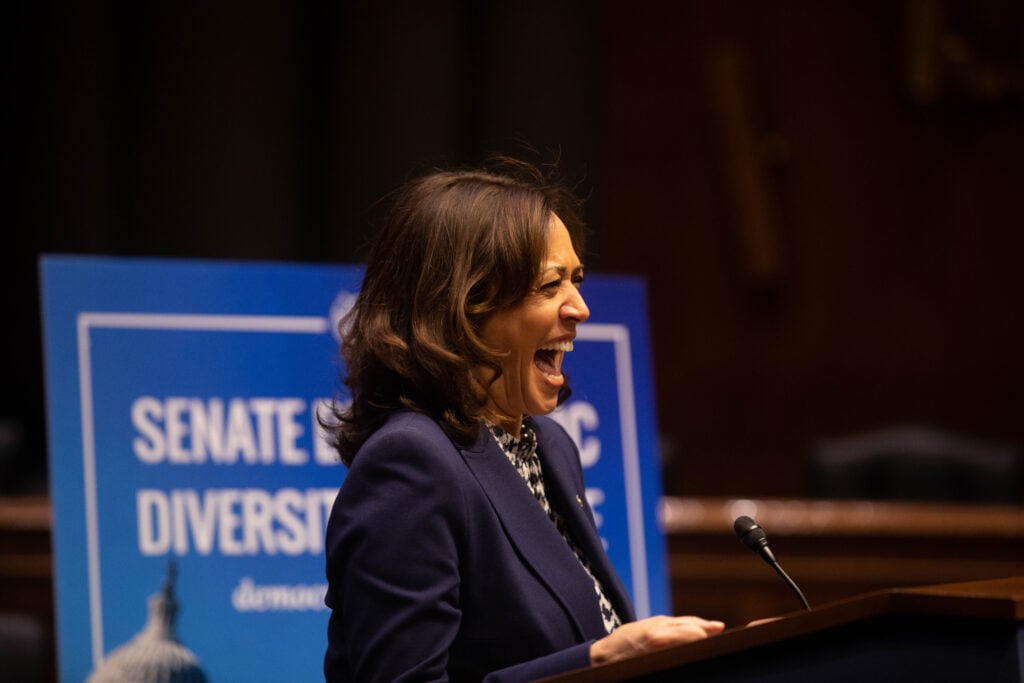
Kamala Harris’s new book, 107 Days, is not a memoir in the ordinary sense. It is a scorched-earth document, a political suicide note that spares no one in her party. Harris does not simply critique strategy or reflect on missteps. She names names, recounts betrayals, and indicts an entire party structure as irredeemably treacherous. In doing so, she has ensured that she has no future in Democratic politics. Her words amount to a declaration that the Democrat Party has eaten itself alive, with loyalty vanishing and cynicism reigning supreme.
Kamala Harris says her "heart breaks" for the residents of Springfield, OH.
— Charlie Kirk (@charliekirk11) September 18, 2024
Or really?
Is it because her policies have flooded that community with 20,000 Haitians overnight?
Is it because residents don't feel safe walking the streets of their once sleepy town?
It is because… pic.twitter.com/AzK0aF4Tt4
Consider her treatment of Joe Biden. Harris calls his decision to run again in 2024 an act of recklessness. She portrays an 81-year-old man too frail to withstand the demands of the campaign, a leader whose ambition endangered the party. She recounts his physical and verbal stumbles, his feeble debate performance, and most damning of all, the way his inner circle conspired to sideline and humiliate her. According to Harris, Biden’s aides delighted in feeding negative stories about her to the press. They operated on the logic that her success diminished him, so she had to be cut down. Even Jill Biden appears in her account as a cold, suspicious figure, demanding loyalty pledges while offering little support in return. Harris includes a telling moment when Jill warned Doug Emhoff, “Be careful what you wish for,” upon Biden’s withdrawal. This was not encouragement. It was a curse, a final reminder that even in the moment of transfer, generosity of spirit was absent.
But Harris does not stop with the Bidens. She singles out Pete Buttigieg, not for personal failure but for what she calls political risk. She admits he was her first choice for vice president, praising his intelligence and capacity, yet she rejected him because, as she writes, “he would have been the ideal partner if I were a straight white man.” She concluded that he was “too gay” to add to a ticket already led by a Black woman who was married to a Jewish man, claiming it was “too much change” for voters to accept. It is a cruel calculation, and it is revealing. Here Harris essentially concedes that Democratic identity politics, once a source of pride, has hardened into a liability. Rather than inspiring, diversity has become something to be rationed. Her bluntness humiliates Buttigieg, who now knows that his exclusion was based on the belief that he was sexually radioactive.
Josh Shapiro fares no better. Harris portrays him as overeager, already measuring drapes for the vice president’s residence, peppering her with questions about bedrooms and art loans from the Smithsonian. She mocks him as presumptuous, reminding him that the vice president is not a co-president. In essence, she paints him as arrogant, more interested in his own advancement than in service. Shapiro’s rejoinder, that Harris lacked the courage to challenge Biden when it mattered, only confirms the portrait of a party without trust, a collection of rivals circling each other warily.
Even Tim Walz, the man Harris actually chose as her running mate, is subject to brutal criticism. She describes watching his debate with JD Vance in horror, groaning as Walz nodded along to Vance’s bipartisanship. She mocks his incoherent response about biking in Nebraska when pressed on a Tiananmen Square gaffe. Walz, supposedly the safe choice, comes across as a blundering liability. By writing this down for posterity, Harris ensures that her supposed ally leaves the campaign diminished and humiliated.
Her scorn extends to the broader party leadership. Gretchen Whitmer, JB Pritzker, and Gavin Newsom all come under her gaze for their hesitation in endorsing her after Biden dropped out. Though their endorsements came within days, Harris noted the hesitation. That she records this detail at all speaks volumes. In her eyes, even the act of pausing before offering support was proof of disloyalty. The message is clear: the party is incapable of unity, even in crisis.
One might be tempted to think Harris is settling personal scores. Yet the cumulative effect of 107 Days is larger. She is not merely recounting slights. She is documenting a culture of mistrust and self-interest that pervades her party. From Biden’s selfishness to Jill’s suspicion, from Shapiro’s arrogance to Walz’s incompetence, from Whitmer’s hesitation to Newsom’s evasiveness, Harris leaves her readers with the impression that no one in the Democratic hierarchy is worthy of respect. There are no good people left, only climbers and saboteurs.
The political consequences are profound. Harris cannot expect reconciliation. By airing these grievances so publicly and in such detail, she has burned her bridges. There is no path back for her into the Democratic mainstream. More than that, her book will live on as a damning record of dysfunction at the highest levels. Republicans do not need to invent attacks when Harris herself has supplied them. Her words will be quoted for years to come as proof that the Democratic Party is a hollow shell, divided and distrustful.
Some Democrats will insist that this is mere candor, that Harris has done the party a service by speaking truth. But candor without loyalty is poison in politics. Harris may believe she has unburdened herself of long-suppressed truths, but what she has actually done is expose her party as a nest of vipers. Voters will draw the obvious lesson: if Democrats cannot trust each other, how can they be trusted to govern a country?
History is unkind to those who betray their own. Think of Al Gore’s coldness to Bill Clinton in 2000 or Hillary Clinton’s disdain for Bernie Sanders in 2016. Such moments of intra-party contempt sowed division and cost Democrats dearly. Harris’s memoir is worse than those episodes because it is comprehensive. She does not target one rival. She targets all. This is not a story of a few bad actors. It is an indictment of the whole.
Harris has written herself out of her party’s future. But more importantly, she has revealed to the country what many suspected: the Democrats are a party rotting from the inside, incapable of loyalty, incapable of unity, and incapable of producing leaders who inspire respect. In that sense, 107 Days is more than a memoir. It is an autopsy.
If you enjoy my work, please consider subscribing: https://x.com/amuse.
Sponsored by the John Milton Freedom Foundation, a nonprofit dedicated to helping independent journalists overcome formidable challenges in today’s media landscape and bring crucial stories to you.
READ NEXT: Supreme Court Hands Trump Sweeping New Power



















This article is an up-to-date summary of the Democrat party by Harris; a must read by anybody who naively supports them without wanting truth. The Lie-beral Demonocrats are DEAD because of their corruption and no common-sense policies. Their number one goal is to acquire more money for themselves, America be damned. They have been cheating in elections since 1898, so GOOD RIDDANCE !!!