

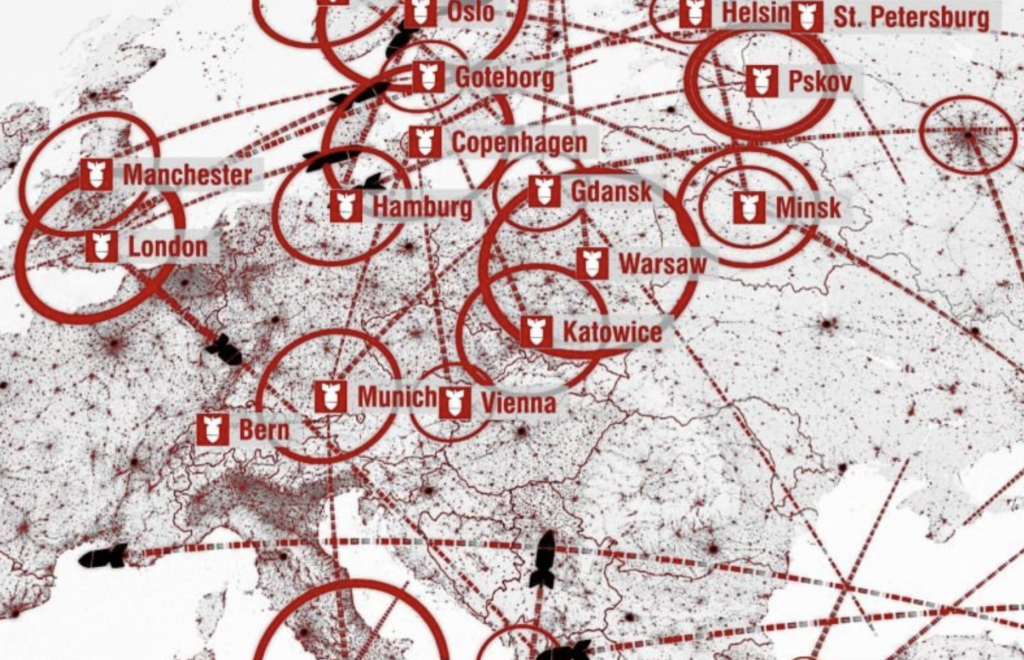
Europe stands at a precarious crossroads, holding the lofty yet perilous belief that it might successfully engage in a direct conflict with Russia absent the robust support traditionally provided by the United States and the broader NATO alliance. Advocates of European strategic autonomy argue earnestly for the continent’s military self-sufficiency, envisioning a scenario where Europe’s combined economic and technological prowess suffices to repel any Russian aggression. But such views are perilously detached from the cold calculus of geopolitical reality.
Consider first the apparent strengths of Europe in isolation: technologically sophisticated militaries, economic might and two nuclear-armed states—France and the United Kingdom—offering a veneer of deterrence. Certainly, Europe’s conventional forces boast an edge in modern weaponry, superior naval and air capabilities and substantial, if fragmented, land forces. Yet, military power, much like political unity, is as fragile as it is formidable. Europe’s Achilles’ heel remains glaringly evident in the logistical realities of defense coordination and reliance on U.S. strategic assets, from intelligence, surveillance and reconnaissance (ISR) capabilities to airlift and missile defense systems.
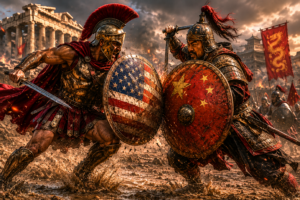
Historical parallels abound. Europe’s reliance on American strategic architecture mirrors the ancient Greek states’ dependency on Sparta against Persian threats; once Sparta retreated, Athens found itself vulnerable. Europe’s contemporary landscape, similarly, has long enjoyed the protective shadow of American military might, fostering a dangerous complacency. The removal of that protective umbrella exposes fundamental vulnerabilities: fragmented command structures, inadequate strategic logistics and political divisions ripe for exploitation.
Russia, conversely, operates from a fundamentally different calculus. Its strategy emphasizes swift, decisive operations leveraging massed artillery, rapid mobilization and the political advantage of decisiveness in leadership. Russia’s strategic doctrine, drawn from historical experiences stretching from the Napoleonic Wars to the Second World War, underscores rapid territorial gains followed by diplomatic coercion. Any military conflict initiated by Russia would likely aim at swift, brutal shocks—perhaps capturing the Baltic states or critical sectors of Eastern Europe—forcing Europe into unfavorable negotiations.
Yet herein lies Europe’s profound strategic dilemma. While Russia might succeed initially, sustaining such operations against Europe’s larger economic base and military mobilization capabilities is an untenable proposition. Like Pyrrhus after his costly victories against Rome, Russia could quickly find itself embroiled in attritional warfare, eroding its already tenuous economic foundations.
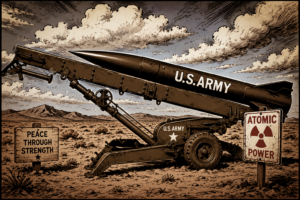
However, the nuclear dimension radically complicates this equation. Russia’s vast nuclear arsenal serves as an unequivocal guarantor against complete defeat. The Russian strategic doctrine, echoing the stark logic of mutually assured destruction articulated during the Cold War, openly acknowledges tactical nuclear weapons as legitimate tools to “level the playing field.” In contrast, Europe’s nuclear posture, principally embodied in France and the U.K.’s modest but capable arsenals, focuses on deterrence through strategic ambiguity, signaling severe repercussions for any nuclear escalation without promising Armageddon.
Yet deterrence depends crucially upon credibility, cohesion and command clarity—attributes currently weakened by Europe’s internal divisions. The absence of a unified, integrated nuclear strategy akin to NATO’s overarching command complicates the clear communication of red lines to Moscow. This fractured nuclear posture diminishes Europe’s ability to project a credible threat of devastating retaliation sufficient to prevent Russian tactical nuclear use.
Should a conventional conflict escalate, Russia’s strategic calculus might shift toward tactical nuclear employment to halt European momentum decisively. The chilling prospect of such escalation echoes the dark days of Cold War brinkmanship. Europe’s response options would be perilously limited: either escalate in kind, precipitating an uncontrolled spiral toward strategic nuclear annihilation, or acquiesce, signaling catastrophic weakness and inviting further aggression.
The fundamental error in the European strategic calculus without U.S. involvement is the assumption of inevitable conventional dominance and cohesive action. The EU and U.K., despite their economic heft and technological advantages, confront daunting logistical and political hurdles. Rapid, coordinated mobilization, critical in the early stages of a conflict, remains uncertain. Russian strategy, conversely, banks precisely on exploiting this initial disunity.
In a scenario stripped of the stabilizing influence of American military might, the specter of nuclear escalation looms ominously. Russia’s demonstrated willingness to wield nuclear threats as explicit policy exacerbates this risk, rendering Europe’s nuclear deterrent, though existent, comparatively frail. Thus, while Europe might withstand an initial conventional onslaught, the trajectory thereafter remains profoundly uncertain and potentially catastrophic.
Ultimately, the notion that Europe could decisively manage, much less prevail, in a conflict against Russia without the United States is dangerously misguided. It dangerously underestimates Russia’s strategic calculus and recklessly overestimates European unity and preparedness. History teaches us clearly: strategic hubris, particularly when matched with geopolitical naivety, invariably ends in disaster. Europe’s leaders must soberly acknowledge this stark reality—lest they risk stumbling blindly toward an abyss from which there can be no victorious emergence, only costly stalemate or devastating ruin.
Sponsored by the John Milton Freedom Foundation, a nonprofit dedicated to helping independent journalists overcome formidable challenges in today’s media landscape and bring crucial stories to you.
READ NEXT: Dems Cry Out After Congress Drops Nuke On Shameful Politician















Nice presentation. So why does it make sense for the USA to go soft on deterring Russia and seem to hand over portions of Europe to rebuild the old Soviet empire? Is it a billionaire greed play?
I thought we agreed that our current Nuke positions on both sides “assured total mutual destruction”. Have we forgotten that bit of the equasion? There are enough Nukes, and if one side goes Balistic and launches the other side will also, that total destruction will take place by nuke winter for those who survived the first salvo. All plant life and other food will be gone, man will die off. The planet will be radiaton hot for hundres of years but it will cleanse itself after a million or so years as tectonic places slide under ground and clean ones appear. Life will start over and who know, maybe the DoDo bird will come back again!
How about it’s Russia’s dangerous gamble against Europe.
This is good to prepare the world for WWIII, but are we being led into battle by the elite globalists? Self-defense of your geopolitical lands, and helping your political neighbors are expected things to do in international relationships. I don’t feel comfortable at this time with the socialist governments in Europe doing what needs to be accomplished to keep peace.
Russia is economically weak at the present time, and this is the best opportunity for Europe to take a stand. The United States seems to be giving Putin Ukraine on a plate, so Europe has to decide if it will oppose or roll over.
Germany and France have continued to purchase gas from Russia, and India and China have bought oil, so the revenue has kept Russia alive. If those sales had been stopped Russia would not have been able to prosecute the Ukranian war and would, by now, have retreated. It’s ironic that the has that Russia has sold into Europe has been used to power the furnaces that make the arms that have been given to Ukraine to use defending the invasion.