

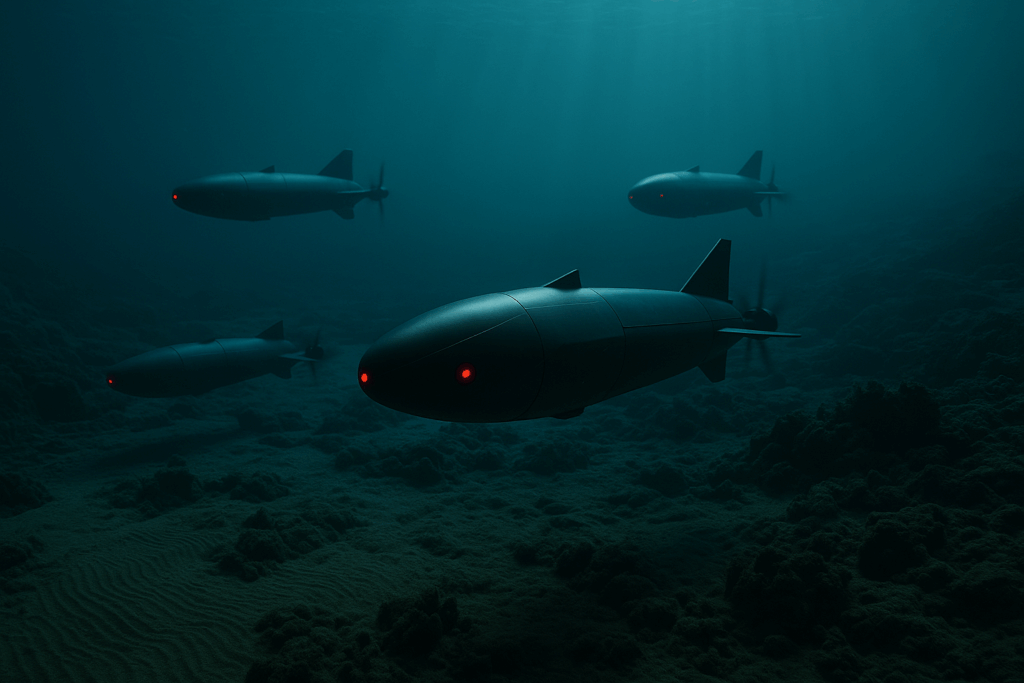
With the current reality of Russian undersea hybrid warfare, including severing internet and other communications and data high-speed fiber-optic cables and sabotaging oil and gas hubs and pipelines, two unnamed European navies are spending $116 million on two new sophisticated autonomous underwater drones capable of transoceanic missions in a bid to address this growing threat.
The Grayshark drones will allow these countries to stealthily patrol or monitor large swaths of undersea terrain for months at a time with no humans directly in the loop.
Russian hybrid warfare operations against NATO, also known as “gray zone” tactics, stop short of armed combat, but can include sabotaging critical infrastructure like pipelines and cables. They can also include operations to disrupt elections, spreading misinformation, and cyberattacks.
The two unnamed nations buying these drones are likely NATO members with coastal and deep-sea interests.
NATO in January said it would beef up its presence in the Baltic, including operating more frigates and maritime patrol aircraft, shortly after a spate of suspected sabotage incidents in the region. Several undersea cables were cut or damaged in November and December 2024, including four data cables and a major power link on Dec. 25.
An estimated 98% of the world’s data speeds through well over 1 million kilometers of underwater cables, and an estimated $10 trillion in financial transfers every day, the vast networks vulnerable to damage or sabotage.
Asian customers are also considering buying this undersea drone technology, and the German navy is considering it as well.
The Grayshark Autonomous Underwater Vehicle (AUV), made by Germany’s Bremen-based EUROATLAS, is a mid-sized, penguin-shaped, multi-mission drone equipped with a wide range of acoustic and electromagnetic sensors augmented by integrated artificial intelligence for automatic target recognition and collision avoidance.
The Bravo model, a shorter-range battery-powered model, can travel for 5.5 days over 1,000km on its electric battery, while the Foxtrot hydrogen fuel cell motor can reach almost 15,000km in 16 weeks, for longer-lasting, high-endurance missions.
Both have a maximum speed of 10-18 knots, all without tethers or data links. Their non-metallic hull, quiet motors, and low sonar signature help make them difficult to detect.
Both versions also have level 5 autonomy, meaning they can operate fully autonomously under any conditions. They can be deployed from aerial, naval, or coastal land platforms and return to base on their own to recharge as needed.
With built-in object recognition, it can act autonomously or securely forward data to a command center for human intervention. Multiple drones can also function as a swarm controlled by a “mothership,” securely communicating with each other using encrypted acoustic means, and coordinating with surface ships and land units via EUROATLAS’ combat cloud tech.
They can navigate open water via GPS, map the Arctic seabed, and execute missions even in GNSS-denied environments.
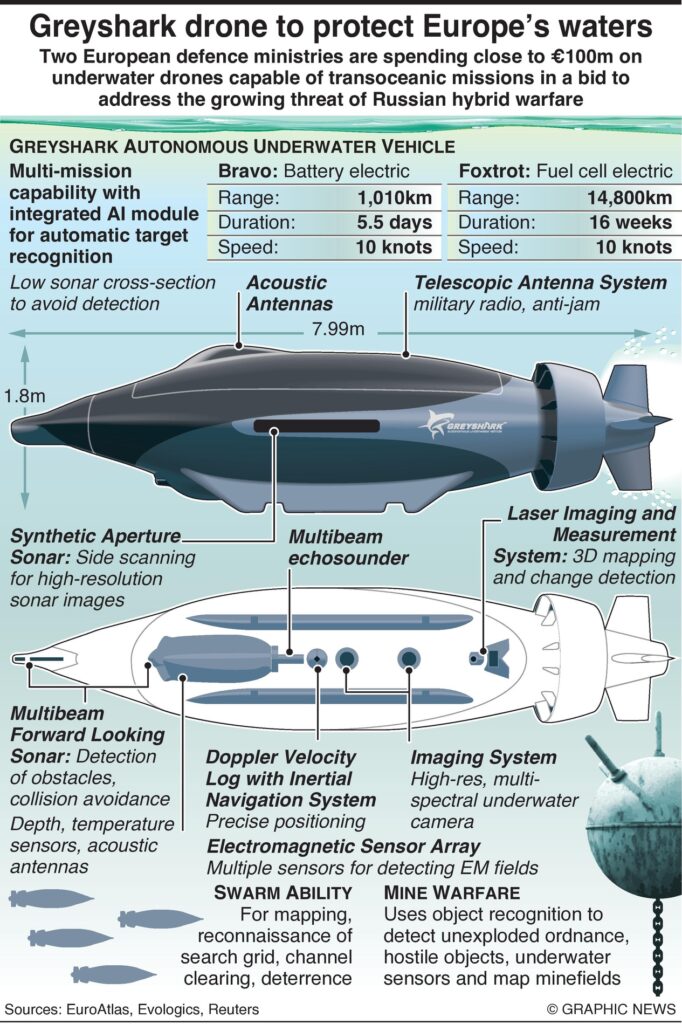
With a total of 17 different types of sensors, including sonar, lidar, cameras, and electromagnetic sensors capable of continuous data collection, these AUVs are ideally suited for undersea mapping, reconnaissance, surveillance and intelligence, monitoring undersea cables, tracking enemy submarines, and searching for sea mines.
These models are not intended to be armed but could later incorporate mine countermeasures and anti-submarine capabilities. The Grayshark’s AI decides on its own when to switch from observing cables to hunting submarines or other roles.
Significantly, the drones can sit quietly on the seabed for long periods and only wake up when they detect unusual activity, like a suspicious boat or submersible near important infrastructure.
Company sources say that the Foxtrot Greyshark could cover 4,800 square km of seabed in each four-month deployment, and a swarm — described as six drones working together — would know the location of vital undersea infrastructure to quickly detect any changes to pipelines or cables.
Meanwhile, other allies are deploying their own armed undersea drones.
Ukraine’s Security Service (SBU) recently unveiled the latest version of its armed Sea Baby surface naval drone that it says can operate at distances of over 1,500 km and carry a payload of up to 2,000 kg, about double the previous limit.
And Australia has said it will spend $1.1 billion on a fleet of armed Ghost Shark autonomous undersea vehicles, developed by its defense force and U.S. startup Anduril Industries, for surveillance and strikes.
The opinions expressed in this article are those of the author and do not necessarily reflect the positions of American Liberty News.
READ NEXT: Senator Inadvertently Reveals Disturbing Military Threat


















And with the Immoral, Greedy and Godless people we have working in the Tech World today…China, Russia, Iran and every other enemy country WILL HAVE THE TECHNOLOGY within a year. And, they will use it as a Weapon as well.
“An estimated 98% of the world’s data speeds through well over 1 million kilometers of underwater cables, and an estimated $10 trillion in financial transfers every day, the vast networks vulnerable to damage or sabotage.”
Is Skylink the answer?