


Does America Need a Black National Anthem?
The opening of the Colorado State Senate session this week, provided a jarring tableau of division under the guise of unity. Dr. Michael Williams, Lorea Edwards, Kristin Grant and a quartet of interpretive dancers performed the so-called Black National Anthem. This spectacle, complete with twirling dancers and overwrought dramatics, was not just tone-deaf but emblematic of a broader trend—the creeping balkanization of America’s shared civic identity.
🇺🇸 Colorado state senate had a performance of the black national anthem to open the secession yesterday. What is that? There is only one national anthem Colorado. Do better.
— Josh Salem (@realJoshSalem) January 9, 2025
pic.twitter.com/Dl4j6XdGmW
Scott Shamblin, reporting on the event, encapsulated the frustration felt by many. “The Colorado State Senate, a body that is meant to represent all of Colorado equally and not favor any minority or majority groups, decided to perform the Black National Anthem during their opening ceremony. Complete with four interpretive dancers.” His frustration was palpable and justified.
To be clear, this is not a critique of the performers themselves but of the political message embedded in the act. When a state legislature, ostensibly a representative body for all citizens, chooses to elevate one group’s cultural identity above others, it sends a divisive signal. The anthem—adopted by some as a hymn of pride and resilience—has been weaponized into a political statement, undermining the principles of unity that national symbols are supposed to embody.
A National Anthem, by its very definition, is meant to be universal. The Star-Spangled Banner, with its storied history and enduring message of perseverance, represents all Americans, regardless of race, creed or background. Introducing a parallel anthem fragments that unity. What happens when every identity group demands its own anthem, its own moment, its own interpretive dancers? Where does it end?
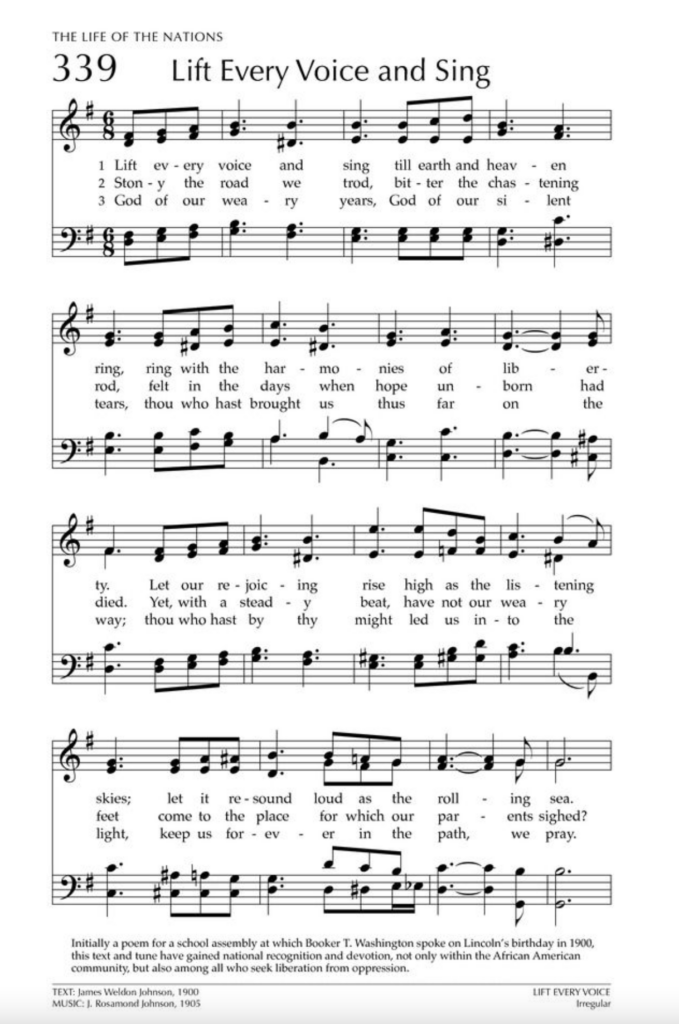
James Weldon Johnson, the distinguished author, poet and civil rights leader who wrote the lyrics to “Lift Every Voice and Sing” otherwise known as the Black National Anthem, would never have supported replacing the U.S. national anthem with his song. Efforts by some Democrats to introduce or elevate “Lift Every Voice and Sing” as a parallel anthem, especially based on racial lines, go directly against the principles of unity and equality that Johnson himself championed. Today, with the NFL playing this song before games as a prelude to the national anthem, many Americans are being pressured to stand for both—an act that can be seen as divisive and counterproductive to national cohesion.
Consider the lessons of history. Ancient Rome’s decline was hastened by the loss of a shared civic identity. As competing factions prioritized their own interests over the collective good, the empire’s unity fractured, leaving it vulnerable to external and internal threats. America is not immune to such dynamics. As Cicero famously warned, “We are bound together by agreement as to law and rights, by the bonds of civil society.” When those bonds fray, chaos follows.
The insistence on a separate anthem also raises uncomfortable questions about the goals of those pushing this agenda. Is the aim to highlight past injustices and work toward healing? Or is it to perpetuate a narrative of perpetual grievance, ensuring that unity remains an unattainable ideal? The latter seems more likely when gestures like this are performed not in the spirit of inclusion but as a political cudgel.
Moreover, the performance’s theatricality—the dancers, the dramatics—reeked of performative virtue signaling. It was less about celebrating culture and more about placating a vocal minority at the expense of broader unity. One can almost hear the ghost of William F. Buckley Jr. quipping, “The modern progressive’s obsession with symbolism over substance knows no bounds.”
The divisive implications of a separate anthem also extend beyond symbolism. They manifest in policies that prioritize identity over merit, quotas over qualifications, and narratives over facts. The Colorado Senate’s decision is symptomatic of a larger ideological drift—one that prioritizes group identity over individual achievement, grievance over gratitude, and division over unity.
To steelman the argument against a Black National Anthem, one must acknowledge the noble intentions behind it—to honor a history fraught with struggle and triumph. However, those intentions do not justify the unintended consequence of fostering division. America’s greatness lies in its ability to unify disparate identities under a shared commitment to liberty and justice for all. When we splinter that identity into hyphenated allegiances, we undermine the very foundation of our national project.
As the session’s opening ceremony fades into memory, we must ask ourselves: What kind of nation do we want to be? One that celebrates our shared identity and works toward a future of unity? Or one that indulges in endless factionalism, where every group has its own anthem, flag and dancers? The choice is ours, but history’s lessons are clear. Division, no matter how well-intentioned, leads to decline.
In the end, the Colorado State Senate’s decision to feature the Black National Anthem was not just a misstep but a missed opportunity. They could have opened their session with a message of unity, choosing a symbol that represents all Coloradans. Instead, they chose a path that underscores the divisions they claim to abhor. It’s a reminder that while symbolism matters, the symbols we choose must unite, not divide. And perhaps, just perhaps, it’s time to retire the interpretive dancers altogether.
Sponsored by the John Milton Freedom Foundation, a nonprofit dedicated to helping independent journalists overcome formidable challenges in today’s media landscape and bring crucial stories to you.
READ NEXT: [SHOCK REPORT] Minority Family’s Harrowing Experience With The Biden Admin – Is Justice Possible?



















As a Coloradoan I find this offensive that our Senate should create this divisive spectacle. Colorado was not a slave state. Why are our elected officials denigrating the majority of our state’s citizens with this performance? There is only 1 national anthem in America. You won’t get my vote again. As a matter of fact, I think I’ll campaign for your opponents next election.
Only those citizens that refer to themselves as Americans are worthy of being citizens and worthy of being called American citizens. If you call yourself an Irish American, Scottish American, German American, or African American you are not an American.
Sorry. Not only was that disrespectful to ALL Americans, it was a terrible rendition. What has happened to this country???
Absolutely NO for a black anthem.
CAN’T FIX STUPID. GUESS YOU CAN VOTE IT OUT. BUT GUESS THEY, AGAIN, MISSED THE POORTUNITY.
UNBELIEVABLE!!! THIS IS DEVISIVE AND RACIST!!!! DESECRATION OF OUR NATIONAL ANTHEM!!!!! THE WHOLE THING IS NOTHING BUT A SHOW OF RIDICULOUS PROPORTIONS!!!!
RACISM!!!! STOP THE DIVISION!!!!
Deivisive. Aren’t there enough problems without breathing energy into racism? UGH!
I knew it!When the voters elected Jared Polis 2018 I knew it would be destroyed in no time.And was I right?
As a USAF Veteran, my opinion is, “This is the United States of America!” We have ONE National Anthem, and it’s the “Star Spangled Banner”, only. All of the soldiers who have died, did so so by defending the symbol of our country. Period.
Is everybody in Colorado so stoned that you allow crap like that in Senate chambers? What the heck is the matter with the people in charge there? I understand that you’re lefty progressive, but you can’t fix progressively stupid.
They might need one but that crapola one they have picked is garbage.
Lift Every Voice and Sing is a religious pem and hymn – it appears in our United Methodist Church hymnal, #519. Words and music writen in 1921. It is not an offical “National Anthem” of any racial group. It belongs to GOD.
Maybe Colorado should have said, “and now, we will sing the praises of Glory to God” Let us sing, “Lift Every Voice and Sing”