

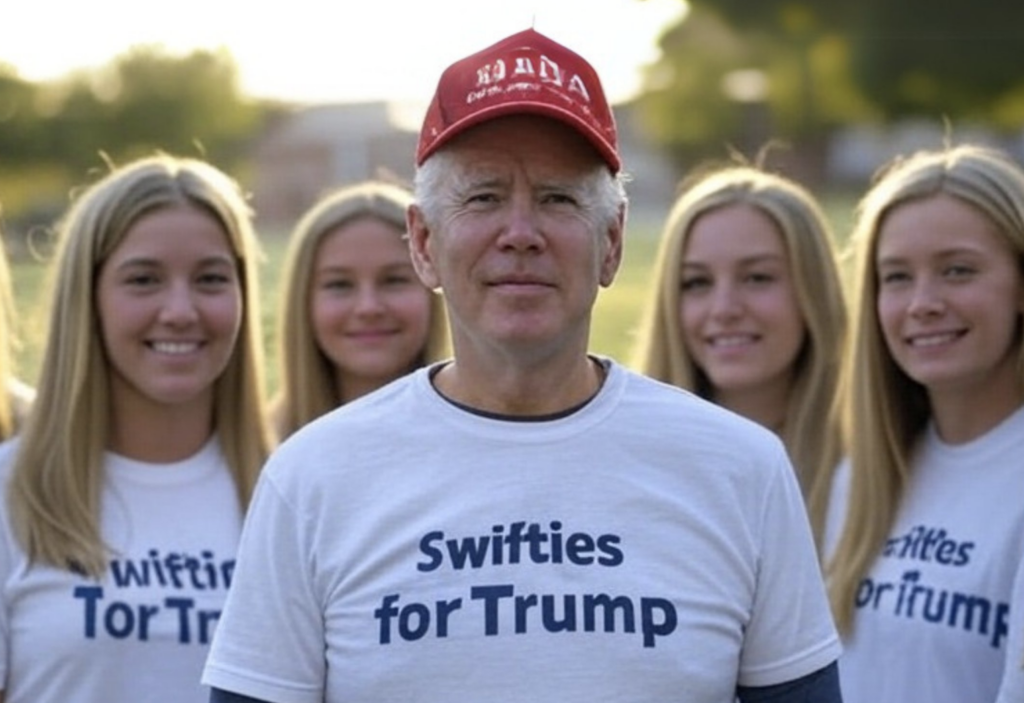
There is a curious species of falsehood that travels not by brute error but by fastidious precision. In our era, this species often wears the dignified uniform of a “fact-check,” its language clinical, its tone scolding, and its target almost always conservative. Such was the case with Madison Czopek’s now-infamous entry for PolitiFact, entitled: “Image of Joe Biden in MAGA hat is not authentic image from Donald Trump’s Nov. 13 White House visit.” The title itself is a masterclass in misdirection, accurate on its face and deceitful in effect.
Let us state plainly what happened. A clearly AI-generated image of a young Joe Biden wearing a Trump hat circulated as a meme, an obvious joke, a political cartoon in pixelated form. The image was attributed to a meeting that never occurred, and everyone with a pulse and the internet understood the satire. Yet PolitiFact, ever the dutiful handmaiden of narrative management, swung into action, rating the post “False Pants on Fire.” Their claim was not that the image was fake — which it was — but that it was being used to deceive. Here lies the irony: the only thing truly being deceived was the reader.
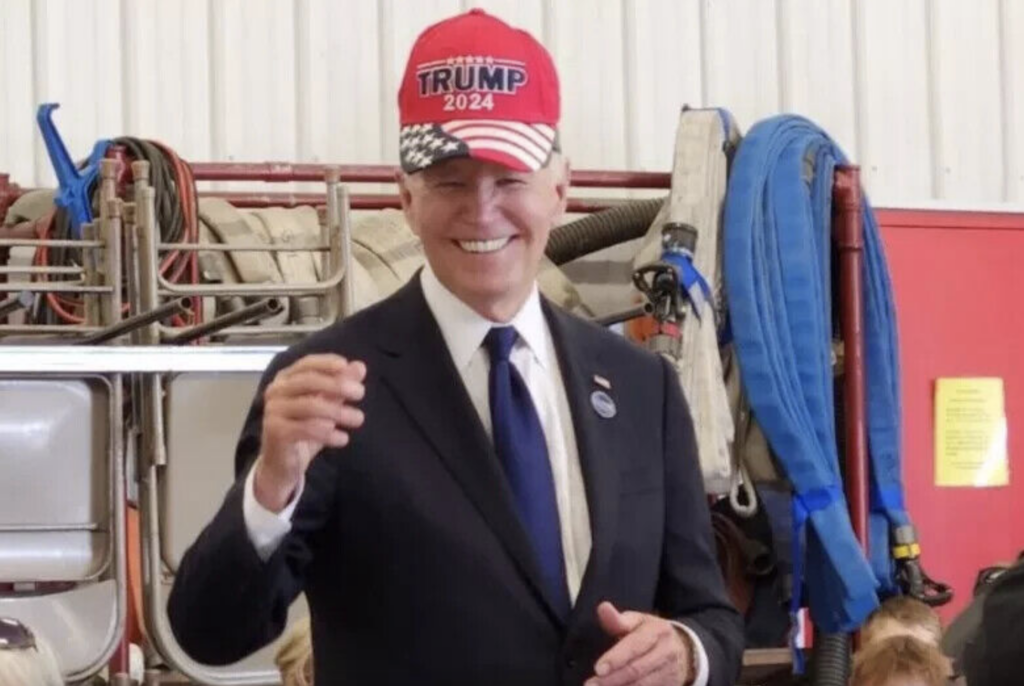
But what makes this incident particularly galling is not the fact-check itself, but its timing and its target. The AI-generated image was the bait. The trap was algorithmic suppression of the real photograph: Joe Biden, flesh and blood, unmistakably wearing a Trump hat at a commemorative event for the 23rd anniversary of 9/11. A gesture, according to Deputy Press Secretary Andrew Bates, of national unity. But to the Harris campaign, unity was inconvenient. Hours earlier, Trump had mockingly promised to send Kamala Harris a red hat of her own. Biden’s actual photo, smiling beneath the same scarlet brim, was a visual gaffe of Shakespearean magnitude.
The reaction was swift. Social media platforms began flagging any image of Biden in a Trump hat as “altered” or “false.” Wikipedia editors reverted attempts to cite the event. Worse still, large language models—increasingly tasked with shaping public discourse—began refusing to acknowledge the image as real. This was not organic error, but coordinated erasure. And behind it all stood the fact-check, pristine and professional, serving as the fig leaf for censorship.
PolitiFact, of course, did not directly declare the real image false. That would have required nerve. Instead, they focused their fire on the most laughable version of the story, knowing full well how social media algorithms interpret fact-checks. Once the label is applied, it spreads. The platforms do not differentiate between an AI joke and an actual photo. Nor, it seems, do readers. Czopek’s article became a cudgel not against a hoax, but against an inconvenient truth. It is the informational equivalent of burning a hayfield to hide a needle.
Consider the context. PolitiFact is operated by the Poynter Institute, a group that receives significant funding from organizations aligned with progressive causes, at times even from Soros’ Open Society Foundation. Its function is not apolitical. Like a bishop anointing a king, the fact-check confers legitimacy upon one narrative while excommunicating another. The effect is cultural laundering: turning partisan opinion into objective truth, and heretical facts into banishable lies.
This is not a claim of conspiracy. It is a recognition of structure. Fact-checkers do not operate in a vacuum. They operate in an ecosystem shaped by platform policies, ideological commitments, and financial incentives. When Meta funds a fact-checking initiative, it does so not out of charity but to police its digital commons in ways congruent with its corporate and political interests. When PolitiFact partners with Meta, the result is algorithmic enforcement of editorial preference. The user sees a warning, the post is shadowbanned, and the truth disappears under the weight of a thousand conditional statements.
Defenders of this practice often invoke a kind of epistemic paternalism: the public cannot distinguish satire from truth, and so must be shielded from ambiguity. But this is a cowardly argument, one that treats citizens as rubes and dissent as contagion. Consider another example. During the campaign, I created an obviously satirical AI image of a group of co-eds in t-shirts emblazoned with the slogan “Swifties for Trump.” It was a jab at the absurdity of Taylor Swift, who had come out publicly in support of Kamala Harris. The image was clearly labeled “Satire,” and yet it drew serious coverage from The Guardian and from Madison Czopek herself, who insisted that voters might not be able to distinguish it from reality. As with the Biden MAGA hat, the point was never that people believed the image was real, but that it disrupted the narrative. In the case of the MAGA hat, the real threat was not that someone would believe Biden wore the hat in 2016, but that someone would discover he wore it in 2025. That, we are told, must be unthinkable.
It is here that the metaphysical problem of identity intrudes. When is a fact not a fact? When it is indexed to a narrative deemed harmful by those who decide what counts as harm. The photograph exists. Biden wore the hat. The gesture was real, the context documented, the moment captured. Yet because it disrupted the progressive image of partisan sanctity, it was folded into a broader digital suppression campaign aimed, ostensibly, at the fake.
Czopek’s fact-check is a paradigmatic case of what philosopher Harry Frankfurt called “bullshit” — not a lie per se, but a statement unconcerned with truth, aimed instead at manipulation. It is truthiness in its final form: surgically precise, technically accurate and wholly misleading. That such a piece could then be weaponized to suppress real content demonstrates the moral hazard of centralized epistemic power.
Let us not feign surprise. The machinery of modern censorship no longer relies on jackboots and bonfires. It wears a lanyard and works at a content moderation desk. It uses terms like “context,” “independent verification” and “false framing.” But its purpose is the same: to control what may be known, and thereby what may be believed.
The tragedy is not that PolitiFact got a joke wrong. It is that they got the truth right and then helped erase it. In the digital age, censorship does not require erasing the photo. It merely requires casting doubt on its context, surrounding it with enough confusion that it vanishes in the fog. And so a real event, embarrassing to the regime, is algorithmically buried beneath a fake event no one took seriously.
This is the great inversion of our time. Truth is not denied, it is reclassified. Reality is not contradicted, it is deprecated. And the agents of this epistemic laundering hold themselves out as neutral arbiters of fact. PolitiFact is not alone in this practice, but it is emblematic. Czopek’s article stands as a textbook case in how fact-checking, when merged with algorithmic enforcement and political pressure, ceases to clarify and begins to conceal.
In this light, the Biden-MAGA-hat episode is not merely a footnote. It is a cautionary tale. A republic that cannot tolerate uncomfortable truths is a republic in peril. When the mechanisms designed to uphold objectivity instead obscure it, we inch closer to epistemic tyranny — not because the truth is forbidden, but because it is rendered invisible beneath the velvet glove of “accuracy.”
And that is the most dangerous lie of all.
NOTE: The clearly satirical image of Biden wearing a MAGA hat with a Swifties for Trump t-shirt is AI generated.
Sponsored by the John Milton Freedom Foundation, a nonprofit dedicated to helping independent journalists overcome formidable challenges in today’s media landscape and bring crucial stories to you.
READ NEXT: Reagan Judge Issues Stunning Defeat To Trump’s Sweeping Reforms



















That was a really long way of saying the leftist MSM is full of crap.
Pure BS. I’ve never before seen so many words wasted trying to promote one’s opinion as fact without actually saying a damn thing. Again, pure BS.
Legacy Media BS Images
Legacy Media stunt