

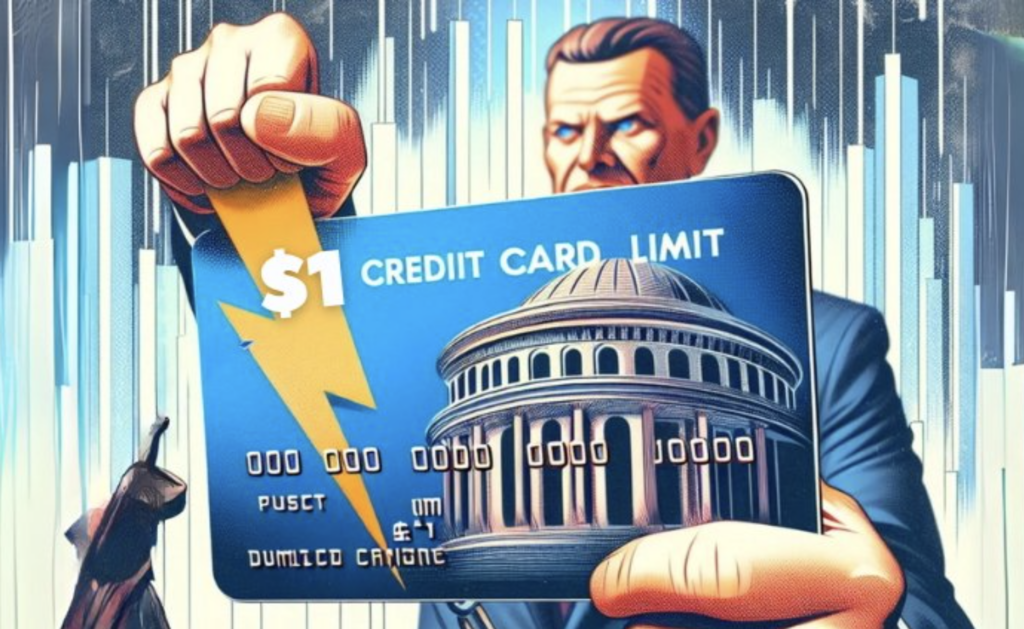
In the history of American bureaucracy, few ideas have carried the sting of satire and the force of reform as powerfully as Steve Davis’s $1 credit card limit. It is a solution so blunt, so absurd on its face, that only a government so accustomed to inertia could have missed it for decades. And yet, here it is, at the center of a sprawling audit by the Department of Government Efficiency, or DOGE, that has, in just seven weeks, eliminated or disabled 470,000 federal charge cards across thirty agencies. The origin of this initiative reveals more than cleverness or thrift. It reflects a new attitude, one that insists the machinery of government need not be calcified. The federal workforce, long derided as passive and obstructionist, is now being challenged to solve problems, not explain why they cannot be solved. This, more than any tally of dollars saved, may be DOGE’s greatest achievement.
When Elon Musk assumed control of DOGE under President Trump’s second administration, he brought with him an instinct for disruption. But disruption, as many reformers have learned, is often easier said than done. Take federal credit cards. There were, as of early 2025, roughly 4.6 million active accounts across the federal government, while the civilian workforce comprised fewer than 3 million employees. Even the most charitable reading suggests gross redundancy. More cynical observers see potential for abuse. DOGE asked the obvious question: why so many cards? The initial impulse was to cancel them outright. But as is often the case in government, legality is not aligned with simplicity.
Enter Steve Davis. Known for his austere management style and history with Musk-led enterprises, Davis encountered legal counsel who informed him that mass cancellation would breach existing contracts, violate administrative rules, and risk judicial entanglement. Most would stop there. But Davis, adhering to Musk’s ethos of first-principles thinking, chose another route. If the cards could not be canceled, could they be rendered functionally useless? Yes. Set their limits to $1.
This workaround achieved in days what years of audits and Inspector General warnings had not. The cards remained technically active, sidestepping the legal landmines of cancellation, but were practically neutered. The act was swift, surgical, and reversible. It allowed agencies to petition for exemptions in cases of genuine operational need, but forced every cardholder and department head to justify the existence of each card. Waste thrives in opacity. The $1 cap turned on the lights.
Naturally, the immediate reaction inside many agencies was panic. At the National Park Service, staff could not process trash removal contracts. At the FDA, scientific research paused as laboratories found themselves unable to order reagents. At the Department of Defense, travel for civilian personnel ground to a halt. Critics likened it to a shutdown, albeit without furloughs. Others, more charitable, described it as a stress test. And indeed, that is precisely what it was: a large-scale audit conducted not by paper trails and desk reviews, but by rendering all purchases impossible and observing who protested, why, and with what justification.
This approach reflects a deeper philosophical question. What is government for? Is it a perpetuator of routine, or a servant of necessity? The DOGE initiative, in its credit card audit, insisted that nothing in government spending ought to be assumed sacred or automatic. Every purchase, every expense, must be rooted in mission-critical need. And for that to happen, a culture shift must occur, not merely in policy, but in mindset. The federal worker must no longer be an apologist for the status quo, but an agent of reform.
Remarkably, this message has found traction. Inside the agencies affected by the freeze, DOGE has reported a surge in what one official described as “constructive dissent.” Civil servants who once reflexively recited reasons for inaction are now offering alternative mechanisms, revised workflows, and digital solutions. One employee at the Department of Agriculture proposed consolidating regional office supply chains after realizing that over a dozen separate cardholders were purchasing duplicative items within the same week. A NOAA field team discovered it could pool resources for bulk procurement, saving money and reducing redundancy. These are not acts of whistleblowing or radical restructuring. They are small, localized acts of efficiency, and they matter.
Critics argue that these are marginal gains and that the real drivers of federal bloat lie elsewhere: entitlement spending, defense procurement, or healthcare subsidies. And they are not wrong. But they miss the point. DOGE’s $1 limit was not about accounting minutiae, it was about psychology. In a system where inertia reigns, a symbolic shock is often the necessary prelude to substantive reform. The act of asking why, why this card, why this purchase, why this employee, forces a reappraisal that scales. Culture, not just cost, was the target.
There is a danger here, of course. Symbolism can become performance, and austerity can become vanity. If agencies are deprived of necessary tools for the sake of headlines, then reform becomes sabotage. This is why the $1 policy included an appeals process, a mechanism for restoring functionality where needed. In a philosophical sense, this is the principle of proportionality applied to public finance: restrictions should be commensurate with the likelihood of abuse, and reversible upon demonstration of legitimate need.
DOGE’s broader audit, still underway, has now expanded to cover nearly thirty agencies. It is not simply cutting cards. It is classifying them, comparing issuance practices, flagging statistical anomalies, and building a federal dashboard of real-time usage. This is not glamorous work. There are no ribbon-cuttings, no legacy-defining achievements. But it is the marrow of good governance. As Aristotle noted, excellence is not an act, but a habit. The DOGE team has adopted a habit of scrutiny. And that habit, when instilled in the civil service, is a kind of virtue.
Here we arrive at the most profound implication. What if the federal workforce is not inherently wasteful or cynical, but simply trapped in a system that rewards compliance over creativity? What if, when given both the mandate and the moral permission to think, civil servants become problem solvers? The $1 limit policy is, in this light, less a budgetary tool than a pedagogical one. It teaches. It asks employees to imagine how their department might function if every dollar mattered, and to act accordingly.
In a bureaucratic culture where the phrase “we can’t do that” serves as both shield and apology, DOGE has introduced a new mantra: try. Try to find the workaround. Try to reimagine procurement. Try to do more with less. This shift may not register on a spreadsheet. It may not win an election. But it rehumanizes the federal workforce. It treats them not as drones executing policy, but as intelligent actors capable of judgment, reform, and even invention.
The future of DOGE will no doubt face resistance. Unions, entrenched bureaucrats, and political opponents will argue it oversteps or misunderstands the delicate machinery of governance. Some of that criticism will be valid. But what cannot be denied is that DOGE has already achieved something rare: it has made federal workers think differently. It has shown that even the most byzantine of systems contains levers for change—if one is willing to pull them.
The $1 card limit is not a policy; it is a parable. It tells us that in the face of complexity, simplicity is a virtue. That in the face of inertia, audacity has a place. And that in the face of sprawling bureaucracies, sometimes the best way to fix the machine is to unplug it and see who calls to complain. That is when the real work begins.
— @amuse (@amuse) March 5, 2025
Sponsored by the John Milton Freedom Foundation, a nonprofit dedicated to helping independent journalists overcome formidable challenges in today’s media landscape and bring crucial stories to you.
READ NEXT: Federal Judge Blocks Hugely Popular Trump-Backed Reform















Awesome NOW also fix Govt celphones issued to said Govt workforce if any
Non WH roles
The Trump team is rocking and likely saving the Republic. The federal gubmint is a bloated pig and needs slaughtering. Next up, someone in DOGE trim the irs and make those paper pushers return the eighty thousand plus firearms pedo joe gave them…..