

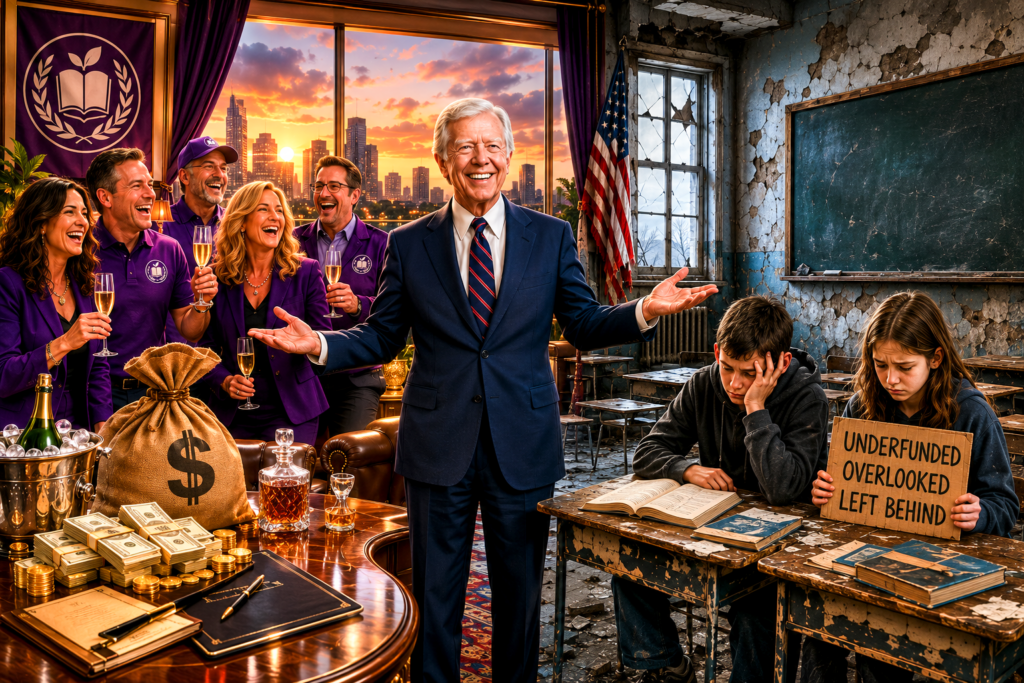
Consider what social scientists almost never get to run: a clean experiment. You take a system, hold most things constant, change one large input, and wait long enough that the result cannot be dismissed as noise. In medicine this is the gold standard, and when the input changes by enough and the output refuses to follow, we stop arguing. The federal Department of Education has, without intending to, given us exactly such an experiment, and it ran for half a century. The input, real per-pupil spending, roughly tripled. The output, what an American 17-year-old actually knows, did not move. That single pairing is the entire indictment, and what makes it lethal is that both numbers come from the government’s own record keepers, not from its critics.
I want to walk you through why this happened, because the flat line is not an accident or a run of bad luck. It is what the department was designed to produce, once you understand who it was built to serve. The answer is not children. It was adults, and the men and women who made the deal said so plainly at the time.
The Department of Education was not born of an educational emergency. It was born of a campaign promise. During his 1976 run for the White House, Jimmy Carter pledged the National Education Association that he would create a stand-alone, Cabinet-level education department, and in exchange the NEA gave the first presidential endorsement in its history. This was a union that had wanted a federal department for roughly a century, and that had never before put its weight behind a candidate. In 1976 it did, and the payoff in raw political muscle arrived immediately. Some 172 NEA delegates sat at the 1976 Democratic convention, the largest single bloc in the hall. Walter Mondale, whose own brother worked for the union, carried the promise to the membership. The transaction was not subtle, and the principals did not pretend otherwise.
Listen to them. Terry Herndon, the NEA’s executive director, said of the agency, “There’d be no department without the NEA.” That is not an opponent’s characterization. It is the union’s own top official describing the department as the union’s creation. Senator Daniel Patrick Moynihan, a liberal Democrat and no conservative partisan, described Carter’s reelection campaign as having become “a wholly owned subsidiary of the NEA.” An NEA official later put the prize more proudly still, boasting that the NEA was the only union in America with its own Cabinet department. When a Harvard education scholar, Marty West, looks back on the episode today, he concludes that the department was created in an ultimately unsuccessful attempt by Carter to win the 1980 election. Even Albert Shanker, who led the rival American Federation of Teachers, opposed the new department because he saw it for what it was, a power grab by the NEA rather than a reform for students.
None of this was smooth or consensual, which is telling. The bill creating the department limped through the House in 1979 by a vote of 215 to 201, and Carter signed it with an eagerness that embarrassed even sympathetic observers as a difficult reelection loomed. Along the way he fired his own secretary of Health, Education, and Welfare, Joseph Califano, who had resisted carving a third of his department away to satisfy the pledge. A president willing to purge his own Cabinet to keep a promise to a union tells you precisely where the children ranked in the order of priorities. They ranked below the endorsement.
Now follow the money, because the scale is the point. When the department opened in 1980 its budget, in constant 2024 dollars, stood at roughly $56.9 billion. By 2024 that figure had climbed to $268.4 billion, nearly a fivefold increase in real terms. In nominal dollars the jump is starker still, from about $14 billion at the founding to $268 billion today. Summed across more than four decades of outlays, cumulative federal education spending runs into the trillions, more than $4 trillion by reasonable accounting. And this is only the federal slice. Taken as a whole, American education spends at levels no other nation approaches. In 2024 the US led the world with $1.353 trillion in government education spending, with China a distant second near $906 billion. Our K-12 systems spend an average of $20,387 per pupil, third highest among 40 developed OECD nations. At the college level we spend $37,400 per student, behind only Luxembourg and more than double the OECD average. By every measure of inputs, we are not merely generous. We are first.
Against that mountain of spending, set the learning. The National Assessment of Educational Progress maintains a Long-Term Trend series designed for exactly this purpose, measuring the same basic reading and math skills, in the same way, since the early 1970s, so that one generation can be compared honestly to another. Its verdict after 50 years is brutal in its plainness. Today’s 17-year-olds read no better than the high school seniors of the early 1970s. For 13-year-olds the story is the same, with the 2023 average reading score sitting a single point above its 1971 level and math just five points above 1973, before recent declines erased even those modest gains. The economist Eric Hanushek of Stanford, who has studied this longer than almost anyone, found that inflation-adjusted spending rose roughly 150% between 1970 and 2010, and that no state today spends less in real dollars than it did in 1970. His summary of the great spending experiment is the sentence that should hang over every appropriations hearing: the money bought smaller classes and better-paid teachers, “but there were no concomitant improvements in student achievement.”
If domestic stagnation does not persuade, the international comparison should. On the PISA 2022 assessment, the most cited cross-national benchmark, 25 education systems scored higher than the U.S. in mathematics, the subject that matters most for a modern economy. Our average math score was not measurably different from the middling OECD average. One composite ranking placed the U.S. 18th overall, well behind Singapore, Macau, Taiwan, Japan, and South Korea. So here is where five decades and trillions of dollars have left us. We are first in the world in what we spend and somewhere in the middle in what our children learn. No competently run enterprise on earth could post that ratio and survive.
A fair reader will raise an objection here, and I want to meet it directly. Perhaps the problem is that we still do not spend enough, or do not spend it in the right places. The 2009 stimulus tested precisely this. Washington poured roughly $77 billion into schools, more than doubling its annual K-12 outlays in a single rush of cash, and achievement did not follow the dollars. The lesson, repeated now across every level of analysis from Hanushek’s national series to that one enormous infusion, is that how schools spend matters far more than how much. Money was never the missing ingredient. A structure built to reward adults rather than to educate children was the missing ingredient, and money poured into that structure does what water poured into sand does.
If you enjoy my work, please subscribe https://twitter.com/amuse/creator-subscriptions/subscribe.
Sponsored by the John Milton Freedom Foundation, a nonprofit dedicated to helping independent journalists overcome formidable challenges in today’s media landscape and bring crucial stories to you.
READ NEXT: 4 Republicans Defect On Major Iran Vote

















More teachers Unions, bureaucracy poor grades for students & we Lose till now