

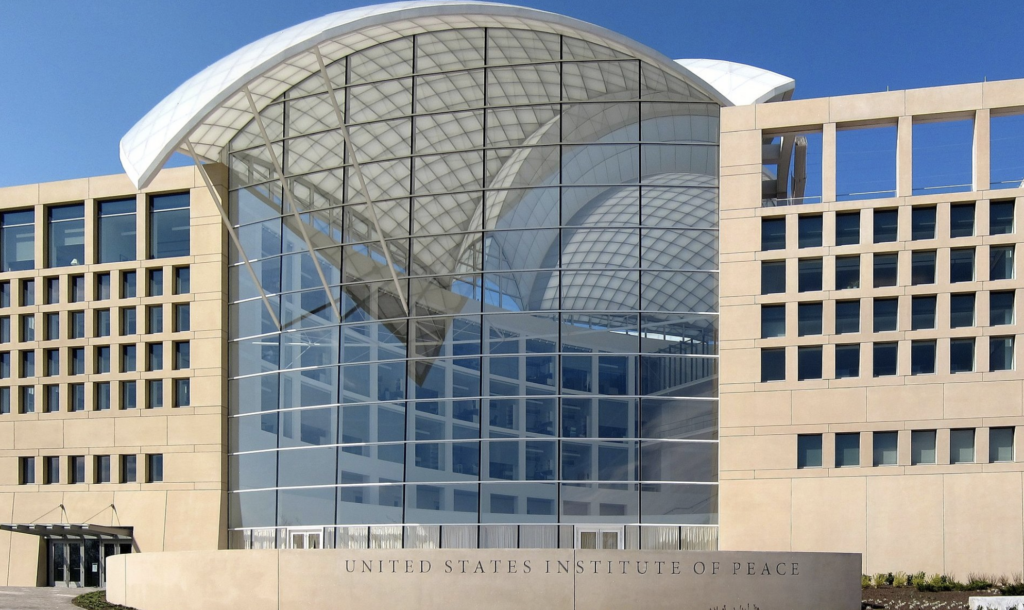
The modern administrative state is a marvel of compartmentalization. Within it, Congress appropriates, the executive executes, and federal agencies are bound by the latticework of law, oversight and public accountability that forms the skeletal integrity of democratic government. This system, whatever its flaws, rests on a premise no less fundamental than gravity in Newtonian physics: public power must answer to public control. Enter the United States Institute of Peace (USIP) and its legal doppelgänger, the Endowment of the United States Institute of Peace Incorporated. Here lies an anomaly so legally clever—and democratically dangerous—that it demands scrutiny.
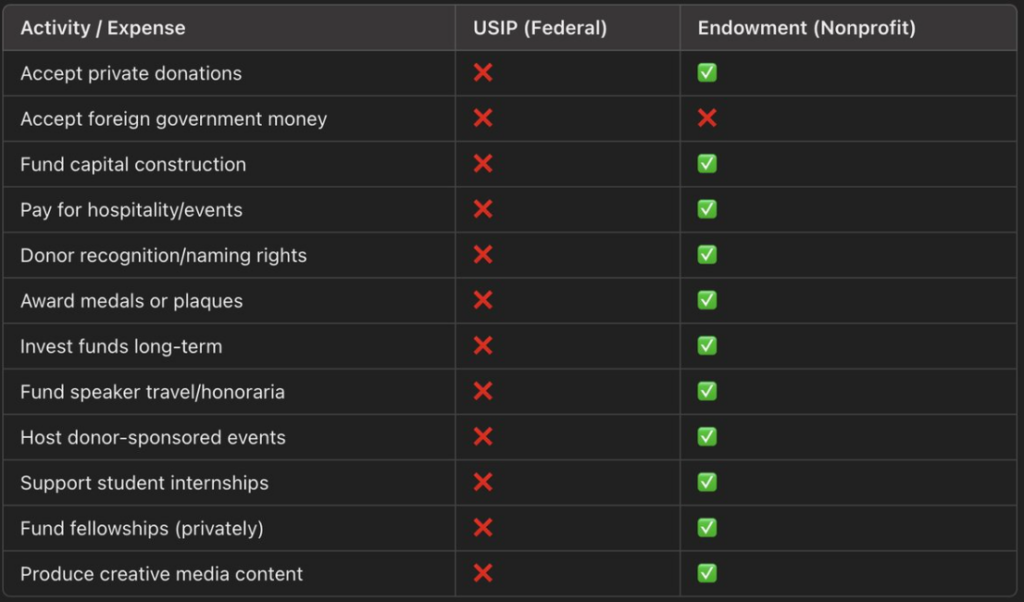
The dual-structure of USIP, which fuses the authority of a federal agency with the operational leeway of a private nonprofit, allows it to bypass virtually every safeguard that governs normal executive entities. It wields the gravitas of a government institution—congressional funding, a presidentially appointed board and international clout—while enjoying the funding agility and opacity of a non-governmental organization (NGO). It is not simply a case of blurred lines. It is a deliberate arrangement—a quasi-governmental chimera—that enables USIP to function with all the privileges of state power and none of its traditional restraints.
This structure was not an accident. When Congress established USIP in 1984, it authorized the creation of a separate nonprofit entity—an Endowment—that could receive and manage funds ostensibly in support of the Institute’s mission. In practice, the Endowment became a legal and financial firewall. While USIP is banned from accepting private donations, foreign government funds or engaging in certain types of spending (hospitality, awards, travel for dignitaries), the Endowment is free to do all of it—so long as the money isn’t used in a way that technically violates the letter of USIP’s enabling statute. This sleight of hand transforms prohibitions into workarounds.
For instance, federal agencies cannot host galas, wine receptions or name buildings after corporate donors. But USIP’s Endowment can. Chevron and Lockheed Martin, among others, have received naming rights inside a federally owned building thanks to their sizable donations. Even more troubling is the nature of some investors. The Endowment accepted hundreds of thousands of dollars from Li Lu, a Chinese national and head of Himalaya Capital, the major investor in China’s electric vehicle giant BYD. In no other federal agency would a foreign financier be permitted to buy influence with federal officials—yet through this hybrid structure, it occurred with impunity. The conflict of interest is profound: USIP is a federal institute operating with a funding model that would be illegal anywhere else in government. The gifts were funneled through the nonprofit. That the building is owned by the federal government and maintained by a federal agency is of no consequence. The transaction was clean—legally speaking. Ethically and democratically, it is less so.
Consider further: USIP cannot legally accept foreign government money. The Endowment cannot either—at least not directly. But a 501(c)(4) social welfare organization, which may accept foreign funds and then donate to the Endowment, can effectively repackage those resources without clear provenance. There is no statutory mechanism requiring the Endowment to audit the origin of such funds unless earmarked or improperly conditioned. The laundering of influence, though legally indirect, becomes functionally indistinguishable from a prohibited transaction. The shell remains intact; the contents bypass inspection.
None of this would raise alarms if the Endowment were a wholly separate philanthropic body. But it is not. The Endowment is governed by the same board as USIP. It convenes jointly. The president of USIP runs both. They share leadership, strategy and personnel. There is no meaningful independence between the two. This fusion of governance means the federal agency’s activities can be influenced—if not dictated—by privately funded initiatives that originate within its own institutional structure. It is the bureaucratic equivalent of having an unmonitored side account.

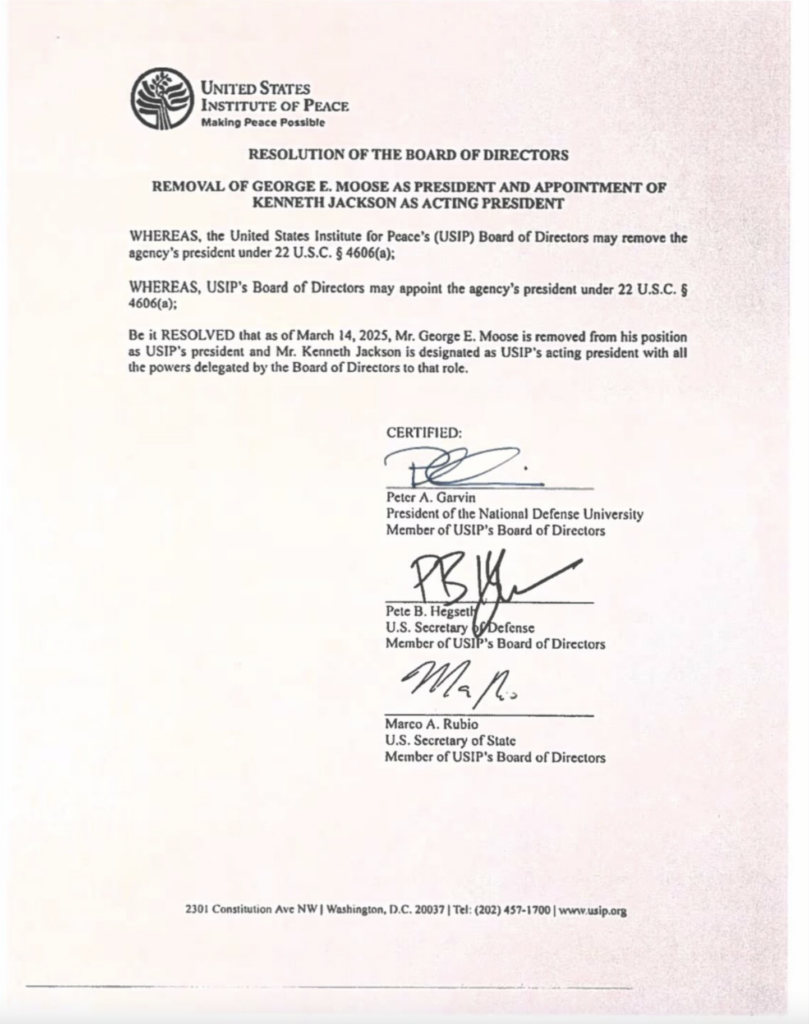
This arrangement might be tolerable under an administration that exercises robust oversight. But what happens when the executive branch attempts to assert control and is met with institutional shell games? This is precisely what occurred when the Department of Government Efficiency (DOGE), led by Elon Musk, attempted to impose new accountability measures on USIP in early 2025. The Trump administration, having fired 11 of USIP’s board members, left only three in place: Secretary of State Marco Rubio, Secretary of Defense Pete Hegseth and Peter Garvin, president of the National Defense University. But the Endowment was untouched. Its coffers, flush with tens of millions of privately raised, congressionally unrestricted funds, continued operations seamlessly.
DOGE officials found themselves obstructed not by hostile actors, but by a bureaucratic smokescreen. USIP staff, when pressed, claimed to be acting in their Endowment capacity—an identity switch that nullified the authority of federal appointees to demand compliance or records. The same individuals who had minutes before been agency officials now wore nonprofit hats. There were no statutory levers to compel cooperation. There was no chain of command that extended beyond the legal fiction of separate incorporation.
One might defend this arrangement by pointing out that hybrid models often bring efficiency and flexibility. That is true, but only in private enterprise. In a republic, public power must remain accountable to elected authority. When a federal agency erects a private scaffolding around itself—shielded from FOIA, from congressional audit from executive direction—it creates not efficiency, but impunity. While technically subject to FOIA, USIP may invoke exemptions more liberally than traditional agencies—especially in matters involving foreign partnerships, conflict zone operations or internal deliberations. This grants it enormous discretion to withhold information, effectively allowing it to hide anything and everything it wishes. The costs of such a structure are not just financial; they are constitutional.
Federal agencies are forbidden from naming rights, private donor influence, unrestricted travel spending and direct foreign entanglements for good reason. These prohibitions exist not because such things are inherently wicked, but because they erode public trust and invite conflicts of interest. By outsourcing prohibited activities to a legally affiliated nonprofit, USIP has not honored the spirit of the law. It has outsmarted it.
We do not allow other federal agencies to create their own NGOs with shared leadership, shared branding and a shared mission while exempting themselves from the rules that bind all others. Imagine if the Department of Justice had a nonprofit arm that could accept anonymous foreign donations, spend lavishly on galas and awards and insulate its staff from executive oversight simply by donning a new lanyard. That is not accountability. It is parody.
Democratic governance cannot coexist with structures that operate in legal shadows. The USIP-Endowment model amounts to a constitutional loophole with global implications. It commands the authority of the United States while dancing just beyond its grasp. As a thought experiment, one could ask: if every federal agency had such an arm, what would remain of our regulatory state? The answer is clear. Oversight would become optional. Law would become elastic. Democracy would become hollow.
The case of USIP is not merely about a peace institute. It is about the integrity of public institutions. If the Department of Government Efficiency is to fulfill its mandate, it must expose and dismantle these hybrid bureaucracies—not because they fail, but because they succeed too well in evading the constraints of democratic power.
Sponsored by the John Milton Freedom Foundation, a nonprofit dedicated to helping independent journalists overcome formidable challenges in today’s media landscape and bring crucial stories to you.
READ NEXT: ‘Obviously Masculine’ Dem Implies He’s Profoundly Triggered By Fox News



















How many more like this in DC VA MD area?? Find more & defund
Simple. Restrict from ANY federal funds. If there are federal employees working there, move to another agency or fire them if given cause. If the building is on federal land, start charging them rent. If government paying ANY bills stop paying them. If they are conducting negotiations with a foreign country, charge them under the Logan Act. Sooner or later, it will be cost prohibitive for them to remain in business which is what this seems to be. There really are NO government agencies that cannot be held accountable. There seem to be at this time only three people on the board of directors. If there are only three existing, I would call that a quorum. Make new rules or vote the organization out of business.
Thank you for shining a light on this—another example—of how far we have moved from the intentions of our founders for a true representative republic. Please stay at this.
I do not care if this organization is constitutional or not; it must have a siphon somewhere costing taxpayers, for which USIP is accountable to “We the People.” Could you find the source of the funding and put stumbling blocks in the way? The year “1984” is akin to George Orwell’s book, when USIP was born. This seems to be the deepest part of the “Deep State,” we have been looking for.