

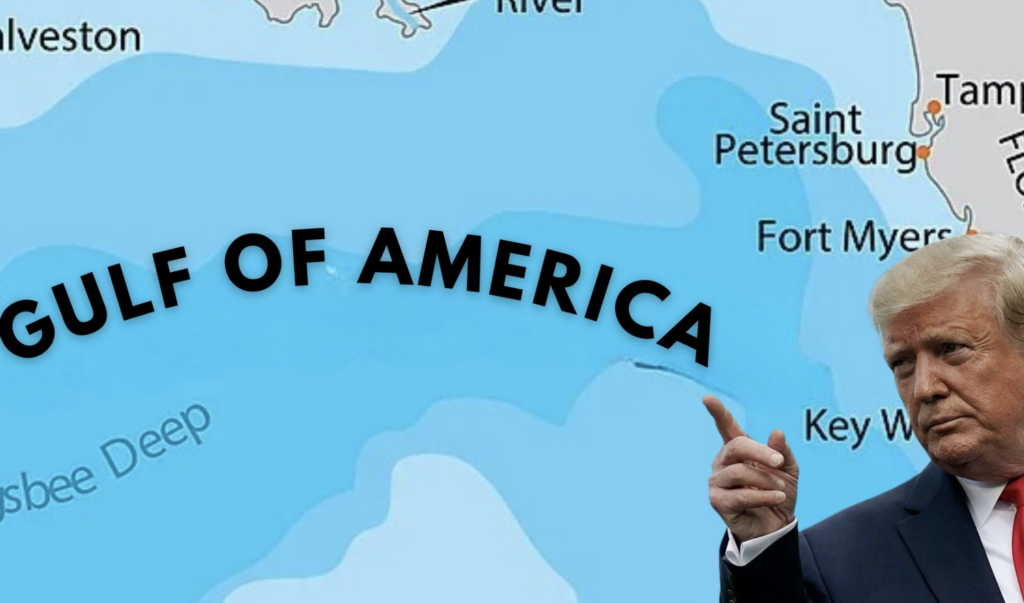
Amidst his whirlwind of policy announcements, President Trump has set social media ablaze by proposing a rechristening of the Gulf of Mexico as the “Gulf of America.” This move, as I’ve theorized in previous essays, may be a deliberate tactic to dominate the news cycle and distract the media from the hard decisions his administration is currently undertaking. While the feasibility of such a change is ripe for debate, this essay sidesteps the politics to examine the geographical and historical underpinnings of the Gulf’s name. What lies beneath this seemingly audacious rebranding? Let’s dive into the waters of history to uncover the evolution of the Gulf’s nomenclature.
From the Shadows of Anonymity
Long before the Spanish galleons cut across its waves, the Gulf of Mexico was an unnamed marvel, a nameless void on European maps. Early cartographers, including Andrew Ellicott—the meticulous surveyor who published detailed maps of the Gulf Coast in 1803—focused more on its coastline than the waters themselves. For centuries, the Gulf remained an overlooked appendage of the Atlantic Ocean or “North Sea.” Guillaume Delisle, a French cartographer, would later shed light on the Gulf with unprecedented detail, charting not only its boundaries but also its identity. His work marked the beginning of the Gulf’s journey from obscurity to recognition.
Enter the Spaniards
When Hernán Cortés’ fleet landed in the early 1500s, the Spaniards began etching their linguistic and imperial footprint across the Americas. The name “Seno Mexicano” (Mexican Gulf) emerged during the 1540s, reflecting the region’s growing association with the burgeoning colonial center of New Spain. It was a title of power and possession, a name that signified the Spanish Empire’s dominance over the Americas.
Yet the Gulf was not always singular in identity. Alternative names like “Golfo de Nueva España” (Gulf of New Spain) and “Mar Bermejo” (Vermilion Sea) peppered maps and chronicles. The latter, inspired by the reddish hues observed by explorers like Francisco de Ulloa, demonstrated how geographical features influenced naming conventions. This multiplicity of identities reveals the fluidity of the Gulf’s early perception—a fluidity as dynamic as its tides.
The Mediterranean Analogy and “Mar de la California”
Interestingly, early explorers sometimes connected the Gulf of Mexico with the Gulf of California, referring to it as the “Mediterranean Sea of California.” This analogy drew on a European lens that sought to fit the New World into familiar paradigms. Such comparisons underscored the explorers’ struggle to make sense of uncharted territories using the geographical shorthand of their time. By the 18th century, however, as cartographic precision improved and colonial borders solidified, the Gulf’s identity crystallized into the name we know today.
The Rise of “Gulf of Mexico”
The enduring title “Gulf of Mexico” owes its permanence to two forces: linguistic practicality and geopolitical reality. Unlike the evocative “Mar Bermejo” or expansive “Golfo de Nueva España,” the term “Gulf of Mexico” offered specificity and clarity. It reflected the Gulf’s centrality to the nation that now shares its name—a burgeoning Mexico breaking free from its colonial chains. In the U.S., however, the Gulf earned nicknames like the “Third Coast,” emphasizing its importance alongside the Atlantic and Pacific seaboards.
The Case for Renaming
Would renaming the Gulf today truly honor its history? Or could it, as I’ve theorized before, serve as yet another example of Trump’s strategic use of bold proposals to dominate media narratives and divert attention from the weighty decisions his administration is grappling with? To conservatives, names anchor us to tradition, conveying the weight of history and identity. Rebranding the Gulf as the “Gulf of America” might be viewed as a declaration of sovereignty, an assertion of dominance in a globalized era. Yet such a move risks erasing centuries of history, much of it shaped by Spanish and Mexican stewardship.
Historical parallels abound. Consider Rome’s penchant for renaming conquered lands and cities, often erasing the local identities to underscore imperial rule. Renaming the Gulf could echo these practices, transforming it into a symbol of modern American exceptionalism. As I’ve theorized before, such moves often align with Trump’s broader media strategy to shift attention away from substantive policy decisions and toward high-visibility, symbolic gestures. But does such an act elevate or diminish the cultural richness of the past?
Conclusion: The Waters Speak
The Gulf of Mexico’s naming history is a tapestry woven with conquest, geography and evolving political landscapes. From its nameless early depictions to the Spanish “Seno Mexicano” and the eventual dominance of “Gulf of Mexico,” the region’s identity reflects the interplay of power and place. Any renaming—however symbolic—must contend with this legacy. It also serves as a reminder of Trump’s propensity to use such bold proposals as strategic distractions, shifting public and media focus away from weightier decisions to the spectacle of rebranding.
As we ponder the potential rechristening of this storied body of water, one truth emerges: the Gulf’s history cannot be rewritten, only reinterpreted. Whether it remains the Gulf of Mexico or becomes the Gulf of America, its waves will continue to lap against shores rich in history, culture and identity. This conclusion echoes my earlier essays, where I emphasized how Trump’s media strategies often utilize bold gestures like this renaming proposal to shape narratives and direct public focus. And perhaps, in that rhythm, we hear not just a name but a story—eternal and unchanging.
Sponsored by the John Milton Freedom Foundation, a nonprofit dedicated to helping independent journalists overcome formidable challenges in today’s media landscape and bring crucial stories to you.
READ NEXT: Trump’s Historic Pre-Inauguration Surprise: A Record Nobody Saw Coming
















How about “Gulf of the Americas”?
in the Gulf where is the territory boundaries? is it an enclosed American boundary or does it belong to Mexico? If American then its time that is what it should be called.
Great idea! I hope we can do it quickly! I know that President Trump will say things to rile up the demoncrat lefties and it makes me laugh. We need Greenland and to take back the Panama Canal that was FOOLISHLY given to Panama. This type of giveaways and funding for Ukraine should be voted on before it is done by ballot of the NATION, not just a representative. I am sick of my tax money going into the pockets of Zelensky.
I love the idea of renaming the Gulf to the Gulf of America. It make sense. Certain groups have renamed other events and institutions. I like the sound of The Gulf of America!!
Trump needs to realize the HISTORY and the GEOGRAPHY of the Gulf of Mexico and also RECOGNIZE that 1/2 of the USA was originally under Spanish and Mexican rule for CENTURIES.
Sorry, but all this does is put the MILLIONS of expat Americans living legally and illegally in Mexico in harms way. Biden made the mistake of treating Mexico as a 3rd world “territory” to the USA. AMLO, then the President of the United State of Mexico, set the record straight in a live speech attended by 1000’s of Mexicans. Assuring Biden and the USA that Mexico is a SOVEREIGN GOUNTRY.
Sorry EEUU (USA) and Trump, Mexico”s history goes centuries BEFORE the USA even became a country. And with 50+ MILLION legal Hispanics and Latinos legally living in the USA as well as the 13+ MILLION citizens of Mexico, does Trump really want to fire up almost 180 MILLION (more than 1/2 the population of the USA) into a Mexico/US divide?
Remember, it also puts all Americans as well American businesses in jeopardy; Trump needs to be smart and prudent vs an Evil Imperialist.
Because everything above Panama is NORTH AMERICA, the gulf should be called Gulf of America!