






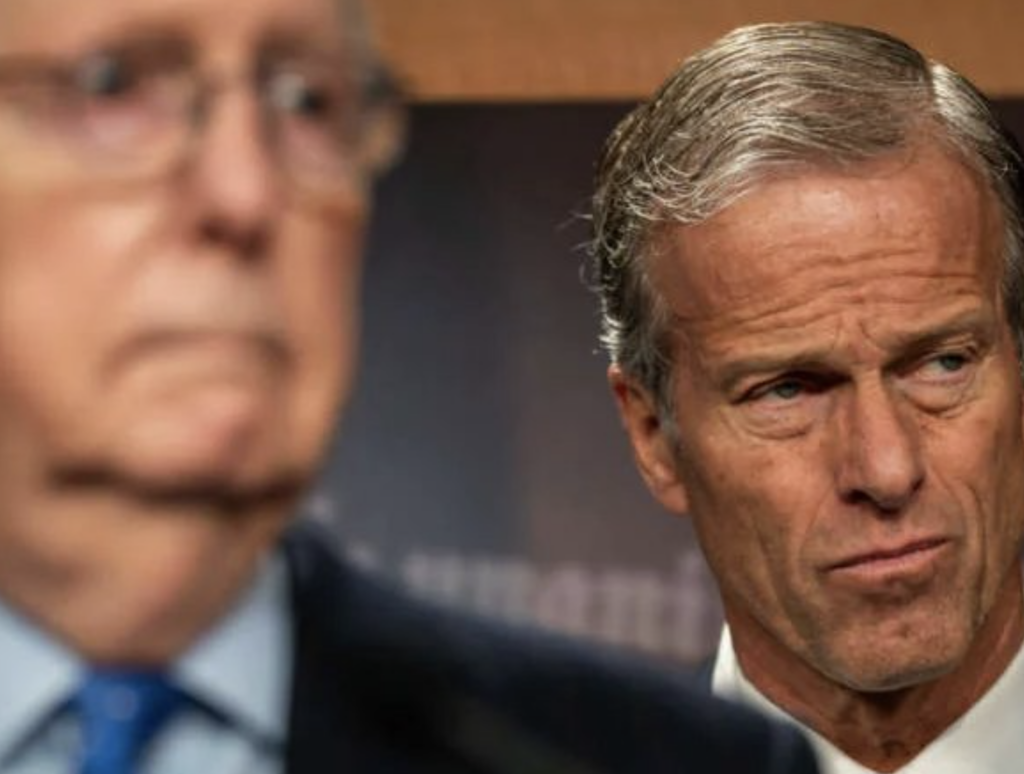
One does not often praise Mitch McConnell without raising eyebrows. For decades, he played the villain in many political dramas, stone-faced, unbending and dismissive of the theatrical flourishes that animate modern politics. But strip away the caricatures and you find something irreplaceable: an institutionalist who understood, revered and masterfully wielded the rules of the Senate.
And in Washington, mastery of rules is mastery of power.
Under McConnell, Republicans did not always win, but they seldom misunderstood where the real levers of influence were. He operated not as a charismatic populist or ideological firebrand, but as a tactician, a general commanding a battlefield of procedure. Whether confirming judicial nominees with chilling efficiency or blocking legislative overreach, McConnell knew when to bend precedent and when to let it stand. He was no philosopher-king, but he did not need to be. He was a constitutional craftsman.
Now, with McConnell no longer holding the reins, one might have hoped for a successor who learned from the master. Yet John Thune, his presumptive heir, appears content to outsource the Senate’s authority to unelected bureaucrats in horn-rimmed glasses, a quiet betrayal, and one that threatens not only the separation of powers but the legislative future of the Republican Party.
The flashpoint is the Congressional Review Act (CRA), a statute designed to allow Congress to disapprove of executive branch regulations through expedited procedures. The CRA was a McConnell-era tool used with precision. Under President Trump, it enabled the rollback of dozens of Obama-era rules. It was, in a sense, legislative judo: using procedural momentum to shift the weight of government away from regulation and back toward representative accountability.
But today, Republicans face a subtle and devastating inversion. In a recent controversy involving Environmental Protection Agency waivers granted to California, the Government Accountability Office (GAO) and the Senate parliamentarian determined that these waivers were not “rules” under the CRA. Their opinion effectively blocked a CRA resolution of disapproval.
This sounds like a legal technicality. It is not. It is a constitutional crisis in miniature.
Here’s why: Congress, not the GAO, not the parliamentarian, has the constitutional authority to make laws and to determine how statutes are interpreted in legislative context. The CRA is, after all, a statute delegating Congress’s own authority to supervise the administrative state. If Congress defers to the GAO or the parliamentarian to decide what is or isn’t a “rule,” it surrenders the very judgment the statute presupposes.
Michael A. Fragoso, former chief counsel to Senator McConnell, lays out the implications with the authority of one who has both studied and shaped the field. In his analysis, allowing the parliamentarian to serve as de facto arbiter of CRA eligibility constitutes a dangerous precedent. That precedent, dubbed the “Whitehouse Rule” (after Senator Sheldon Whitehouse), is one that would allow Democrats, and eventually a hostile administrative state, to negate legislative checks by appealing to bureaucratic opinion.
Consider the absurdity: under this logic, a future Trump EPA could issue sweeping deregulatory waivers, and if a Biden-aligned GAO or parliamentarian ruled them outside the CRA, Congress would be powerless to respond. The sword of legislative oversight becomes a foam cutout, ceremonial, decorative, harmless.
Defenders of the current approach may argue that the parliamentarian, as a neutral referee, ensures procedural fairness. But that misunderstands the role of the parliamentarian, whose job is to advise on Senate procedure, not to issue substantive interpretations of statutory law. The CRA exists to constrain the executive, not to empower the clerical class. Deference to the parliamentarian’s legal judgment here is not impartiality, it is abdication.
McConnell would have seen this for what it is: a usurpation masquerading as a technocratic clarification. And he would have marshaled his conference to act decisively, if quietly, to reassert legislative control.
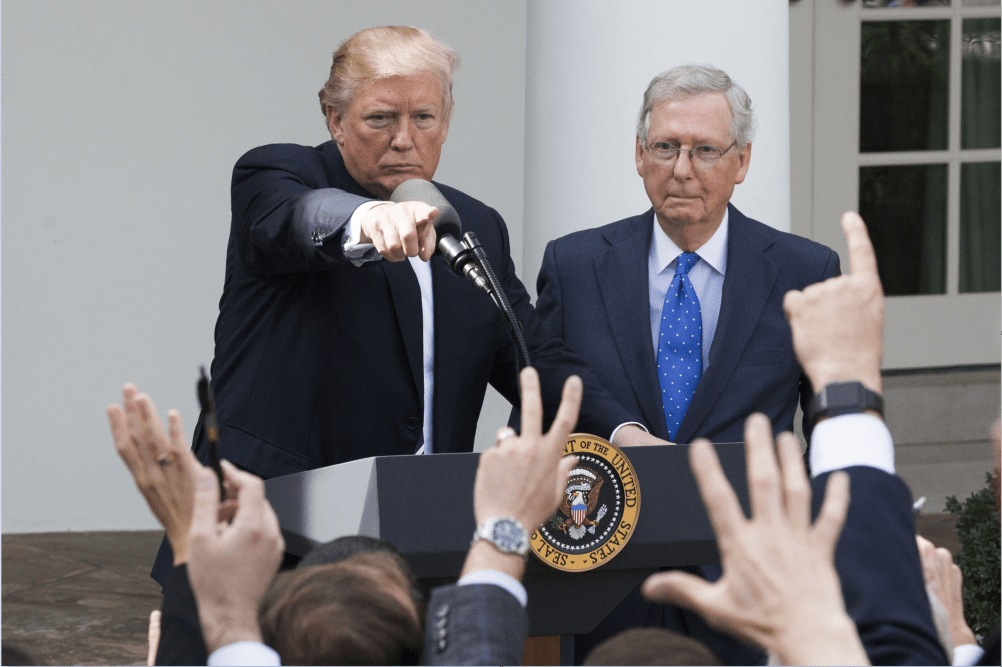
Thune, by contrast, seems unwilling or unable to do so. His passive acceptance of the parliamentarian’s ruling is not mere proceduralism; it is strategic surrender. If the GOP Senate leadership allows this precedent to calcify, they may find in a future Trump administration that the very mechanisms once used to push back against Democratic overreach are no longer operative.
This is not a hypothetical concern. The Trump administration has returned to office with an energy agenda reliant upon aggressive use of the CRA to undo Biden-era climate regulations. Allowing the CRA to be neutered now means laying the groundwork for a future impasse, where even with the White House and the House of Representatives aligned, the Senate’s own internal machinery will refuse to move.
It is not the most visible kind of failure. It will not trend on social media. But it is the kind of failure that McConnell understood was often the most consequential: procedural erosion that, over time, renders an institution irrelevant.
And what of the claim that GAO or the parliamentarian are simply interpreting the law? That is precisely the point: interpretation of statutes is a legislative function when it concerns internal mechanisms like the CRA. The courts may have the final say in cases or controversies, but within the Senate, the Senate must rule.
To be clear, no one is suggesting anarchic disregard for institutional advice. Rather, the leadership must exercise discernment. Fragoso’s warning is not to dismiss the parliamentarian, but to remember the parliamentarian advises; she does not decide. When a legislative tool like the CRA is at stake, the final judgment must belong to the senators themselves.

McConnell treated the Senate like a chamber of constitutional significance. He did not outsource judgment to the unelected. He respected the parliamentarian but never ceded control. Thune, if he wishes to be more than a placeholder, must learn this lesson quickly. Otherwise, he risks becoming the first Senate leader to preside over his institution’s own obsolescence.
The framers understood that power, once relinquished, is seldom reclaimed. Authority, once ceded to bureaucrats, metastasizes. What begins as interpretive modesty ends as legislative amnesia. Today’s procedural concession becomes tomorrow’s constitutional irrelevance.
There is still time to reverse course. The CRA can still be enforced by a Senate that remembers its own role. But that will require leadership, not from the GAO, not from the parliamentarian, but from senators who remember what the Senate is for.
McConnell, for all his faults, remembered. Will Thune?
Sponsored by the John Milton Freedom Foundation, a nonprofit dedicated to helping independent journalists overcome formidable challenges in today’s media landscape and bring crucial stories to you.
READ NEXT: Did Foreign Enemies Buy Our Election? Liberal Fundraising Giant Under Scrutiny





















About 1994, we gave the House, the Senate, and the White House to the GOP. The GOP pissed it all away(thank you Newt). Newt Gingrich was the domino that began the tumble to the likes of the peanut farmer, slick willie, the Kenyan, and sleepy Joe.
Hopefully, for the survival of the USA, President Trump has a team together that will prevent the 1994 tumble of the dominoes.
Damn DC Deep State
Remove the power of the Bureaucrat from ever having power again. Return it to Congress where it belongs.
Americans (mainly the Conservative Voters): Hello. I was surprised when the Senate majority leader voting resulted in John Thune. Especially with the bull-in-the-china shop motions by the rino cornyn. Thune: glad it was him not cornyn. But, he must act like the majority leader. mcconnell was the rino shafter of countless 2024 Republican candidates, both for the House and Senate to my understanding. Then, last-minute during the 2024 campaigns, mcconnell feined concern for the candidates to “release” some funds for the candidates at the last minute…to no good. Trump47: get mcconnell to retire EARLY to get a real Republican in that seat, even if only for a short while. CONSIDER: mcconnell voted like a demoncrat for the last 2 to 3 years. Get rid of him.