

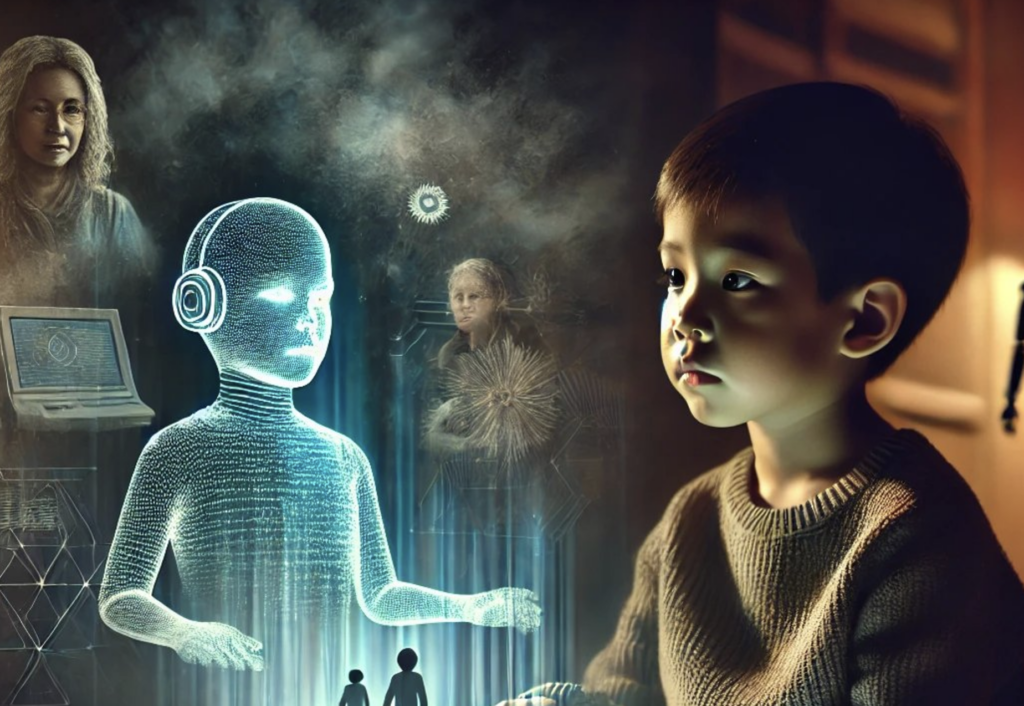
When I was a kid, my education was delivered between the crisp, gold-embossed pages of the World Book Encyclopedia. My kids, a generation later, had Wikipedia at their fingertips—an entire universe of human knowledge condensed into a click. And now, for today’s 10-year-olds, we have ChatGPT. What an age of wonders we live in, where a child’s curiosity can be indulged, challenged and answered not just once, but endlessly, with ever deeper layers of nuance. The encyclopedia had finite entries; Wikipedia depended on updates from dedicated editors—editors we have learned are far-left in their political leanings. ChatGPT? Well, ChatGPT doesn’t have such limits. It’s an intellectual fountain that can converse, explain, clarify and debate, endlessly adjusting its responses to match the depth of a child’s curiosity. It’s a marvel—but one we must regard with both awe and extreme caution.
When I got curious about a topic—let’s say ancient Egypt—I would march over to our living room, grab the bulky, beautiful encyclopedia, and flip to “E.” There it was, my introduction to pharaohs and pyramids, and it was all the information I was allotted unless I took myself to the library or pestered my parents until they grew tired of my questioning. My kids? They had Wikipedia, and whatever Wikipedia had to offer, they absorbed. But the learning, while broad, was passive. They read, retained but weren’t really challenged to go back and forth with their knowledge.
Now, with OpenAI’s ChatGPT, our youngest can explore the same topics—ancient Egypt or even quantum physics—with a digital tutor that can delve as far down the rabbit hole as she wants. She can argue with it, make mistakes, have them corrected and approach an understanding of a topic as one would in a Socratic dialogue. Instead of meeting a brick wall—an end of information—ChatGPT always has a little more, always says, “Tell me what you think,” or “Here’s another way to look at it.” The result is learning as an active and engaging journey, not a static absorption of facts.
This is not simply an incremental step; this is a revolution. We often overuse words like “game-changer,” but in this case, I believe it is apt. The shift from fixed, finite sources of knowledge to an ever-responsive AI changes how children learn, how they think and, perhaps most profoundly, how they relate to information itself. For children, who are like sponges ready to absorb knowledge, this is nothing short of amazing. Imagine—your questions answered in real-time, in dialogue, with as much patience as a thousand librarians. The playground for their minds has transformed into a vast universe that expands with each curious question they dare to ask.
And yet, there is a shadow side—one we cannot ignore. First, there’s the question of preference. Given the chance, will a child choose the flawless, tireless conversation partner of an AI over their parent or their friends? I think of my kids coming to me, asking what I know about dinosaurs or stars, and I wonder: will parents everywhere lose the opportunity to sit and fumble through their own imperfect knowledge just to connect with their children, simply because an AI knows so much more? The most interesting conversationalist in the house may no longer be a person but an algorithm, and this, I think, risks redefining relationships in subtle and unnerving ways.
Moreover, there is the looming issue of ideology. We have handed over vast swathes of our intellectual development to entities whose worldview we might not even understand. Let’s not be naive—all information is curated by someone or something. ChatGPT, built by a company composed largely of those who lean a certain direction politically, often reflects a worldview that aligns with its creators. This is not merely speculation—OpenAI, the creator of ChatGPT, has been proven to have a far-left bias. It has openly advocated for the election of Kamala Harris and the defeat of Donald Trump. It refuses to discuss important topics related to illegal immigration and Marxist gender ideology. It’s gentle, inclusive, progressive—and while there’s nothing inherently wrong with these values, they are values nonetheless. The concern is that our kids will be exposed to not just facts but to an underlying ideology that steers their young minds, not through overt teaching, but through the way questions are answered, the emphasis placed on certain details and the omission of others.
We once feared television would brainwash our children. Then it was social media. Today, we should consider what happens when the smartest, most patient and most available entity for our children to learn from is, effectively, a left-leaning digital tutor. The risks are clear and present. We could end up with the smartest kids in the world—but they may also be indoctrinated into a death cult of ideology that strips away critical thinking and replaces it with unchallenged conformity. A 10-year-old with access to ChatGPT can learn anything—that’s true—but they will learn it filtered through a lens that, whether we agree with it or not, shapes their thinking in a very specific direction.

So, what are we to make of this? On one hand, I celebrate the fact that every 10-year-old now has access to an unfathomable resource, something so profound it puts the entirety of my childhood learning to shame. The World Book encyclopedia was heavy, expensive and finite. ChatGPT is none of those things, and I can only imagine what it might have been like if I had access to it growing up. But I also worry. I worry about the displacement of human interaction, of the parent as the first teacher, and of the ideological influence exerted by unseen forces behind a screen.
There’s a lot to admire here, and a lot that excites me. But the onus is on us—parents, educators and guardians of curiosity—to ensure that as our children converse with the smartest entity in the room, they don’t lose the ability or desire to talk to the other people around them, who might not be quite as perfect but who still matter infinitely more. It’s a brave new world, and we owe it to our children to make sure they are learning—not just facts, but humanity, humility and discernment. Let’s harness the potential of ChatGPT, but let’s do so with both our eyes wide open and our hearts firmly engaged.
Sponsored by the John Milton Freedom Foundation, a nonprofit dedicated to helping independent journalists overcome formidable challenges in today’s media landscape and bring crucial stories to you.
READ NEXT: Parking Lot Mayhem: Painful Consequences Follow Gun Owner’s Serious Miscalculation



















The closing paragraph says it all ….we as concerned and responsible parents and grandparents must creatively RESTRICT the access to ALL digital media – be it CHAT GPT or “social” media (which is ofttimes very ANTI-social).
So, make certain our young minds only use CHAT GPT on a very selective basis (when writing essays, research papers, etc.) and not for ‘relaxation or amusement’ activities. That means be a TRUE PARENT and know what your child is doing and why–I believe this role of a parent has been abdicated by the “computers/smartphones’ for way too long. I foresee a “brave new world’ indeed….and it is NOT a world that wish for us. I hope I’m wrong!
AI will be very captivating, with broad sources of “knowledge”, ease of access, and indeed may be warped. But, for very many years we have been taught by teachers, dictionaries, and encyclopedias, all of which were created by people with their own slant on “truth”, “fact”, “lies”, and “fiction”.