

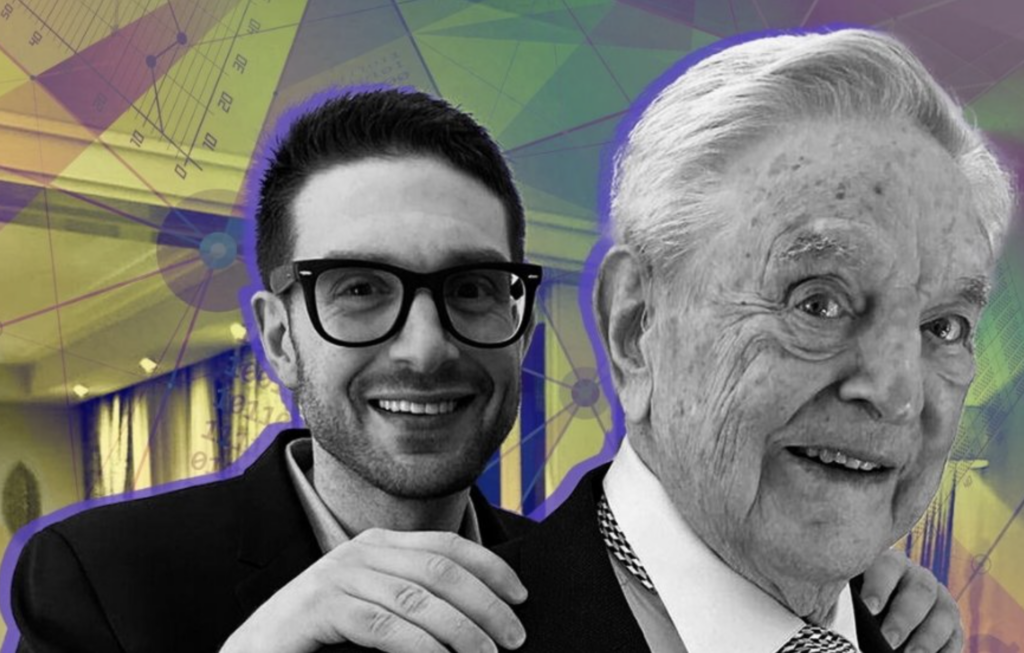
The claim that George Soros hides behind a latticework of NGOs to execute a political agenda is not, as some suggest, a fever-dream of the conspiratorially inclined. Rather, it reflects a sober observation about structure and intent in contemporary political warfare. The form may be new—the foundation, the grant, the advocacy nonprofit—but the function is ancient: indirection, obfuscation and the use of proxies. As Machiavelli might put it, a prince need not always appear to be the one drawing the sword.
This matters because democratic accountability presupposes visibility. The citizen must be able to trace power back to its source. When vast sums are routed through nonprofit networks whose official purposes are noble—”civil rights,” “voting access,” “equity”—yet whose practical activities subvert electoral safeguards or shelter lawless action, the very architecture of a republic is imperiled.
The present case, involving opposition to the SAVE Act and the larger web of Soros-funded initiatives, demands this kind of structural analysis. The SAVE Act—the Safeguard American Voter Eligibility Act—seeks a plain thing: that those who vote in federal elections be citizens of the United States and prove it. One would think such a proposition uncontroversial. But it has met with a chorus of institutional opposition, orchestrated by over 100 organizations, many of which enjoy direct financial patronage from Soros’ Open Society Foundations (OSF).
At issue, however, is not merely the opposition, but the pattern—the recurrent deployment of NGO front groups to achieve political ends while shielding the financier from legal and reputational consequences. This pattern is neither accidental nor benign.
To make this concrete, Soros-directed entities have funneled more than $150 million into at least 40 organizations opposing the SAVE Act. The Leadership Conference on Civil and Human Rights, for example, received $7.72 million; the NAACP Legal Defense Fund, $17.9 million; People for the American Way, $2.375 million. This is not passive philanthropy. It is active political investment.
More crucially—and more quietly—these initial seed funds often triggered a larger cascade. Soros’ true genius was not merely in donation, but in design. By positioning his NGOs as civic-minded intermediaries, he enabled them to tap into the vast purse of the US Agency for International Development (USAID), which under continuous Democratic control became a de facto match funder for left-wing causes abroad and at home. Soros put down the seed capital; USAID supplied the fertilizer. In many cases, this meant Soros’ initial investment was amplified ten- or even twentyfold—millions became billions, channeled not through public debate, but bureaucratic appropriation.
The mechanism was elegant. NGOs, seeded by OSF, applied for USAID grants with baked-in ideological alignment. Administrators sympathetic to the cause ensured the applications succeeded. The result was a soft fusion of private ideological vision with public funding. It was a public-private partnership in the most cynical sense: public funds, private agenda.
Now that USAID has been effectively dismantled by DOGE, the pipeline has gone dry. The left’s vast financial circulatory system has lost its beating heart. Without the bureaucratic booster shot from USAID, Soros-funded NGOs have lost the leverage that allowed modest initial investments to balloon into large-scale influence operations. Panic has ensued.
The consequences are already being felt. Groups downstream of the old funding ecosystem, including ActBlue and its affiliates, have seen their coffers dry up. Donations have plummeted. Organizing capacity is shrinking. The edifice is cracking. For years, Democrats relied on the NGO-to-USAID-to-political-payoff machine like a junkie depends on a needle. With the source cut off, withdrawal has set in.
Moreover, the problem is not limited to legislative advocacy. Consider the recent coordinated disruptions at Tesla dealerships across the United States and Europe, allegedly linked to entities with Soros affiliations. These protests—often crossing the line into criminal trespass, vandalism, and intimidation—are carried out not by Soros himself, but by NGOs whose ties to him are real, financial and ideological. Should the law come knocking, the financier can plead ignorance. “I merely support democratic activism,” he might say. Yet were similar events linked to a right-wing benefactor—say, Elon Musk—the press and prosecutors would not be so easily appeased.
To be clear: the argument is not that all NGO activism is illegitimate. Nor is it that Soros cannot lawfully fund causes he supports. Rather, the concern is the opacity—the creation of an ecosystem where accountability is diffused and legal culpability always lands one rung below the summit. One does not have to pull the trigger to be guilty of the crime if one pays the man who does. And when the same hand funds the lobbying against election security, the hiring of progressive prosecutors, and the legal foundations that now pursue Donald Trump with a zeal more appropriate to inquisitors than impartial attorneys, the claim of coincidence grows thin.
It is no secret that Soros and his son Alex have backed district attorneys in cities across the country who have redefined crime downward and prosecution upward—except, it seems, when political adversaries are involved. These are not isolated efforts. They form a strategy: to change not the law, but the executors of the law; to transform not statutes, but the interpretive will behind them. This is the essence of the judicial revolution now underway—an ideological capture of the prosecutorial class, financed under cover of nonprofit benevolence.
The connection to the Trump indictments is not speculative. It is structural. Many of the district attorneys involved in these cases have received support, direct or indirect, from Soros-funded political action committees or allied nonprofits. The result is a kind of juridical theater: a prosecution in form, but a political execution in substance. Again, Soros is not in the courtroom. He is not listed on the brief. But his money—often laundered through layers of institutional insulation—is there, underwriting the assault.
This is the genius—and the danger—of the NGO strategy. It permits power without exposure, influence without responsibility. It is the political equivalent of corporate veiling, where a parent company avoids liability by burying the act in a subsidiary. Soros has simply adapted the corporate playbook to the domain of ideological finance.
Some might object: isn’t this just how democracy works? Donors give; groups organize; policy debates ensue. But this misses the asymmetry. The scale of Soros’ funding—over $40 billion to date, and nearly a billion dollars annually, according to InfluenceWatch—dwarfs that of any comparable right-of-center actor. Moreover, the transparency demanded of conservative donors is rarely demanded of their left-wing counterparts. There is no Media Matters for the Open Society Foundation, no “60 Minutes” exposé on its operations. The camouflage is effective because it is cultural as well as financial.
And let us not forget the practical consequences. The Brennan Center for Justice, a leading opponent of the SAVE Act and a recipient of Soros funds, took in $225 million in 2022 alone. Its president earns over $600,000. One wonders how many “disenfranchised” voters could have been aided directly with such sums. But that, of course, is not the goal. The goal is power—not empowerment. The rhetoric is access; the reality is control.
The SAVE Act is emblematic of the larger battle: between a vision of politics as transparent, rules-based and citizen-oriented and a counter-vision in which elites manipulate institutions from behind nonprofit curtains, draping themselves in moralism while operating with the cold efficiency of power brokers. To vote in America, one must be a citizen. The objection to such a proposition is not rooted in constitutional theory or empirical disenfranchisement. It is rooted in a political calculus: that tighter rules might reduce the electoral utility of the irregular and the undocumented.
Here lies the true risk. If electoral safeguards can be portrayed as racism, if lawfare can be disguised as justice and if a billionaire’s private ideology can hide behind the mask of civic virtue, then the republic is governed not by law, but by narrative—curated and financed by those who remain untouched by the consequences of the policies they promote.
Thus the issue is not merely Soros, or even his network, but the precedent. If one man can build a shadow state beneath the procedural state—if he can fund prosecutions, rewrite voting rules and sabotage legislation through surrogates—then democratic self-rule becomes illusory. The citizen votes, but the outcomes are preordained by those who purchased the frame within which those votes occur.
In philosophical terms, it is the difference between substance and appearance. We are presented with the form of democracy: ballots, courts, NGOs, debates. But the substance—the locus of decision-making, the site of real power—has shifted. What matters is not who casts the vote, but who funds the organizations that determine the rules of voting, the prosecutors who interpret the laws and the media that shapes the narrative.
That is why the opposition to the SAVE Act is so revealing. It is not about voter access. It is about voter control. It is not about civil rights. It is about civil power. And at the center of this web sits a financier with plausible deniability, an empire of proxies and a vision of an open society that closes the circle of elite rule ever tighter around the throat of democratic legitimacy.
Sponsored by the John Milton Freedom Foundation, a nonprofit dedicated to helping independent journalists overcome formidable challenges in today’s media landscape and bring crucial stories to you.
READ NEXT: Washington Swamp Slugs Panic As Elon Reveals JUICY New Targets
















Soros senior is a naturalized citizen. send him back to Hungary. Confiscate his money since he is waging war against the United States.
Good article!
You have to remember The Golden Rule: Whoever’s Got The Gold, MAKES THE RULES !
Is there some reason President Trump CAN’T divest George Soros of huis US Citizenship and DEPORT him? His US assets need to be froze n and action taken to do so, if there is no reason for not doing so
That was a great article thank you.
Fine him and his companies $ 5 trillion,
REVOKE George Soros’ US Citizenship. FREEZE all of his assets and DEPORT him
Damned fine article, well written.