

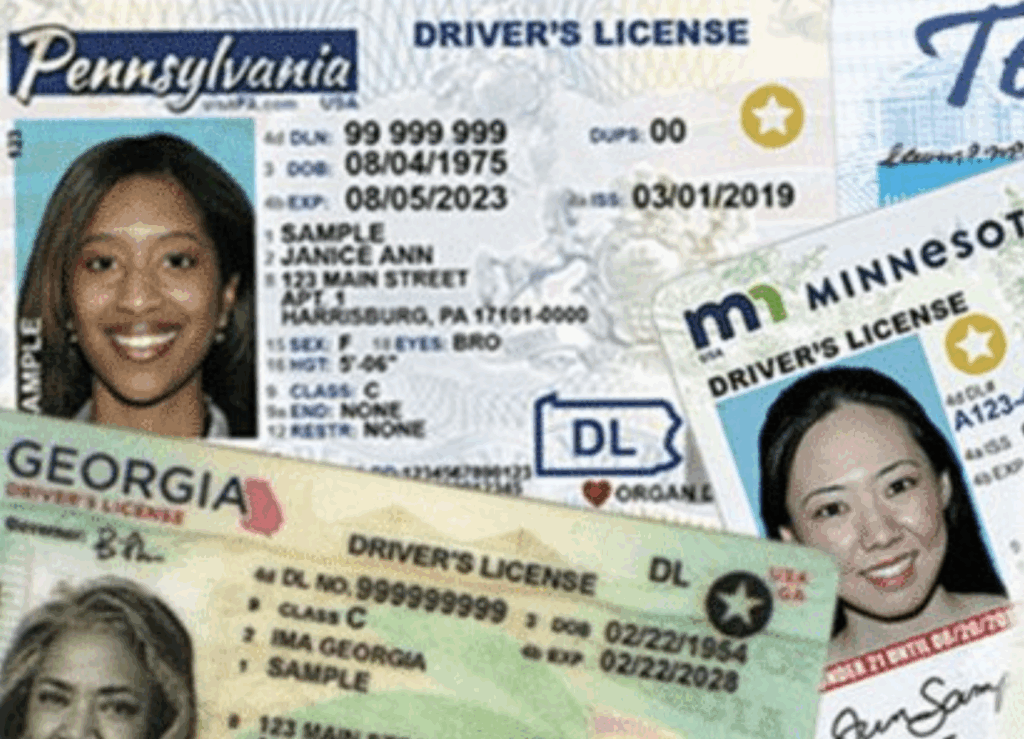
America does not run elections; America runs election procedures. This essay’s objective is to examine the state of voter ID in the United States as of 2026, ahead of the midterm elections, arguably the most consequential midterm election in a generation, by laying out, in plain terms, how Americans are asked to prove who they are when casting a ballot. That distinction sounds pedantic until you see what it buys us: a nation that asks every losing side to accept the result, while refusing to offer a single, intelligible standard for how identity is verified at the moment a ballot is cast. In one state, the voter shows a government photo ID, and the matter ends. In another, the voter announces a name, signs a book, and a poll worker squints at a signature captured years ago. In another, a neighbor can vouch for a neighbor, up to eight at a time. Then we act surprised that faith collapses. This is not a problem of one party’s rhetoric; it is a problem of a system designed to look like a patchwork quilt and then asked to bear the weight of the republic.
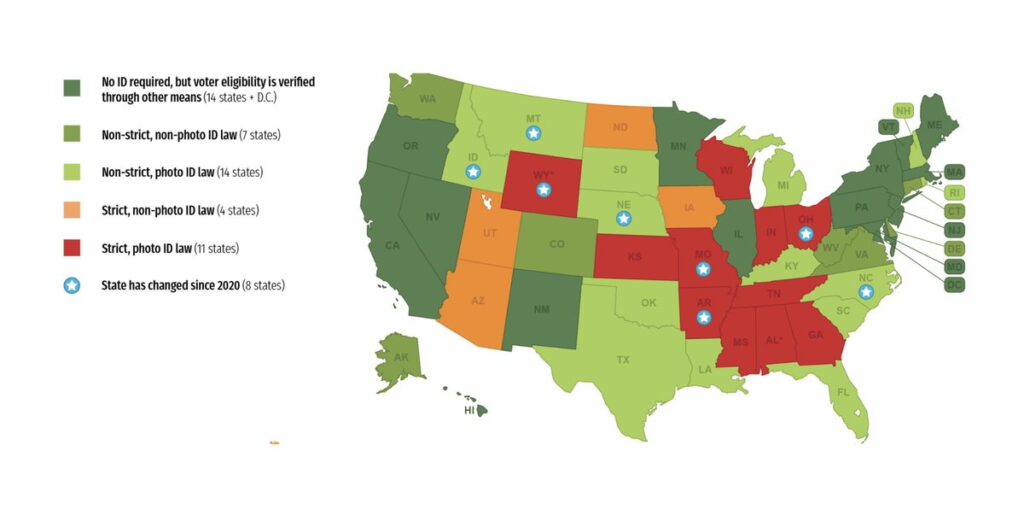
Begin with the basic landscape. Roughly three dozen states now request or require some form of identification at the polls, and roughly one dozen plus D.C. do not require a document at all for most in-person voters. Those categories hide further variation that matters more than the label. Some states have strict photo ID rules, where lacking the right credential triggers a provisional ballot and a post-election cure process. Some have non-strict photo ID rules, where a voter without an ID can sign an affidavit, complete a reasonable impediment declaration, or otherwise have the ballot counted without returning later. Some accept non-photo documents such as a utility bill, bank statement, paycheck stub, or voter registration card. Some require no document but do require an identifying ritual, usually a signature, sometimes additional personal information, and always an assumption that a signature match is a reliable identity check. The result is not just variety, it is conceptual incoherence. It is as if we decided that banks could use fingerprints, or a driver’s license, or a handwritten note, or a neighbor’s attestation, depending on which side of a state line you stand.
If you want to understand the legitimacy problem, do not begin with the question of how much fraud exists. Begin with the question of what the system looks like to a rational person who does not have access to internal audit reports and who does have access to the headlines. A strict photo ID rule is a public signal; it says the system takes identity seriously. A no-document rule is a different signal; it says identity is a matter of administrative convenience, with a signature doing the heavy lifting. A vouching rule is a third signal; it says identity can be outsourced to private citizens under social pressure. Each may come with penalties for lying, but penalties are not prevention. The legitimacy of elections depends on prevention because we do not get do-overs. A contested result is not an academic dispute; it is a civic solvent.
Now add the registration layer, where the absurdity becomes harder to defend. Many Americans assume that if a state does not demand ID at the polls, it must demand robust ID at registration. Sometimes it does, sometimes it does not. Online voter registration exists in most states, but the identity proof required to use it differs sharply. In many states, you cannot complete online registration unless you have a state driver’s license or state ID on file, because the system is anchored to DMV records and uses the stored signature. In other states, you can register online using the last 4 digits of a Social Security number, or a hybrid method that allows SSN4 to substitute for a DMV credential and then relies on later verification. Under federal law, states are instructed to collect a driver’s license number if the applicant has one, and if the applicant does not, to collect the last four of the Social Security number, with verification through federal and state databases. That sounds technical. In practice, it means we have treated a reusable secret as an identity credential.
To see why this matters, consider the difference between what you know and who you are. A photo ID is presence-based. It ties a face in front of the poll worker to a credential that is difficult to counterfeit casually, and that is difficult to share without leaving a trail. SSN4 is knowledge-based. Knowledge-based tokens leak, and they leak at scale. In modern life, data breaches are not a rarity; they are the background hum of commerce. A system that treats SSN4 as a sufficient identifier at registration is building the franchise on the assumption that a small fragment of a number is private. That is a fragile assumption, and fragile assumptions are not how you run adversarial systems.
Here, a puzzled reader might object: but is there evidence of widespread impersonation? The honest answer is that there is little evidence precisely because, in many states, we are not meaningfully looking for it. The absence of tickets does not prove the absence of speeding; it proves the absence of enforcement. If a city stops issuing speeding tickets, the conclusion is not that everyone suddenly drives the speed limit, but that violations go undetected. Modern voter registration systems and mail‑in voting regimes are structured in ways that make detection of impersonation and identity abuse extraordinarily difficult after the fact. Ballots are separated from envelopes, signatures are subjective, identity checks are minimal or non‑existent, and audit trails are thin by design. The result is epistemic blindness: we cannot say with confidence whether large‑scale election fraud has occurred because we have built systems that, in most cases, are optimized to prevent detection rather than enable it. The steelman case for a uniform photo ID baseline is therefore not a moral indictment of voters. It is an argument about the attack surface. Elections are adversarial because incentives exist for bad actors, and because errors happen even when no one is malicious. Photo ID narrows the ways a system can be exploited, and it narrows the ways honest mistakes can occur. It reduces the risk that a poll worker checks in the wrong John Smith. It reduces the risk that a ballot is issued to someone who is not who he says he is. It reduces the risk that a lax identity check becomes the weak link exploited by organized schemes that depend on low detection probabilities.
Yet today, we have layered weak substitutes on top of weak substitutes. In a no-document state, a signature is treated as an identity check. In a mail ballot state, signature matching is treated as an identity check for a ballot that is never cast in public view. In a state that requires an ID number on absentee paperwork, SSN4 is treated as an identity check. In Minnesota, for Election Day registrants, vouching is treated as an identity and residence check. Each may be defensible in isolation. Together, they form a system where everyone can find the version of election security they want to believe in, which is another way of saying no one has to accept a common standard.
Minnesota’s vouching procedure illustrates the deeper point. It is easy to describe vouching in warm terms. A neighbor helps a neighbor participate. Civic solidarity, local trust, democratic inclusion. The trouble is that elections are not the place for warmth; they are the place for auditability. A vouching system asks private citizens to perform identity verification under social pressure, often in a hurried environment, without training, without incentives to be cautious, and without the tools that trained officials use in other contexts. Worse, by allowing one person to vouch for multiple registrants, it creates a scalable vector. You do not need a conspiracy of 10,000 people; you need a small number of high-energy activists willing to exploit a permissive procedure. And if that sounds paranoid, ask yourself the right question: in a polarized environment, why would we choose a model that looks easy to game, even if it rarely is.
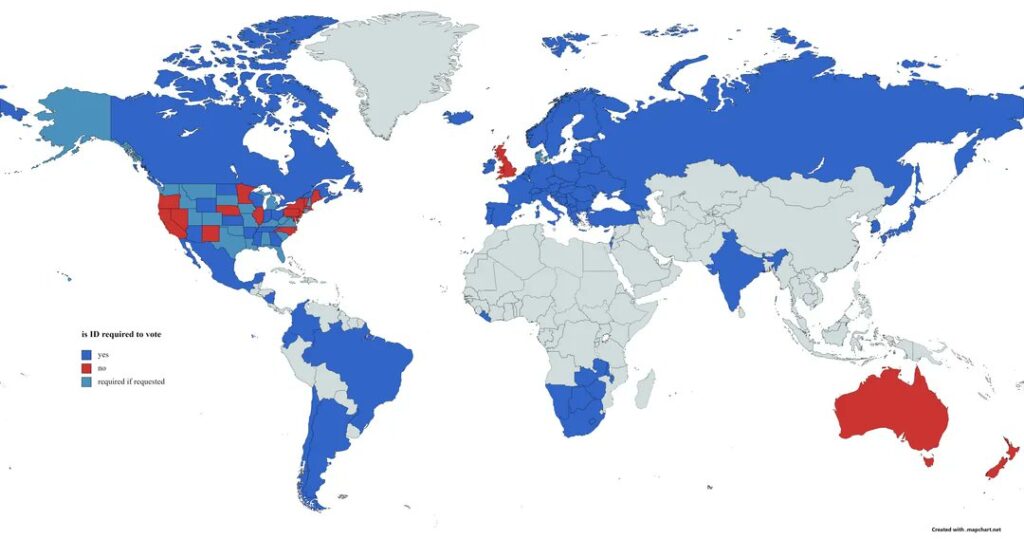
At this point, the reader may say, fine, but the U.S. is different. It is large. It is decentralized. It has a long tradition of state control over elections. That is all true. But it is precisely because the US is decentralized that it should not copy the loosest models. A decentralized system needs a clear baseline to prevent the perception that some jurisdictions are soft targets. Other developed countries often do something the US refuses to do. They establish a national identity infrastructure that makes voter identification routine. Most jurisdictions around the world require photo ID or biometric checks at the point of voting, and the global center of gravity is closer to robust identity verification than to informal signature rituals. There are exceptions. Some peer democracies do not require a voter to present an ID in the way Americans mean it. But those countries typically offset that decision with centralized rolls, consistent procedures, and a public culture that does not treat elections as an endless litigation strategy. The U.S. has none of those luxuries.
The patchwork gets even harder to defend when you look at the interaction between voting rules and the broader context of immigration and citizenship. Under U.S. law, only citizens may vote in federal elections. That principle is basic, and it is affirmed repeatedly by state law as well. But the legal rule is not the whole story. Trust depends not only on the rule, but on the public’s confidence that the rule is being reliably enforced. Over the last four years, the country has experienced an immigration surge that even many Democrats now concede strained enforcement and capacity. One does not need to believe that noncitizens are voting in large numbers to see the legitimacy problem. A high-visibility border crisis combined with low-visibility identity controls at the polls is a recipe for suspicion. In politics, suspicion is often enough.
Now add an uncomfortable complication: in a growing number of states, undocumented residents can obtain some form of driver’s license or driving privilege card. In those states, motor vehicle agencies are generally prohibited from inquiring into or adjudicating an applicant’s immigration status beyond what state law explicitly requires. The system, therefore, depends heavily on self‑attestation and document presentation rather than affirmative status verification. These credentials are typically marked as not valid for federal purposes, but in several states, they are designed to look as normal as possible, sometimes with only a subtle federal limits notation. Meanwhile, separate federal audits have flagged serious compliance problems with commercial driver’s licenses, including cases in which state systems did not properly align license validity with immigration status. That matters for election integrity not because a CDL is a voting credential in most states, but because it illustrates an institutional fact: when identity systems rely on declarations rather than verification, and when agencies are barred from asking basic questions, errors and abuse become harder to detect. It is not a stretch to note that an individual who entered the country unlawfully has already demonstrated a willingness to violate the law, and a system that assumes perfect candor at the identity layer is not a serious security model. The adult response is to minimize the consequences of mistakes by requiring robust, in-person identity checks at the moment that matters.
Consider the comedic level of complexity an ordinary voter faces. You may need a photo ID to vote in person, unless you sign a declaration, unless you have a specific alternative document, unless you are a first time voter who registered by mail without the right documentation, unless you are voting absentee, in which case you may need to write an ID number on an envelope or include a copy of a photo ID, unless your state uses signature matching, in which case your ballot may be rejected because your handwriting changed, unless you can cure it in time, unless you cannot. In Minnesota, you may register on Election Day with a voucher, unless the voucher has already been vouched for by eight others, unless the voucher was vouched for, in which case the voucher cannot vouch, and so on. This is not a serious way to run the most consequential transaction in civic life.
A system this messy does something else. It invites moral posturing. Democrats talk as if any ID requirement is a plot to suppress lawful voters. Republicans talk as if any absence of ID is an invitation to fraud. Both statements are too crude, and the patchwork is the reason. When there is no shared national standard, policy debate becomes a symbolic battle over narratives rather than a practical debate about which set of procedures best secures legitimacy while preserving access. The result is predictable. Each side points to the other side’s most extreme jurisdiction as evidence that the other side cannot be trusted with elections.
The steelman case for a nationwide photo ID system is therefore not merely that it would prevent a certain category of fraud. It is that it would upgrade legitimacy by establishing a clear, uniform baseline for how we verify the person casting the ballot. One rule nationwide would not eliminate litigation, but it would eliminate a whole class of disputes. It would reduce the perception that some states are running elections on the honor system. It would reduce the temptation to treat election administration as partisan theater.
What would such a national standard look like if we were serious? It would begin with a simple requirement: to cast a ballot in person, you must present a government-issued photo credential, with narrow exceptions only for genuinely incapacitated voters, paired with an easy and free path to obtain the credential. It would then align mail voting with the same principle. If a state offers no-excuse mail voting, the state should require identity verification that is at least as strong as in-person voting. Relying solely on signature matching for large-scale mail voting is asking for trouble because signature matching is subjective, error-prone, and difficult to explain to the public. Third, it would tighten the registration choke point. Registering to vote should require a robust proof of identity, and the system should stop treating SSN4 as a functional equivalent of a photo credential. Fourth, it would address procedures like vouching, which are hard to audit and easy to caricature, by replacing them with objective proofs of residence and identity.
Here is where the predictable counterargument arrives. A national voter ID rule sounds like a barrier. Some citizens lack ID. Some citizens have difficulty obtaining ID. Some citizens face costs, travel burdens, and bureaucratic hassles. Those are real problems, and the steelman acknowledges them. But the solution is not to abandon identity verification at the moment of voting. The solution is to do what serious countries do. Make the credential free. Make issuance widespread. Offer mobile issuance units. Offer automatic issuance when a citizen turns 18. Offer same-day emergency issuance with verification. Make the process boring and universal, the way Social Security cards and passports are boring and universal, even if imperfect.
A second counterargument is legal and constitutional. Elections are run by states. Congress cannot dictate everything. That is partly true, but the US Constitution gives Congress significant authority over the time, place, and manner of federal elections. The question is not whether national action is conceivable; it is whether our political class has the will to trade a small amount of local variation for a large gain in national legitimacy. When a system has become this untrustworthy, the burden shifts. The defenders of the patchwork should have to explain why a single standard is impossible, rather than the other way around.
Now return to the most politically charged claim, the one many readers will bring to the page before they read the first sentence. Did the last four years of border policy undermine confidence in elections? Yes, in the most straightforward sense. Confidence is a function of perceptions of enforcement. If voters see a government that appears unable or unwilling to enforce basic border rules, they will be less inclined to trust that the same government enforces the citizenship line in elections with rigor. Democrats may insist that noncitizen voting is rare and heavily penalized, and that is likely true in some places. But confidence is not built by insisting; it is built by procedures that look rigorous, that are easy to describe, and that apply everywhere. We do not strengthen trust by saying, trust us.
So the right posture is not panic. It is institutional sobriety. The U.S. should choose a set of election identity procedures that can be defended not only to friendly audiences but to hostile ones. A uniform voter ID requirement is exactly that sort of procedure. It does not depend on the virtue of neighbors vouching for neighbors. It does not depend on the fragile secrecy of SSN4. It does not depend on a poll worker’s subjective judgment about a signature. It depends on a basic, widely understood norm: if you are selecting the government, you should be able to prove you are who you say you are.
If you want to ridicule the current system, you do not need to exaggerate. You can simply describe it. In 2026, Americans will vote under at least 4 broad categories of in-person identity rules, dozens of state-specific exceptions, and a second overlay of mail ballot identity regimes that diverge from the in-person rules. They will register online in most states, but the proof required to do so will depend on whether their DMV record is in the right database. They will be told, correctly, that only citizens can vote, but they will also see that identity systems are inconsistent, opaque, and contested. That is a recipe for conflict.
The right to vote is not merely a personal entitlement. It is a social fact that exists only if others recognize it, and recognition depends on shared public standards. When standards are incoherent, the fact itself becomes fragile. A uniform voter ID rule would not solve every dispute, but it would stabilize the concept of a legitimate vote. It would make the rules simple enough to explain, simple enough to enforce, and simple enough for the losing side to accept.
In the end, the argument for nationwide voter ID is an argument for a single civic language. A country cannot remain a democracy if half the citizens believe elections are rigged and the other half believes the first half is crazy. The path out is not to demand trust. The path out is to build institutions that deserve it.
If you enjoy my work, please subscribe: https://x.com/amuse.
Sponsored by the John Milton Freedom Foundation, a nonprofit dedicated to helping independent journalists overcome formidable challenges in today’s media landscape and bring crucial stories to you.
READ NEXT: FBI/Homeland Security Warns Of Times Square Threat Ahead Of New Year’s Eve














2026 rerun 2020??